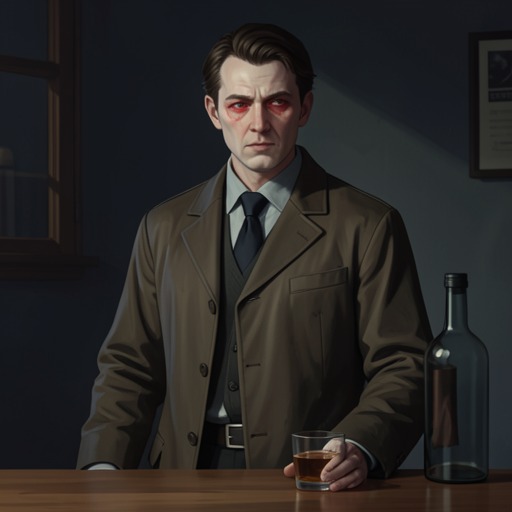
Tom
DublinersTom is Farrington’s young son, one of five children in a household ruled by an unstable exchange of power: his mother bullies Farrington when he is sober, while he bullies her when drunk. Tom’s brief appearance in the kitchen becomes the scene in which Farrington’s accumulated anger is directed at a child who is trying to answer him and prepare his dinner. His final offer to say a Hail Mary for his father gives the beating a painful religious and familial dimension: Tom attempts to stop violence by promising prayer on behalf of the person inflicting it.
Identity and Household
Tom is introduced as the little boy who runs downstairs after Farrington calls for Ada. Farrington peers into the dark and first asks whether the child is Charlie; Tom corrects him by identifying himself. The exchange establishes both Tom’s place among several children and the difficulty of seeing clearly in a house where the kitchen lamp has not yet been lit. He is present not as an independent agent in the larger action but as a child summoned into his father’s increasingly hostile attention.
The account of the household makes that confrontation part of a wider domestic imbalance. Farrington’s wife is described as a small, sharp-faced woman who bullies him when he is sober and is bullied by him when he is drunk. The couple have five children, and Tom’s encounter with his father shows one consequence of that volatile arrangement: the adult conflict does not remain between the spouses but reaches the children. The scene gives no account of Tom’s life beyond this household or of his relations with the other children; within the episode, however, he is the child available to answer Farrington’s demands.
The Kitchen Confrontation
Farrington arrives home after his tram lets him down at Shelbourne Road, moving along the barracks wall, and the narration says that he loathes returning home. He enters through the side door to an empty kitchen, a fire nearly out, and no immediate sign of his wife. From the darkness he calls for Ada. Tom tells him that she has gone to the chapel, then answers that dinner was left for Farrington. When the boy begins to explain that he is going to cook it, the unfinished reply meets a father already demanding an answer rather than waiting for one.
Before the violence begins, Farrington makes Tom light the lamp and complains about the darkness. Seated heavily while the boy does so, he mimics Tom’s report that his mother is at the chapel, turning the child’s simple answer into something to mock. Once the room is lit, he bangs his fist on the table and demands his dinner. Tom’s response that he is going to cook it makes clear that the meal has not yet been prepared, but also that he is trying to meet the demand. Farrington instead fixes on the nearly extinguished fire as evidence for anger, shouting that he will teach the boy not to let it go out.
The Beating and Tom’s Plea
Farrington takes a walking-stick from behind the door and rolls up his sleeve to give his arm free play. Tom cries out and runs whimpering around the table, but his father follows and catches him by the coat. Looking about wildly and seeing no escape, the boy falls to his knees. The movement from running to capture to kneeling marks the shrinking space available to him: he first tries to evade the blow physically, then has no recourse but to plead.
Farrington strikes him vigorously with the stick, and one blow cuts Tom’s thigh. The boy squeals, clasps his hands in the air, and speaks with a voice shaking with fright. He begs his father not to beat him and promises to say a Hail Mary for him, repeating the offer even as the threat continues. The prayer is not presented as a considered religious act or as proof that the beating stops; it is the child’s desperate means of bargaining with his father, recasting an appeal for his own safety as an offer of spiritual care for the person hurting him.
Narrative Significance
Tom’s scene makes the domestic consequences of Farrington’s temper physically immediate. The fire, the unlit kitchen, and the delayed dinner are ordinary household circumstances; Farrington turns them into grounds for punishment, although Tom has said that he will cook and has tried to answer him. The contrast between the father’s demand for obedience and the child’s attempts to comply sharpens the cruelty of the beating without requiring the narrative to explain it away.
Tom also becomes the recipient of anger that the household’s earlier description presents as part of a recurring pattern of bullying. The episode does not supply a later account of what happens to him, whether he is injured beyond the cut to his thigh, or how his mother responds. His appearance ends at the moment of his plea. That abrupt limit leaves the scene centered on the vulnerability visible in his kneeling posture and on the disturbing reversal by which a frightened child promises prayer for his aggressor.