Richard J. Tierney
DublinersRichard J. Tierney is a candidate in a municipal election for the Royal Exchange Ward, presented through the printed appeal of his campaign and the precarious work of the men canvassing on his behalf. Although he remains offstage in the available scenes, his election gives the committee room its immediate purpose and makes political loyalty inseparable from the question of payment: his supporters are asked to secure votes and influence while waiting to see whether he will settle what he owes them.
Identity and Campaign
Tierney’s election card identifies the contest as a municipal election and names the Royal Exchange Ward. It presents him formally as “Mr Richard J. Tierney, P.L.G.” and respectfully asks for the voter’s vote and influence at the coming election. The address turns a political candidacy into a compact piece of printed solicitation, circulating Tierney’s name even while he himself is absent from the room where his campaign is discussed.
The text supplies no direct account of Tierney’s policies, personal history, or public appearances. His characterization instead emerges from the practical arrangements surrounding the canvass: an agent has engaged Mr O’Connor to work one part of the ward, and the card used to identify the campaign is later torn up to light O’Connor’s cigarette. The contrast between the card’s formal appeal and its use as kindling places election language beside the material discomfort of the people employed to carry it.
The Canvass and the Committee Room
On 6 October, a dismal, cold day, O’Connor has spent much of his time sitting by the fire in the committee room in Wicklow Street rather than canvassing. The weather is inclement, and his boots let in the wet; he has been there with Jack, the old caretaker, since the short day darkened. These circumstances give the campaign a distinctly local and physical scale: its work depends on a paid canvasser making his way through a ward, but the conditions of the day have kept him indoors.
When O’Connor asks whether Tierney has said when he will be back, he is told that Tierney gave no such indication. The question establishes that the candidate’s movements and return are matters of immediate concern to those in the committee room, although the scene does not explain where he is or why he is away. Tierney’s absence is therefore not a described journey or decision; it is a practical uncertainty for the men waiting on his campaign.
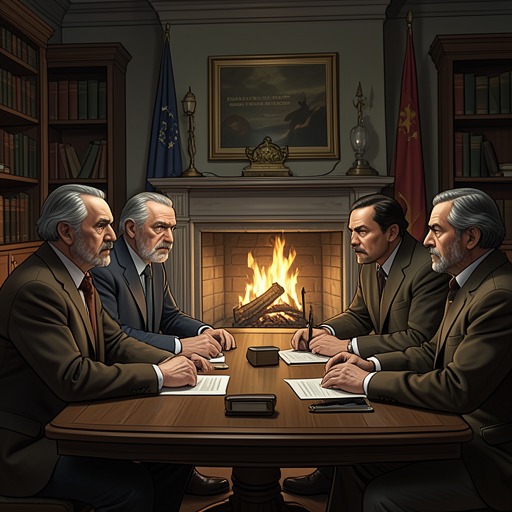
The room itself is sparse. When Jack brings candlesticks from the fire to the table, the light reveals bare walls, a copy of an election address, and a small table covered with papers. The setting makes the campaign’s organization visible in modest objects rather than grand political display: cards, papers, a hearth, and the address on the wall. Tierney’s public appeal is present, but the room’s conversation turns toward whether the people doing the work will be paid.
Payment and Political Dependence
Hynes asks O’Connor whether Tierney has paid him. O’Connor replies that he has not, and hopes that Tierney will not leave them in the lurch that night. Hynes laughs and assures him that Tierney will pay, but O’Connor responds that, if Tierney means business, he hopes he will act smartly about it. The exchange makes the canvass’s financial dependency explicit: the candidate’s appeal for votes and influence rests on labor whose compensation remains unsettled.
The scene does not confirm whether payment is eventually made, nor does it establish that Tierney intends to withhold it. Instead, it preserves the distinction between expectation and evidence. Hynes speaks confidently; O’Connor, who has yet to be paid, voices the risk from the worker’s side. Tierney’s campaign thus acquires an ambivalent presence: it is sufficiently active to employ canvassers and print ward-specific cards, yet its credibility among those canvassers is tested by a simple unresolved question of money.
Narrative Significance
Tierney is defined less by personal description than by the gap between political representation and lived campaign work. His card makes a polished request for public support; the committee room shows a cold day, wet boots, a fire, and men waiting for wages. The juxtaposition does not supply a verdict on Tierney’s character, but it locates the election within everyday relations of labor, dependence, and political expectation.
That indirect presentation also limits what can responsibly be said about him. Tierney is named as the candidate and as the person expected to pay O’Connor, but the scenes do not give him dialogue, explain his platform beyond the printed solicitation, or resolve the canvasser’s complaint. His significance lies in this offstage pressure: while he is absent, his candidacy organizes the room, the card, the work, and the argument over whether promises of political business will be matched by payment.