Old Cotter
DublinersOld Cotter is an older visitor in “The Sisters” whose insinuations about Father James Flynn make him an unsettling, deliberately incomplete source of information. He warns that the priest was “queer” and that children should not spend too much time with a man like him, but stops short of explaining what he believes. His role is less to solve the priest’s death than to sharpen the story’s central uncertainty: the child resents being treated as impressionable, even as Cotter’s hints feed the child’s fearful curiosity.
Identity and Introduction
Cotter appears at supper in the narrator’s home, seated by the fire and smoking while the narrator’s aunt serves stirabout. His manner suggests that he is returning to an earlier discussion: he begins with a hesitant judgment of Father James Flynn and says that he has an opinion about what was unusual in the priest’s case. He pauses to puff at his pipe, apparently arranging his thoughts, and later calls it one of the “peculiar cases,” while admitting that it is hard to say.
The story gives no settled account of Cotter’s relationship to the household or to the priest. What it does establish is his place in this evening’s conversation: he offers interpretations from the adult side of the table, and the child listens, watches, and resists being drawn into the role Cotter assigns him.
His Warning About the Priest
Cotter’s most pointed claim concerns the boy’s association with Father James Flynn. He says that he would not want his own children to have too much to say to a man like the priest. When the aunt asks what he means, Cotter frames his concern as a matter of children’s upbringing: a young lad, he argues, should run about and play with boys his own age rather than be in close company with the priest.
The aunt presses him to explain why he thinks this is unsuitable. Cotter replies that children’s minds are impressionable and that seeing “things like that” affects them. He never identifies what those things are. His wording makes the warning unmistakable while keeping its basis obscure: the reader hears a suspicion, not evidence that can confirm or define it.
Effect on the Child Narrator
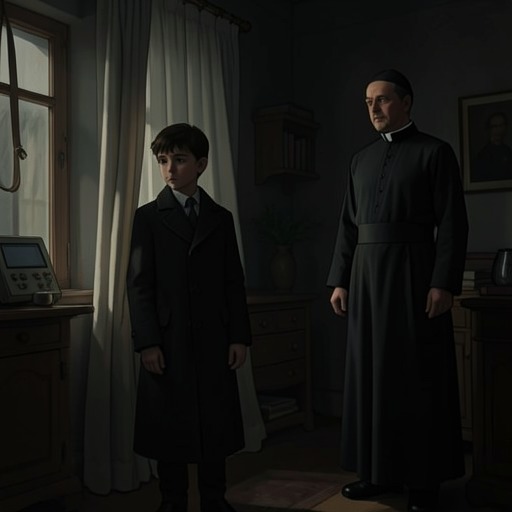
The narrator experiences Cotter’s remarks as a personal slight as well as an accusation against the priest. Cotter looks at him with small, beady eyes, apparently examining him; the boy refuses to look up from his plate and will not give Cotter the satisfaction of a response. When Cotter again insists that the subject is bad for children, the narrator stuffs his mouth with stirabout to keep from voicing his anger.
That anger does not make Cotter’s words disappear. Later, unable to sleep easily, the boy puzzles over Cotter’s unfinished sentences and imagines the dead priest’s heavy grey face. In the imagined scene, the face seems to want to confess, and the boy wonders why it keeps smiling. Cotter’s warning thus helps shape the child’s private encounter with the priest’s death: what the adult leaves unsaid returns as a troubling mixture of fear, fascination, and imagined confession.
Narrative Role and Significance
Cotter’s importance lies in the gap between the force of his warning and the thinness of what he explains. He speaks as if he knows that the priest’s influence on children is dangerous, yet offers no account the boy or the reader can test. The story preserves this gap rather than turning Cotter into a reliable interpreter of Father James Flynn. His remarks open a line of suspicion, while their vagueness leaves the priest’s history unresolved.
The contrast between Cotter’s adult certainty and the child’s response gives the exchange its tension. Cotter treats the boy as someone whose mind must be protected; the boy, angry at being spoken of as a child, nevertheless absorbs the warning and carries it into the night. Cotter’s unfinished speech therefore does more than withhold an explanation: it becomes part of the atmosphere in which the boy tries to understand death, adult authority, and the priest’s mysterious past.