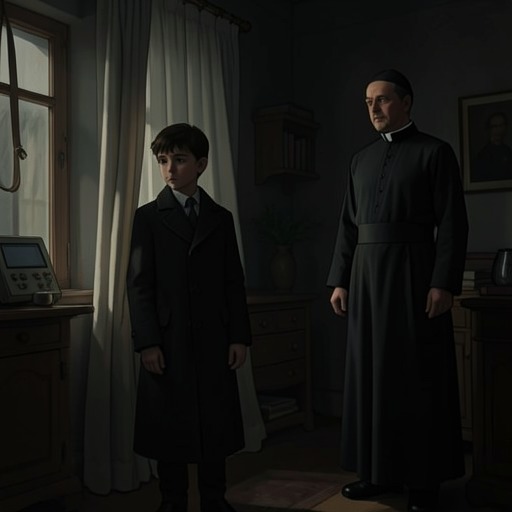
Nannie Flynn
DublinersNannie Flynn, the sister of Father James Flynn, is presented through the work of mourning: she receives visitors, leads them to her brother’s coffin, and shares the labor of arranging his burial. Quiet and visibly worn down, she stands at the center of the household’s care for the dead, while the narrator’s attention to her gestures and clothing gives that care an unceremonious, human scale.
Identity and Introduction
Nannie appears when the narrator and his aunt visit the house of mourning after sunset. She meets them in the hall, and, because it would be unseemly to call out to her, the aunt communicates by shaking her hand and nodding. Nannie points upward to indicate the way, then climbs the narrow staircase ahead of them, her bowed head scarcely rising above the banister. At the landing she beckons the visitors toward the open door of the room where Father James Flynn lies.
Her introduction is made through action rather than explanation. She guides the visitors without speaking, and when the narrator hesitates at the threshold, she repeatedly signals him to come in. The scene establishes her as a practical attendant to the dead priest and a quiet intermediary between the visitors and the private room of mourning.
At the Coffin
Inside the room, Nannie takes the lead as the three visitors kneel at the foot of the bed. The narrator tries to pray, but his thoughts are scattered by her mutterings; his attention also catches on the back of her skirt, hooked clumsily, and on the heels of her cloth boots, worn down and slanted to one side. These details do not make her grief explicit, but they register the ordinary, worn material circumstances surrounding the funeral.
When the visitors rise and move to the head of the bed, the narrator sees Father James Flynn vested as for the altar, his large hands loosely retaining a chalice. Nannie’s role is to lead the visitors through this encounter with the body: she brings them to the room, indicates where to go, and remains part of the small group gathered around the coffin. The narrator’s uneasy fancy that the dead priest is smiling gives way to the sober sight of his face; Nannie’s steady presence belongs to the same passage from uncertain impression to the physical fact of death.
The Household After the Visit
After the visitors bless themselves and leave the dead-room, they find Eliza Flynn seated in the priest’s armchair downstairs. Nannie goes to the sideboard, brings out sherry and wine-glasses, sets them on the table, and, at her sister’s bidding, pours and passes the wine. She also offers the narrator cream crackers. He declines them because he fears making too much noise while eating; Nannie seems disappointed, then quietly goes to sit behind Eliza on the sofa.
This brief hospitality follows the solemn visit to the coffin, but it does not displace the silence of the house. No one speaks, and the visitors and the sisters gaze toward the empty fireplace. Nannie’s contribution is again expressed in service—bringing refreshments and making room for the visitors—while her subdued movement back to the sofa leaves the room’s grief unspoken.
Exhaustion and Care
Eliza later observes that Nannie is worn out. The sisters have had to bring in a woman to wash Father James Flynn and lay him out, arrange the coffin, and make arrangements for Mass in the chapel. Nannie’s exhaustion is therefore tied to specific work surrounding the death, not simply to a generalized display of sorrow. The funeral has required care for the body as well as a sequence of practical arrangements, and the sisters have borne that work in straitened circumstances.
Eliza credits Father O’Rourke with bringing flowers and two candlesticks from the chapel, writing the notice for the Freeman’s General, and taking charge of the cemetery papers and Father James Flynn’s insurance. The account sets Nannie’s and Eliza’s labor beside the help supplied by the priest: their bereavement is organized through washing, laying out, a coffin, a Mass, a newspaper notice, cemetery documents, and insurance. Nannie’s apparent exhaustion gives the funeral’s practical demands a human presence.
Family Memory and Narrative Significance
Eliza recalls that Father James Flynn had continued to say that, before summer ended, he would take her and Nannie for a drive to the old house in Irishtown where the family had been born. He imagined hiring one of the quiet new carriages Father O’Rourke had told him about, with “rheumatic wheels,” from Johnny Rush’s across the way, and taking the three of them out together on a Sunday evening. His plan remained unrealized: by the time the sisters tell the story, he is dead, and the family outing survives only as a recollection of what he hoped to do.
Nannie is not given an independent account of her memories or feelings, so the reader encounters her through the narrator’s close observation and Eliza’s speech. Yet her repeated presence—guiding visitors upstairs, leading the prayers at the bed, serving refreshments, and sharing the funeral work—makes her indispensable to the story’s portrait of mourning. The hoped-for drive also places her within the priest’s remembered family life: she was meant to be part of a return to the house where the siblings were born, but instead she is left with the labor and silence of his funeral.