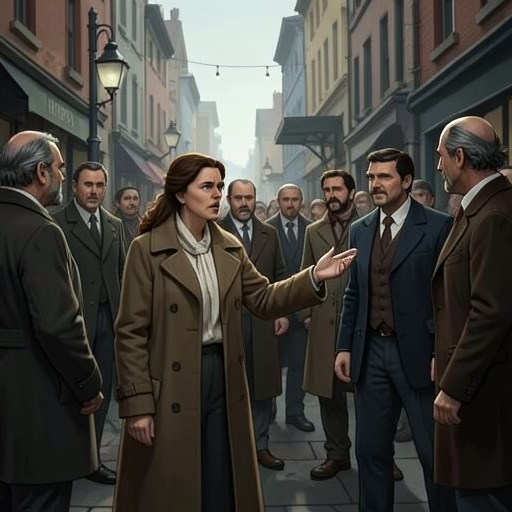
Mr Fitzpatrick
DublinersMr Fitzpatrick, secretary of the Éire Abu Society, is a minor but consequential figure in the concert dispute in “A Mother.” His unhurried, vacant manner makes him an emblem of the Committee’s evasiveness: when Mrs Kearney seeks the payment promised by her daughter’s contract, he neither resolves the issue nor prevents it from escalating into a public confrontation.
Identity and Introduction
Mrs Kearney meets Mr Fitzpatrick in the dressing-room behind the stage during the Society’s concert series. He is described as a little man with a white, vacant face, a soft brown hat worn carelessly at the side of his head, and a flat accent. While speaking with her, he chews the end of a programme into a moist pulp. His appearance and small habitual gestures establish an impression of heedlessness rather than authority.
The performers are waiting nervously as the first concert begins late and the nearly empty hall grows impatient. Mr Fitzpatrick comes into the dressing-room, smiles vacantly, and proposes opening the event. Mrs Kearney answers his flat final syllable with a stare of contempt. Their first exchange thus sets her alert, exacting attention against his apparently casual approach to the Society’s responsibilities.
Role in the Concert Dispute
The conflict becomes explicit after the Thursday concert, when Mrs Kearney learns that Friday’s performance will be abandoned. Because Kathleen has been engaged for four concerts, Mrs Kearney argues that cancelling one does not change the contract. Mr Holohan advises her to speak to Mr Fitzpatrick, who does not quickly understand the point at issue. He says he will take it to the Committee, leaving Mrs Kearney without an immediate answer about whether her daughter will receive the stipulated fee.
At the Saturday concert, the dispute unfolds amid a clamorous audience. Mr Fitzpatrick enters the dressing-room with Mr Holohan and several banknotes. He counts four into Mrs Kearney’s hand and says that she will receive the other half at the interval. Mrs Kearney immediately identifies the shortfall, telling him that the amount is four shillings short. His payment does not settle matters: it confirms that the Society is offering only part of what she considers due under the agreement.
Conflict and Consequences
After the first part of the concert, Mr Fitzpatrick and Mr Holohan tell Mrs Kearney that the remaining four guineas will be paid after the Committee meeting on the following Tuesday. They add that if Kathleen does not perform in the second part, the Committee will consider the contract broken and pay nothing. The proposed delay and conditional threat turn the disagreement over fees into a confrontation about who controls the contract and whether the Society will honor it.
Mrs Kearney refuses to accept the Committee’s terms. She says that her daughter has a contract and must receive four pounds eight before she will let her step onto the platform again. Mr Fitzpatrick’s handling of the matter has helped bring the concert to this impasse: he first defers the question to the Committee, then participates in announcing payment conditions that Mrs Kearney rejects. The evidence does not show him resolving the dispute or what further role he takes after this exchange.
Narrative Significance
Mr Fitzpatrick is sketched through a few pointed details and decisions rather than through an independent history or inner life. His vacant smile, careless hat, chewed programme, and slow grasp of the payment issue make his mild manner memorable, while the concrete business of the contract gives that manner consequences. Against Mrs Kearney’s insistence on exact terms, he represents the Society’s imprecise and procedurally evasive response; the resulting clash exposes how an apparently courteous musical event can become a struggle over money, authority, and professional dignity.