Mrs Donnelly
DublinersMrs Donnelly’s hospitality shapes Maria’s Hallow Eve visit to Joe’s household, where small mishaps and unresolved family tensions sit beside games, music, and affectionate conversation. As Joe Donnelly’s wife, she helps make Maria welcome, leads the household through its festivities, and gives the evening a warmth that culminates in Joe’s emotional response to Maria’s song.
Identity and Place in the Household
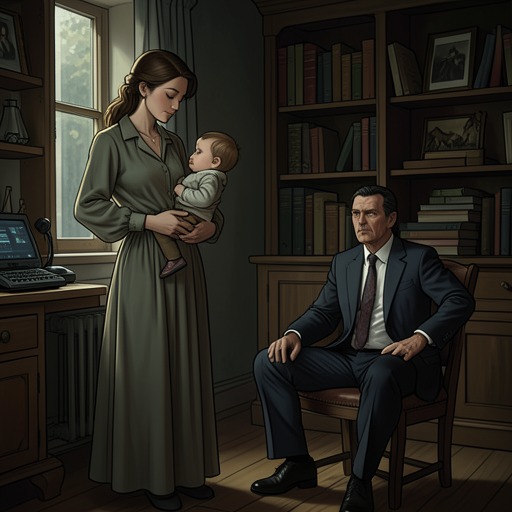
Mrs Donnelly is Joe’s wife and the hostess of the family gathering Maria attends on Hallow Eve. When Maria arrives, Joe is home from business, the children are in their Sunday clothes, and two girls from next door have joined them. The bustle of children and games makes the house a social setting rather than a private visit between adults; Mrs Donnelly receives Maria as part of the household’s familiar circle.
Her welcome is expressed through practical gestures. She has the children thank Maria for bringing cakes, and she appreciates the large bag she has brought. When Maria cannot find the plumcake meant especially for Joe and Mrs Donnelly, Mrs Donnelly suggests that it was left behind on the tram. The missing cake disappoints Maria, who had spent two shillings and fourpence on it, but Mrs Donnelly’s response helps place the loss within an evening that continues rather than collapsing around the failed surprise.
Hosting and Domestic Care
As the evening proceeds, Mrs Donnelly helps maintain its convivial rhythm. When the children dance and sing, she plays the piano; later, she and Joe offer Maria a drink, and Mrs Donnelly mentions that there is port wine if Maria would prefer it to stout. Maria says she would rather not be asked to take anything, but Joe insists. The exchange shows the household’s habitual generosity, even as Maria’s reluctance indicates that being cared for does not always mean being allowed to choose freely.
Mrs Donnelly also responds to Joe’s anger when Maria mentions his brother Alphy. Joe declares that he will never speak to Alphy again and denies that Alphy is his brother. Mrs Donnelly calls it a shame to speak that way of one’s own flesh and blood. Her brief intervention makes the family rupture explicit: beneath the evening’s hospitality, Joe’s estrangement from his brother remains a live point of conflict. Joe avoids prolonging the quarrel because of the occasion, asks for more stout, and the gathering returns to its games.
The Hallow Eve Games
The next-door girls organize the traditional saucer game, in which blindfolded participants select objects associated with different futures. One child picks a prayer-book, others choose water, and a girl who finds a ring blushes as Mrs Donnelly knowingly shakes a finger at her. Mrs Donnelly’s gesture turns the game into a playful social reading of the children’s prospects, with the ring understood as a sign of marriage.
When Maria takes her turn, she laughs as the bandage is put on and reaches for a saucer. Her fingers meet a soft, wet substance, but nobody immediately explains what she has touched. There is a pause, followed by whispering and confusion; someone mentions the garden, and Mrs Donnelly sharply tells one of the girls to throw the object out because it is no play. Maria understands that the first result is unacceptable and tries again, this time drawing the prayer-book. The interruption reveals the game’s disturbing element without spelling it out, while Mrs Donnelly’s response protects the occasion from dwelling on it.
Afterward, Mrs Donnelly plays Miss McCloud’s Reel for the children. She also predicts that Maria will enter a convent before the year is out because Maria has drawn the prayer-book. The prediction converts the game’s symbolic result into a joke about Maria’s future, a future that the gathering can imagine through conventional signs even though Maria’s life remains largely defined by care for others.
Music and the Evening’s Emotional Turn
As the children grow tired, Joe asks Maria to sing an old song before she leaves. Mrs Donnelly joins the request and then plays the prelude, directing the children to be quiet and listen. Maria sings “I Dreamt that I Dwelt,” beginning in a small, wavering voice. In the second verse she repeats the line about dreaming that she was still loved, although that is not the correct lyric. No one points out the mistake.
The uncorrected lyric gives the performance an unexpected emotional charge. Joe is deeply moved and speaks fondly of the old music, saying that there is no time like the long ago and no music for him like poor old Balfe. His eyes fill with tears, and he cannot find the corkscrew until he asks Mrs Donnelly where it is. The song has shifted the gathering from playfulness toward memory and feeling; Mrs Donnelly’s piano accompaniment and her request for Maria to sing have helped bring about the moment, even though Joe’s response belongs to him.
Narrative Role
Mrs Donnelly is presented principally through her actions as hostess: she welcomes Maria, supports the children’s entertainment, offers food and drink, intervenes when the saucer game goes wrong, and helps direct the musical close of the visit. Her domestic attentiveness does not erase tension. She challenges Joe’s rejection of Alphy, yet the family conflict remains unresolved, and the evening’s renewed merriment does not reconcile the brothers.
The episode’s warmth is likewise tempered by disappointment and uncertainty. Maria’s special cake is missing, her first saucer draw is quietly suppressed, and the prayer-book prompts a light prediction of convent life. Against these unsettled signs, Mrs Donnelly keeps the household gathering moving toward song. The result is neither a resolution of the family’s troubles nor a simple celebration, but a carefully sustained evening in which hospitality makes room for embarrassment, old grievances, play, and a sudden glimpse of feeling.