Little Chandler
DublinersLittle Chandler is a quiet, refined clerk whose reunion with his old friend Ignatius Gallaher briefly turns a habitual melancholy into a vision of literary achievement and escape. But the imagined future—London, poetry, recognition—contracts against the obligations and frustrations of his home life; his anger at his infant son ends not in liberation but in shame and remorse.
Identity and Background
Little Chandler is slightly below average height, with a fragile frame, small white hands, a quiet voice, and refined manners. His careful attention to his fair, silken hair and moustache, discreet perfume, and immaculate nails makes his delicacy part of his visible character. When he smiles, his small white teeth seem almost childish, reinforcing the impression of a man whose cultivated appearance conceals a lack of confidence.
He works at a desk in the King's Inns, where tiresome writing interrupts his habit of looking out at the gardens. The late-autumn light falling on nurses, old men, children, and passers-by prompts thoughts about life; those thoughts reliably make him sad. He regards resistance to fortune as futile, and his melancholy feels to him less like a passing mood than the settled burden of wisdom.
At home, he owns books of poetry bought during his bachelor days. He has often wanted to take one from the shelf in the small room off the hall and read to his wife, but shyness has stopped him. The books remain unread, while repeating lines silently to himself provides a modest consolation. The contrast between the poetry he cherishes privately and the poems he imagines publishing defines both his desire and the inhibition that keeps it from becoming action.
The Reunion and the Promise of Elsewhere
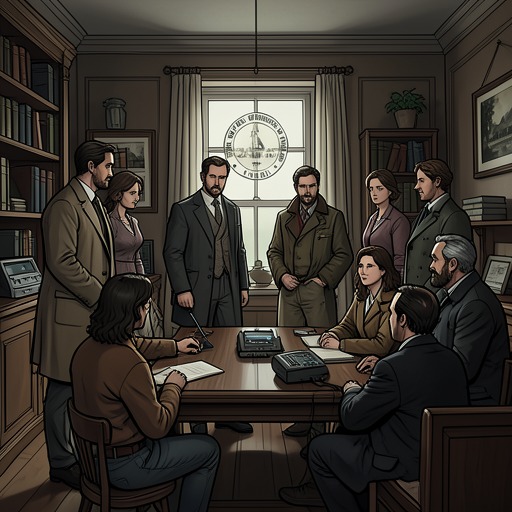
Eight years before the meeting, Little Chandler had seen Gallaher off at the North Wall and wished him godspeed. Gallaher, once shabby and in need, has since become a conspicuous figure on the London Press. His travelled air, well-cut tweed suit, and confident accent make his success immediately legible to his friend. Little Chandler considers him talented and believes that success has not spoiled his good heart; Gallaher’s rise is a source of pride as well as envy.
The prospect of meeting Gallaher occupies Little Chandler’s thoughts from lunchtime onward. In the office he repeatedly turns from his work to the window, measuring the intervening eight years and imagining the difference between his friend’s life and his own. His attention to the garden scenery, however vivid, cannot hold him: the approaching encounter has become a possible opening onto another life.
At Corless’s, Gallaher greets him with easy familiarity, calls him Tommy, offers a drink, and orders malt whisky. Gallaher jokes about his hair thinning and describes the pressure of newspaper work: the need to find copy, produce something new, and endure proofs and printers. He is glad to be back in Dublin for a holiday. His confidence and conversational ease make him seem at home both in the world he has left and in the city he has returned to.
The encounter gives Little Chandler a momentary share in Gallaher’s mobile, triumphant life, but also sharpens the inequality between them. After three small whiskies and Gallaher’s strong cigar, the normally abstinent and delicate Chandler feels warm, excited, and mentally unsettled. He thinks himself superior to Gallaher in birth and education, and believes he could achieve something higher than what he sees as tawdry journalism if only he had the chance. Yet the obstacle he identifies is his own timidity. He interprets Gallaher’s friendliness as patronage—as though the successful friend were condescending to him just as he condescends to Ireland—revealing how quickly admiration curdles into grievance.
Ambition and the Imagined Literary Future
On his walk, Little Chandler experiences a new sense of superiority to the people around him and recoils from what he sees as Capel Street’s dull inelegance. He draws a blunt conclusion from Gallaher’s success: anyone who wants to succeed must leave, because nothing can be done in Dublin. As he crosses Grattan Bridge and looks toward the lower quays, the houses become in his imagination a crowd of tramps, huddled beside the river in soiled old coats. The harshness of this image marks a shift: the city that had formed his ordinary world now looks like a landscape of stagnation from which he hopes to depart.
He wonders if he might write a poem expressing the idea that has stirred in him, and whether Gallaher could place it in a London paper. The thought of a poetic moment takes on the force of an infant hope. At thirty-two, he tells himself, he is not too old; his temperament may be reaching maturity, and he has many moods and impressions waiting for expression. His imagined poetic voice is melancholy, but not wholly without faith, resignation, and simple joy. He can picture a book reaching a small circle of kindred minds, even if he will never sway a crowd.
The ambition quickly takes the form of an imagined critical reception. He hears English critics praising the grace of his verse and its wistful sadness, and expects them to recognize a Celtic note. He considers adding his mother’s name to make his own name look more Irish: Thomas Malone Chandler, or, more compactly, T. Malone Chandler. The fantasy shows the distance between his wish to write and the external recognition he has not yet earned: even before a poem exists, he is rehearsing its reviews and adjusting the name on its cover.
Absorbed in this reverie, he walks past his street and must turn back. Near Corless’s, his earlier agitation returns; he hesitates outside before going in. Inside, the bright, noisy bar and its red and green glasses briefly confuse his sight, and he thinks the people are watching him. Once his vision clears, no one has taken particular notice. This small misreading echoes his broader tendency to experience ordinary situations through self-consciousness, as if every entrance exposed him to judgment.
Marriage, Fatherhood, and the Outburst
The return to home life places his imagined freedom beside the practical routine he shares with Annie. The couple keep no servant to save money; Annie’s younger sister Monica helps for an hour in the morning and another in the evening, but she has already gone home when Chandler arrives late for tea. He has also forgotten the parcel of coffee he was meant to bring from Bewley’s. Annie answers him shortly, says she will do without tea, and then goes out before the corner shop closes to buy tea and sugar herself.
Before leaving, Annie places their sleeping child in Chandler’s arms and warns him not to wake the baby. In the room off the hall, a lamp with a white china shade lights Annie’s photograph in a frame of crumpled horn. Chandler studies her tight lips and the pale-blue summer blouse he had bought her. The blouse cost ten shillings and elevenpence, but the purchase had cost him an ordeal of nerves: waiting for the shop to empty, trying to appear at ease while choosing it, forgetting his change, being called back by the cashier, and hiding his blushes as he left. His recollection makes tenderness and embarrassment inseparable; even a loving gift is remembered through his fear of appearing awkward.
With the child in his arms, Chandler tries to return to poetry, but the baby’s wailing breaks his concentration. He concludes that he can do nothing and calls himself a prisoner for life. Then, bending toward the child, he shouts for it to stop. The baby falls silent only for an instant before starting to scream again; Chandler walks hastily up and down the room, trying to soothe it as the crying grows more convulsive. When he counts seven sobs without a break, he catches the child to his breast in fright, suddenly imagining the possibility of its death.
Annie returns and takes the child, clasping him tightly while she walks and murmurs to him. Chandler steps back out of the lamplight, his cheeks suffused with shame, and listens as the sobbing gradually lessens. Tears of remorse come to his eyes. The scene does not settle the domestic strain or fulfil the literary ambition; it exposes, instead, the damage his sense of confinement can do when transferred onto someone more vulnerable than himself.
Narrative Role and Significance
Chandler’s episode turns the contrast between aspiration and paralysis into a concrete sequence. Gallaher’s journey from Dublin to London gives Chandler a model of departure and success, while the unspoken poems on the shelf and the imagined book of verse reveal how little that model has changed his daily habits. His reverie briefly supplies a future, complete with a literary name and favorable reviews, but it remains an inward performance rather than a completed act.
The shift from the golden garden outside the office to the cramped room off the hall narrows the scale of his hopes. At first he imagines the city as an obstacle and London as the route to achievement; at home, the forgotten coffee, the sleeping baby, and the thin walls of the room make his limitations immediate. His shouted command cannot restore the silence he wants, and the frightened child’s renewed crying turns his private fantasy of imprisonment into an act with consequences for another person. The final movement from anger to fear, then to shame and tears, defines his predicament without granting it an easy resolution: he recognizes the harm, but the story offers no evidence that recognition has yet become change.