Jimmy Doyle
DublinersJimmy Doyle is a wealthy young Irishman whose exhilarating entry into an international circle ends with the loss of much of his money at cards. In “After the Race,” his inherited wealth and social connections open doors to business, prestige, and pleasure, but his eagerness to live up to the glamour of his companions leaves him unable to control the stakes or even follow the game. The morning after the revels, he is left with the knowledge that he has lost heavily and will regret it.
Identity and Background
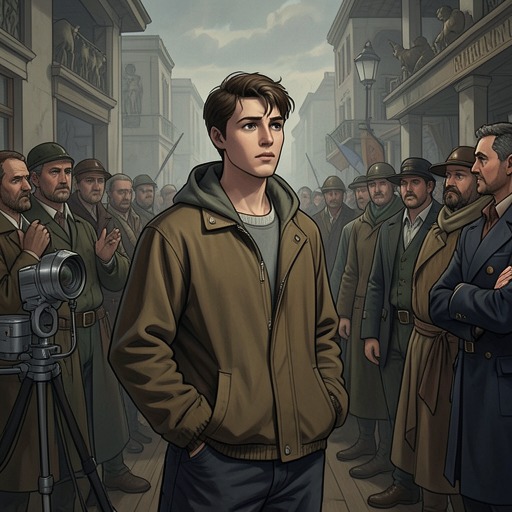
At about twenty-six, Jimmy is the son of a prosperous butcher whose shops in Dublin and its suburbs, together with police contracts, made him rich enough to be described in the newspapers as a merchant prince. His father had begun as an advanced Nationalist but modified his views early. He sent Jimmy first to a large Catholic college in England and then to Dublin University to study law. Jimmy did not apply himself seriously to his studies, and for a time he took to what the narrative calls bad courses. Money and popularity nevertheless gave him room to move between musical and motoring circles, two social worlds that his education and means allowed him to inhabit without having to master either.
His father later sent him to Cambridge for a term “to see a little life.” There Jimmy met Charles Ségouin, whom he did not yet know well but whose worldly experience, reputed ownership of some of France’s largest hotels, and charm made him seem valuable company. Jimmy’s father agreed that the connection was worth keeping, even on commercial grounds. Jimmy also befriended Villona, a brilliant pianist, although Villona was poor. From the start, Jimmy’s circle brings together money, cultural accomplishment, and international status—but those forms of advantage are unevenly distributed among the young men.
Business, Status, and Excitement
On the day of the race, Jimmy rides with Ségouin, Ségouin’s cousin André Rivière, and Villona in one of the blue French cars. The crowds gathered near Inchicore cheer the French vehicles as symbols of a continent whose wealth and industry are passing through a landscape described as marked by poverty and inaction. The French team has finished strongly, in second and third place, and the winning German car’s driver is reported to be Belgian. The welcome for the blue cars therefore carries both sporting enthusiasm and a local investment in the French success.
The company’s high spirits have different causes. Ségouin has unexpectedly received advance orders for a motor establishment he is about to start in Paris, and Rivière is to manage it; both are pleased by the French cars’ performance as well. Villona is content after a satisfactory lunch and remains an optimist. Jimmy, by contrast, is excited without being genuinely happy. The distinction anticipates the difference between his companions’ settled sources of satisfaction and the more unstable thrill he draws from speed, attention, and money.
The narrative identifies three sources of that thrill: rapid movement, notoriety, and possession of money. Jimmy has been seen with the Continentals by many of his friends. At the race control, Ségouin introduced him to one of the French competitors, whose shining smile gave Jimmy a gratifying sense of recognition. Returning to the spectators, he enjoyed the nudges and significant looks directed at the party. The social performance matters as much as the car itself: Jimmy is pleased not only to be travelling quickly, but to be publicly associated with men and machines that carry international prestige.
His investment in Ségouin’s motor business turns that prestige into a consequential financial decision. Ségouin has made it seem that including a small amount of Irish money in the concern is a favour of friendship, although Jimmy is preparing to stake most of his own substance. Jimmy’s father first proposed the investment and believes that the motor trade can make pots of money; Ségouin, meanwhile, has the unmistakable air of wealth. Jimmy does not dismiss the value of his capital. He knows how hard it was accumulated, a knowledge that had previously kept his bills within the limits of reasonable recklessness. Now, because the proposed venture promises large returns and arrives wrapped in friendship and status, he is willing to risk far more.
The car gives that decision a seductive physical image. As it runs smoothly along the country roads, Jimmy tries to translate its grandeur into days of work; its speed makes labour and machinery seem to move in harmony. Yet the image does not erase the practical disparity between Ségouin’s wealth and Jimmy’s Irish inheritance. Ségouin may regard the Irish contribution as a mite, while Jimmy understands what the money represents. His participation in the venture is at once a bid for profit and a way to enter the world embodied by the motor car.
Social Performance and Cultural Company
After driving down Dame Street, Ségouin stops near the Bank. Jimmy and Villona get out amid the people gathered to admire the car, then walk north through the city under the pale lights of a summer evening. The crowd’s attention briefly extends the spectacle of the race into Dublin’s streets. At home, the dinner planned with Ségouin is treated as an occasion: Jimmy’s parents feel pride as well as apprehension, and the names of great foreign cities lend the gathering an attractive aura. Jimmy looks well dressed, while his father is unusually friendly to Villona and shows respect for foreign accomplishment. The Hungarian, however, is chiefly becoming eager for dinner, a small contrast between the host’s social calculation and his guest’s immediate appetite.
At Ségouin’s dinner, the company expands to include Routh, an Englishman whom Jimmy had seen with Ségouin at Cambridge. The five young men eat in a snug room lit by electric candle-lamps and talk freely. Jimmy imagines the Frenchmen’s lively youth elegantly joined to the firmness of Routh’s English manner, and admires Ségouin’s skill in directing the conversation. The group’s talk moves across distinct kinds of cultural capital: Villona explains the beauties of the English madrigal and laments the loss of old instruments; Rivière undertakes to describe the triumph of French mechanicians. When the discussion turns to politics, Jimmy feels his father’s buried zeal awaken in him and finally draws the otherwise torpid Routh into the exchange. As the room grows hot and the conversation threatens personal spite, Ségouin raises a toast to Humanity and opens a window.
Jimmy’s place in this company is real but precarious. He has enough money and education to be welcomed, and enough familiarity with his companions to take part in their evenings; still, he strains to catch the Frenchmen’s quick remarks over the wind and the noise of the car, often guessing at their meaning before replying. His cultural ease is partly aspirational. He admires Villona’s musical knowledge, Rivière’s technical confidence, and Ségouin’s social command, while his own excitement depends heavily on being present among them. The passage makes his social position visible through the effort required to keep up, not merely through the wealth that got him there.
That night, the city seems to wear the mask of a capital as the five men stroll along Stephen’s Green, smoking, talking loudly, and allowing the people to make way for them. The cosmopolitan performance continues aboard an American yacht, where supper, music, and cards await. Villona plays a waltz on the cabin piano while Farley dances as cavalier and Rivière as lady; an improvised square dance follows, with the men inventing their own figures. Jimmy joins in wholeheartedly and takes the evening as proof that he is “seeing life.” The phrase captures the motive that underlies his participation: pleasure is also a test of whether he can inhabit the expansive, unrestrained world his companions appear to offer.
Gambling and the Morning After
The company drinks to Ireland, England, France, Hungary, and the United States of America. Jimmy delivers a long speech, with Villona calling “Hear! hear!” at pauses and the group applauding when he finishes. Farley claps him on the back. The approval seems to confirm that Jimmy belongs, although the evening’s warm fellowship soon becomes a setting in which his money is at risk. After the meal and speech, the table is cleared for cards. Villona returns quietly to the piano, while the others play game after game and drink to the Queen of Hearts and the Queen of Diamonds.
Jimmy senses that he lacks an audience for the wit circulating around the table, even as he enjoys the talk and the game. He does not know exactly who is winning, but he knows he is losing. He frequently mistakes his cards, forcing the others to calculate his I.O.U.s for him. The detail is more than a sign of inexperience: Jimmy is wagering in a game whose progress he cannot reliably read, and the company that has made him feel included now has to keep account of his losses for him. He wishes the game would stop, but the play continues and the sums represented by the paper grow consequential.
Before the final game, someone proposes a last contest. The piano has stopped, and Villona has apparently gone up on deck. Jimmy understands that the decisive game is between Routh and Ségouin. The men stand, talk, and gesture; after pausing to drink for luck, they play the last tricks. Routh wins. The cabin shakes with the young men’s cheers as the cards are gathered and the winnings collected. Farley and Jimmy are the heaviest losers. What had begun as a buoyant demonstration of international fellowship ends as a financial reckoning, and the outcome places Jimmy among those who have paid most dearly for the night.
Jimmy knows that he will regret his actions in the morning, but for now he welcomes rest and the dark stupor that will cover his folly. With his elbows on the table, he rests his head between his hands and counts the beats in his temples. The physical gesture replaces the earlier images of speed, applause, dancing, and speech: the exhilarated passenger is now still, focused on the bodily aftermath of the evening and on an error he cannot undo. When the cabin door opens, Villona stands in a shaft of grey light and announces, “Daybreak, gentlemen!” His words end the night but offer no rescue from its consequences.
Narrative Role and Significance
Jimmy’s trajectory connects “After the Race” to the collection’s concern with social paralysis, but his predicament is not simple deprivation. His family’s accumulated wealth, his education, and his father’s business judgment give him opportunities denied to poorer Dubliners. Yet these advantages do not ensure independence or discernment. The very money that could secure a stable future becomes the means by which he tries to buy participation in a more glamorous world, and the race-day investment and yacht gambling expose different versions of the same vulnerability: he is drawn toward risk by the promise of access and distinction.
The story sets Jimmy’s Irish inheritance against the international signs of success surrounding him. The French cars are cheered as they pass through poverty and inaction; Ségouin’s Paris enterprise promises a share in the motor trade; the dinner gathers French, English, Irish, and Hungarian company; the yacht gives the party a stage for national toasts and cosmopolitan pleasure. Jimmy moves through these settings with genuine enthusiasm, but the morning’s loss shows that proximity is not the same as mastery. He can admire the machinery, join the dance, speak to the company, and place his money beside theirs, while still misreading his cards and failing to control how much he gives away.
His final position is therefore both social and financial. The night leaves him not with a triumphant entry into the world he admires, but with a large loss, a headache, and foreknowledge of regret. The contrast between the day’s rapid motion and the stillness of dawn gives the episode its decisive turn: Jimmy’s passage through speed, recognition, and revelry arrives at a reckoning that his excitement had temporarily obscured.