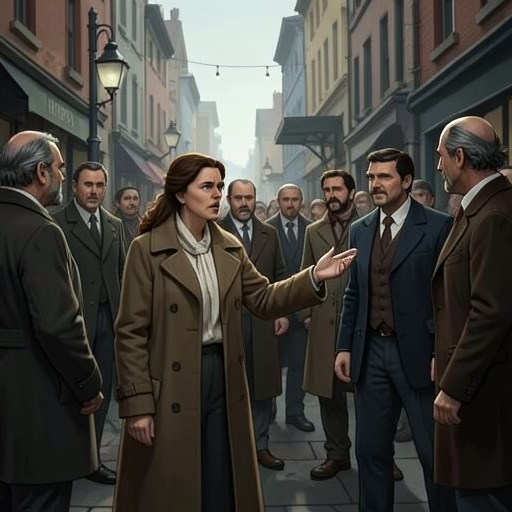
Hoppy Holohan
DublinersHoppy Holohan is the assistant secretary of the Éire Abú Society and the organizer of a series of four concerts in the Antient Concert Rooms. Known to his friends as Hoppy because he has a game leg, he spends nearly a month arranging the concerts, yet when a dispute over his accompanist’s fee threatens the performance, his organizational role gives way to helpless appeals. His story turns the labor of cultural organization into a public test of authority, contract, and payment.
Identity and Work
Holohan walks up and down Dublin with dirty scraps of paper in his hands and pockets, making notes, arguing at street corners, and arranging the Society’s concert series. The repeated movement and improvised paperwork suggest strenuous, piecemeal work rather than a smoothly managed institution. Despite his effort, Mrs Kearney ultimately arranges everything, establishing from the outset that practical control rests with her as much as with the Society’s assistant secretary.
His physical disability is briefly specified: he has a game leg, and his friends’ nickname for him, Hoppy, derives from it. The narrative also repeatedly presents him limping as he moves through the concert venue. This detail marks his body in the action without explaining it away or making it the cause of the payment dispute; the immediate source of his difficulty is the gap between his organizing responsibilities and his limited authority over the concert’s finances.
The Concert Arrangements
When Holohan proposes that Kathleen Kearney serve as accompanist, Mrs Kearney receives him in the drawing-room and joins the practical work of organizing the enterprise. A contract is drawn up for Kathleen to receive eight guineas for accompanying the four concerts. Holohan also relies on Mrs Kearney’s advice about the bills and programme: she knows how to distinguish the prominence given to different performers and how to arrange items so that the audience remains entertained. He calls on her every day for help, while she treats him with friendly, almost domestic hospitality.
The arrangement makes their different kinds of power visible. Holohan initiates the proposal and carries out the Society’s business, but Mrs Kearney brings professional judgment and insists that the written fee be honored. At the venue, Holohan tells her that Mr Fitzpatrick is responsible for payment and that the matter is not his business. Mrs Kearney rejects that division of responsibility: Holohan had brought her the contract, she argues, so the promise to pay Kathleen cannot be dismissed as someone else’s concern.
The Payment Dispute
Before the opening item, Mrs Kearney draws Holohan aside in a discreet part of the corridor and asks when Kathleen will be paid. Their disagreement is no longer an abstract matter of administration: Kathleen has signed for eight guineas, and her mother wants the money secured before she performs. Holohan answers that Mr Fitzpatrick has charge of payment; Mrs Kearney replies that she does not know Mr Fitzpatrick and that, whether or not the issue is Holohan’s business, she will see to it herself.
The confrontation interrupts the concert’s progress. Holohan later returns to the dressing-room with Mr O’Madden Burke and finds an uneasy hush: the first item, Mr Bell, is ready with his music, but Kathleen, the accompanist, makes no sign. The audience is already clapping and stamping in the hall. Holohan speaks earnestly and volubly to Mrs Kearney, turning red and excited as the noise grows, while she states the condition for Kathleen’s appearance: “She won't go on. She must get her eight guineas.”
Holohan points desperately toward the waiting audience and appeals to Mr Kearney and Kathleen, but neither gives him the response he seeks. Mr Kearney strokes his beard; Kathleen looks down and moves the point of her new shoe, with the narrative noting that the situation is not her fault. Holohan’s efforts to keep the concert moving cannot resolve the prior obligation. The scene leaves him caught between the Society’s event and the contracted performer’s demand, while Mrs Kearney makes payment the condition of proceeding.
Narrative Role
Holohan’s arc is defined by a contrast between sustained activity and limited command. For nearly a month he has walked, argued, and made notes to bring the concert series into being; in the critical moment, however, he can only point toward the hall and appeal to others. The dispute exposes the difference between arranging a performance and possessing the authority to ensure that its terms are met.
The limping organizer also anchors the story’s view of cultural enterprise in its practical particulars: scraps of paper, programme decisions, a written fee, a crowded dressing-room, and an audience waiting. The conflict does not make Holohan the decisive opponent of Mrs Kearney; rather, his repeated deferral to Mr Fitzpatrick and his frantic appeals place him between institutional responsibility and personal powerlessness. His importance lies in that exposed gap, as the concert’s public momentum presses against a promise that has not been honored.