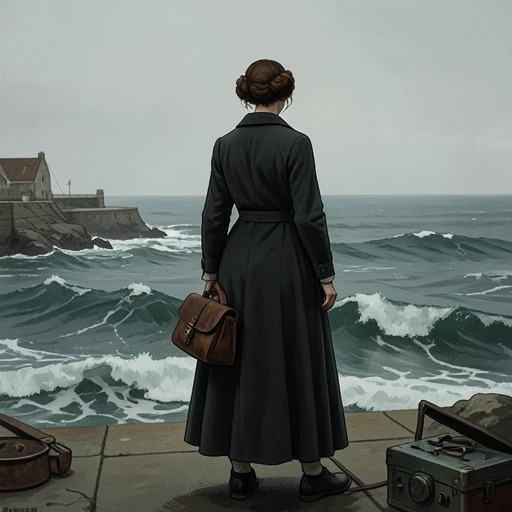
Frank
DublinersFrank is Eveline Hill’s sailor suitor and the promised companion of her attempted escape from Dublin. Kind, open-hearted, and associated with ships, music, and distant countries, he offers her marriage and a home in Buenos Aires; at the North Wall, however, the future they have booked together becomes a threshold she cannot cross. Her refusal leaves his offer unresolved and reveals the force of the family obligations and fear that hold Eveline in place.
Identity and Background
Frank is a sailor who has returned to Ireland from Buenos Aires for a holiday. He first meets Eveline while lodging in a house on the main road she visits. She recalls his peaked cap pushed back from his head and his hair falling over a bronzed face, an image that joins his arrival in her life to the wider world beyond her neighborhood.
His account of his working life gives their courtship a geography of departure. Frank says that he began as a deck boy earning a pound a month on a ship of the Allan Line bound for Canada. He tells Eveline the names of ships and services on which he has sailed, recounts passing through the Straits of Magellan, and describes the terrible Patagonians. He says he has made his way in Buenos Aires and has come back to the old country only for a holiday. These stories make him a living contrast to Eveline’s confined routine: he has travelled, while the life she knows has been organized around the house and the people dependent on her.
Courtship and Promise of Escape
Frank and Eveline become acquainted over time. He meets her outside the Stores each evening and walks her home. He takes her to see The Bohemian Girl, where she feels elated at sitting with him in an unfamiliar part of the theatre. Music is one of their points of connection: Frank is very fond of it, sings a little, and is known to be courting her. When he sings about the lass who loves a sailor, Eveline feels pleasantly confused. He jokingly calls her Poppens. What begins as the excitement of having a suitor grows into affection for him.
The relationship also takes on practical urgency. Frank is to take Eveline away on the night-boat, marry her, and live with her in Buenos Aires, where he says he has a home waiting. The passage has been booked. For Eveline, therefore, he represents more than romance: he makes a specific alternative to the hard life she has been living seem immediately attainable. She imagines that he will save her and give her a life that might contain happiness and love.
Family Opposition and Secret Meetings
Eveline’s father discovers the affair and forbids her to have anything to do with Frank. His suspicion is expressed in a warning that he knows sailors; after a quarrel with Frank, Eveline has to meet her lover secretly. The relationship thus develops under direct family opposition, making the prospect of leaving both an escape from her father’s control and a break with the household to which she remains attached.
That attachment complicates Eveline’s decision. She remembers her father’s harshness and the difficulty of getting money from him for the household, but also recalls moments of kindness: when she was ill, he read her a ghost story and made toast for her at the fire. She also remembers a family picnic to the Hill of Howth, where he put on her mother’s bonnet to make the children laugh. Frank’s offer stands against not only hardship but a life containing memories and obligations that Eveline cannot simply discard.
The North Wall and the Failed Departure
At the station at the North Wall, Frank is physically beside Eveline as the night-boat waits. Soldiers with brown baggage fill the station; through the shed doors she glimpses the black mass of the boat against the quay, its portholes lit. Frank speaks repeatedly about the passage, while she says nothing. The booked journey to Buenos Aires is close enough to see and hear, yet Eveline is unable to turn the plan into action.
She prays to God to direct her and show her what her duty is. The boat’s long, mournful whistle intensifies the decision: if she goes, she will be at sea with Frank the following day. She wonders whether she can still draw back after all he has done for her, while distress brings on nausea and her lips move in silent, fervent prayer. When Frank seizes her hand and tells her to come, the scene’s bodily details register a reversal from imagined rescue to terror. She grips the iron railing with both hands and cries out that it is impossible.
Frank passes beyond the barrier and calls Eveline by the familiar name Evvy, urging her to follow. He is shouted at to go on, but continues to call. Eveline’s face is white; she looks passive and helpless, and her eyes give him no sign of love, farewell, or recognition. She does not board the boat. Frank’s promised future remains on the other side of the barrier, while the relationship’s decisive moment ends not in departure or reconciliation but in separation.
Narrative Role and Significance
Frank is presented through Eveline’s recollection and expectation rather than through an independent account of his thoughts. His maritime history, affectionate courtship, and concrete plan of a home in Buenos Aires establish the force of the possibility he offers; the final scene then shows how little the promise alone can overcome Eveline’s fear and divided sense of duty. The story does not establish that Frank deceives her or explain what becomes of him after the station. Its emphasis is the contrast between his repeated call to come and Eveline’s silence and immobility, which turn the planned escape into an aborted departure.