Old Jack
DublinersOld Jack is the elderly caretaker of the Wicklow Street committee room in “Ivy Day in the Committee Room.” As he tends the fire and waits with political canvasser Mr O'Connor, his account of a nineteen-year-old son’s drinking and defiance turns a brief conversation into a portrait of authority worn down by age, poverty, and disappointment. The scene’s quiet, cyclical work at the hearth frames a father’s frustrated wish to make his son decent—and the recognition that he can no longer enforce his will.
Identity and Setting
Old Jack is identified through his work in the committee room: he tends its fire while the room is occupied by men involved in Richard J. Tierney’s political campaign. He is an old caretaker, physically marked by a bony, hairy face, moist blue eyes, and a mouth that sometimes falls open as he mechanically munches. These details place him among the room’s ordinary labor and waiting rather than among its political decision-makers.
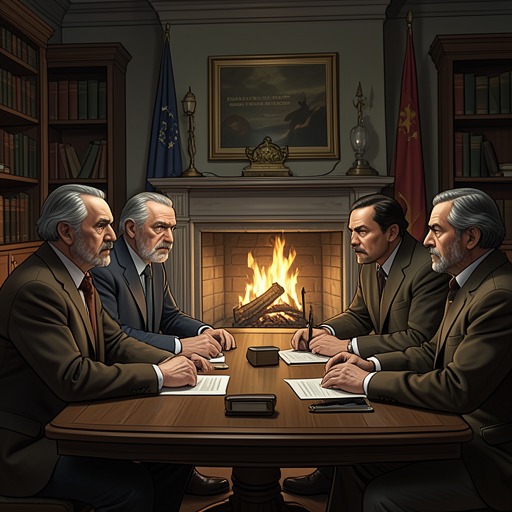
The fire gives his presence a visible rhythm. He rakes the cinders together with a piece of cardboard, spreads them over the coals, and fans them until they catch. As the fire dims beneath its covering, his face slips into darkness; when he bends to fan the coals, his crouching shadow rises on the opposite wall and his face slowly returns to the light. The scene introduces him not through public authority but through repeated, practical care for a fire that must be coaxed back to life.
Life in the Committee Room
Old Jack shares the room with Mr O'Connor on a dismal, cold sixth of October. Mr O'Connor has been engaged by Tierney’s agent to canvass part of the ward, but the inclement weather and his leaking boots have kept him sitting by the fire for much of the day. By the time the short day has grown dark, the two men have been there together for hours. Their waiting makes the committee room a place where political activity is suspended and everyday talk takes its place.
Old Jack’s small courtesies and routines establish an easy, familiar exchange. After he has got the fire burning, he addresses his companion with satisfaction: “That's better now, Mr O'Connor.” Mr O'Connor is rolling tobacco for a cigarette; when Old Jack speaks, the younger man meditatively undoes his work, rolls it again, and eventually licks the paper. Old Jack later tears a strip from a card and lights the cigarette for him. The flame catches a glossy ivy leaf in Mr O'Connor’s lapel, bringing the day’s commemorative emblem into the intimate space of the hearth.
His Son and His Authority
The conversation turns to Old Jack’s son when he reflects on how difficult it is to bring up children. He says that he sent the boy to the Christian Brothers and did what he could for him, hoping to make him “someway decent,” but the son now goes drinking. Old Jack’s account joins parental effort to disappointment: schooling and care, as he understands them, have not produced the behavior or independence he hoped for.
His regret is sharpened by age. He says that if he were not an old man, he would change his son’s ways and beat him with a stick, as he had done many times before. He also blames the boy’s mother for indulging him. The memory of past physical discipline sits beside the present inability to impose it: Old Jack can describe the authority he once exercised, but now presents himself as too old to act on that authority.
When Mr O'Connor agrees that indulgence ruins children, Old Jack elaborates on the son’s disrespect. The boy, he says, takes the upper hand whenever he sees that his father has had a drink. Old Jack’s complaint therefore turns on more than drinking alone: his own drinking weakens the position from which he expects obedience, while the son’s behavior makes that weakness visible. His question about what the world is coming to when sons speak that way to their fathers gives a personal grievance the sound of a broader generational decline.
Work, Drinking, and Dependence
Asked why he does not put his son to work, Old Jack answers that the boy has been a “drunken bowsy” ever since leaving school. He says he told him that he would not keep him and that he must find a job for himself. But employment has not solved the problem: in Old Jack’s telling, the son drinks away what he earns whenever he gets a job. Work is thus both the remedy Old Jack tries to demand and a fresh occasion for the drinking he deplores.
The account reveals a household conflict without presenting the son or mother directly. The mother appears only through Old Jack’s charge that she “cocks him up with this and that”; the son appears through his father’s reports of drinking, failed employment, and insolence. Mr O'Connor offers sympathy, shaking his head, but does not supply another explanation or a resolution. Old Jack eventually falls silent and gazes into the fire. His words have made the family’s difficulty present in the room, yet neither sympathy nor recollection changes the circumstances he describes.
Narrative Role
Old Jack’s domestic complaint unfolds amid a political gathering, but the scene gives no indication that his family story is resolved by the campaign. Instead, its contrast is structural: the committee room is associated with public organization and political canvassing, while Old Jack’s attention repeatedly returns to the household authority and economic dependence he cannot control. His son’s drinking also complicates the father’s moral position, since Old Jack’s own occasional drinking is precisely when the boy can take the upper hand.
The repeated handling of the fire quietly echoes the effort described in his speech. Old Jack rakes, covers, and fans the coals; he has likewise tried to educate and discipline his son, and still speaks of wanting to correct him. But the fire answers his work in a way his grown son does not: the coals catch when he tends them. After the exchange, the old caretaker is left gazing at the fire, his complaint suspended rather than settled. That ending preserves the scene’s central tension between continuing responsibility and diminished power.