Hynes
DublinersHynes is a tall, slender young man with a light brown moustache, introduced as he steps into a firelit room where election workers are anxiously waiting to be paid. His arrival turns a hushed discussion of money and political uncertainty into a direct challenge to the men assembled there: he argues that a working-man such as Colgan has a better claim to represent the people than the publican supported by their group. The scene gives Hynes a clear political voice, while showing that his convictions do not dissolve the practical pressures shaping the campaign.
Identity and Entrance
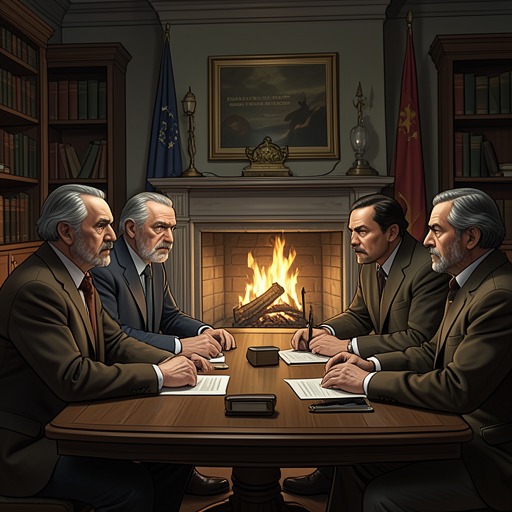
Hynes arrives after someone opens the room’s door and calls out, “Hello! Is this a Freemasons' meeting?” His question makes the darkness itself part of the introduction: the men have been sitting without adequate light, and another voice asks what they are doing there in the dark. Mat O'Connor recognizes the newcomer as Hynes, who advances into the light of the fire. He is described as tall and slender, with a light brown moustache; small drops of rain hang at the brim of his hat, and his jacket-coat collar is turned up. These details place him outdoors in wet weather immediately before his entrance, then make his movement into the firelight a visible change in the room’s scene. Hynes greets Mat with a casual inquiry about how things are going. The friendly address establishes familiarity between the two men, but their conversation quickly returns to the campaign’s unsettled business. Hynes is not introduced through a private history or an extended account of his role; instead, what the scene chiefly establishes about him is how he reads the political contest and how readily he speaks his judgment aloud.
The Election Room and Its Pressures
The room has been dark enough for the old man to stumble about before bringing in two candlesticks. He thrusts them, one after the other, into the fire, then carries them to the table. Their light reveals bare walls, a heap of papers, and a copy of an election address: the room’s objects mark it as a modest campaign workplace rather than a comfortable political salon. The fire, which had given the room a cheerful colour, loses that colour once the candlesticks expose the bare interior. The change in illumination does not settle the political tension; it makes the improvised surroundings and the work underway within them more apparent. Before Hynes enters, Mat has explained that a man in his household drinks away the money whenever he gets a job. Mat responds by shaking his head sympathetically, and the old man falls silent, gazing into the fire. Hynes’s arrival therefore interrupts not only political business but also a conversation about employment, drinking, and money that has already made the gathering’s economic strain plain. The election workers are waiting on payment, and their immediate question is whether the man they are working for will leave them in the lurch that night. Hynes asks whether the candidate has paid Mat. Mat says he has not yet been paid, though he hopes the man will not abandon them. Hynes answers confidently that he will pay, while Mat hopes that the candidate will act smartly if he is serious. Hynes’s assurance is not evidence that payment has arrived: the scene leaves the debt outstanding. His confidence and Mat’s anxiety remain side by side, exposing a practical dependence that complicates the group’s political loyalties.
Political Argument
Hynes turns to the old man and asks satirically what he thinks. The old man replies that the candidate has the money, unlike “the other tinker,” whom he identifies as Colgan. The dismissive label makes class and occupation part of the room’s political argument. Hynes directly challenges the old man’s distinction, asking whether he says that because Colgan is a working-man. He compares an honest bricklayer with a publican and insists that a working-man has as much right to sit in the Corporation as anyone else, indeed more right than the “shoneens” who are always deferential to anyone with a title. He then appeals to Mat, who answers that he thinks Hynes is right. Hynes’s case rests on a contrast between representation and self-interest. He describes Colgan as a plain, honest man, without “hunker-sliding,” who seeks to represent the labouring classes. The publican backed by the group, by contrast, is said to want some job or other. The distinction is not merely between two candidates: Hynes frames the contest as a choice between representing workers and pursuing personal advantage, and as a challenge to the social habit of deferentially bowing before a man with a title. His intervention gives the room’s political disagreement a moral and class-conscious vocabulary.
Character and Narrative Significance
Hynes’s entrance is brief, but it alters the scene’s emphasis. The conversation begins with the possibility that campaign workers may not be paid; it then opens into an argument over who has the right to represent working people and what motives drive the competing candidates. By assuring Mat that payment will come while defending a working-man candidate against the publican supported by the group, Hynes inhabits the tension between practical reliance on a campaign and criticism of its politics. The text does not show him resolving the unpaid bill, persuading the old man, or determining the outcome of the election. It leaves his argument in circulation: Mat agrees with him, while the old man’s earlier contempt for Colgan has exposed the class assumptions Hynes is resisting.