Griffolino d' Arezzo
Griffolino d' Arezzo is a minor but vividly characterized figure in Dante Alighieri's Inferno, appearing among the falsifiers in the Tenth Bolgia of Malebolge. His brief testimony encapsulates the intersection of vanity, credulity, and fraudulent art that defines this circle of Hell, while also offering a sharp satirical commentary on the foolishness of the Sienese people. His punishment, like that of all the damned in this region, is administered by the infallible judgment of Minos, who condemns him specifically for the practice of alchemy in the world above.
Identity and Background
Griffolino identifies himself as a native of Arezzo, a Tuscan city, and states that he was burned at the stake by Albert of Siena. He is careful to clarify, however, that the execution was not for the sin that lands him in this Bolgia. Rather, he explains, he had boasted in jest that he could fly through the air, and Albert, a man of conceit but little wit, demanded that Griffolino demonstrate the art. When Griffolino proved unable to perform as Daedalus, Albert had him burned by a man who held Albert as his son. This anecdote establishes Griffolino as a figure whose glib tongue and overconfidence in his own cleverness led to his earthly demise, but whose deeper, persistent guilt lies in the practice of alchemy.
Sin and Punishment
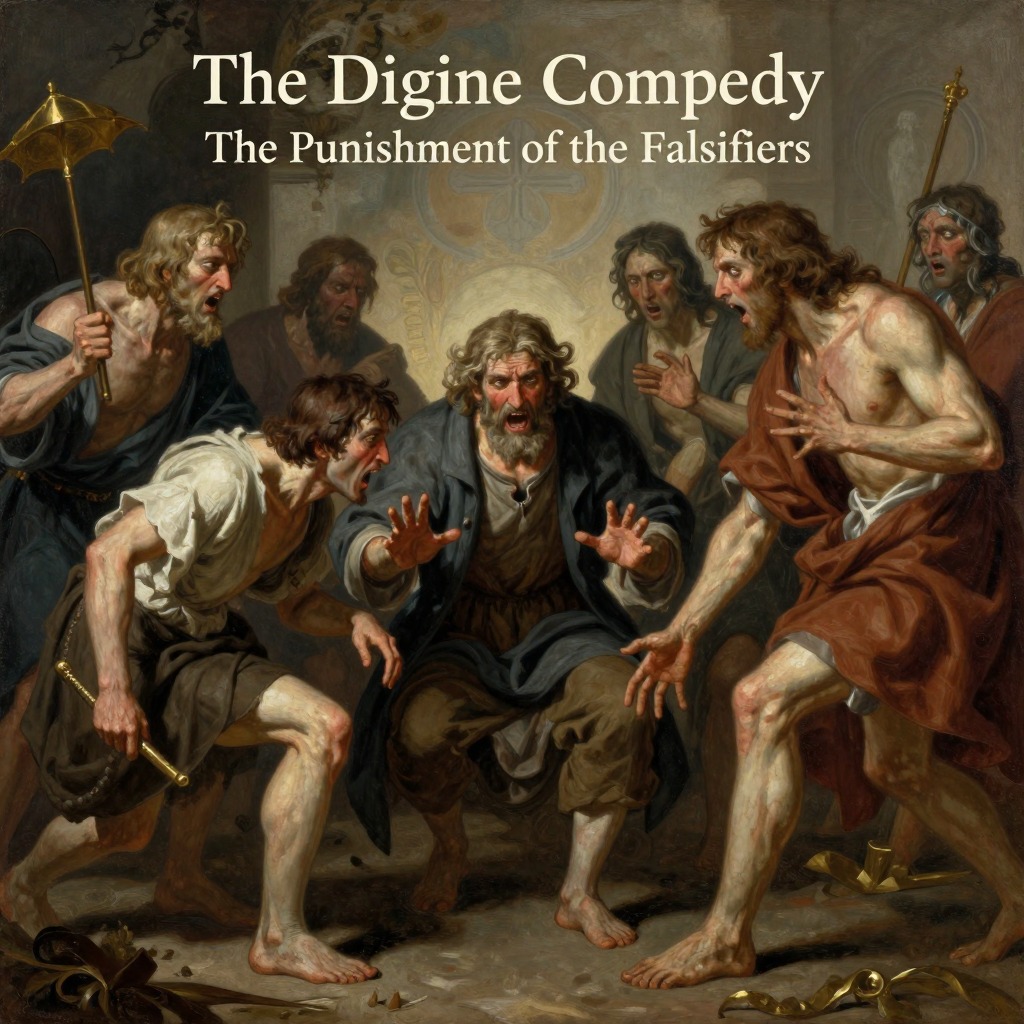
Griffolino's eternal torment is explicitly for alchemy, which he practiced in the world. He states that Minos, who cannot err, has condemned him to the last Bolgia of the ten for this crime. The Tenth Bolgia is reserved for various types of falsifiers, and Griffolino's presence there aligns him with other counterfeiters and impostors who corrupted the natural order through fraudulent arts. His punishment, like that of his fellow sufferers, involves a loathsome disease—here, a leprous scabbing that the damned scratch incessantly with their nails, as if using currycombs. Griffolino is first seen leaning against another sufferer, Capocchio, both of them covered from head to foot with scabs, and he is described as one who "plies fast the bite of nails upon himself" out of the great rage of itching that has no other succor.
Encounter with Dante and Virgil
When Virgil and Dante approach, Griffolino is one of the two leprous shades who respond to Virgil's inquiry about whether any Latian is among them. Weeping, he identifies himself and his companion as Latians. After Virgil explains his mission to show Hell to the living Dante, Griffolino and the other shade tremble and turn toward the pilgrim. Encouraged by Virgil to speak freely, Dante asks them to reveal their identities and origins, promising that their memory will survive in the world above. Griffolino then delivers his account, concluding with the crucial distinction that his execution was for a jest, while his damnation is for alchemy. This confession underscores the contrapasso logic of Hell: the punishment fits the sin, not the earthly penalty.
Narrative Role and Thematic Significance
Griffolino's role in the Inferno is twofold. First, he serves as a vehicle for Dante's satirical attack on the Sienese, whom the poet derides as a vain people. After hearing Griffolino's story, Dante turns to Virgil and exclaims that no people are so vain as the Sienese, not even the French. This outburst is immediately challenged by Capocchio, the other leprous shade, who defends certain Sienese individuals while implicitly confirming the general indictment. Second, Griffolino's case illustrates the distinction between earthly justice and divine judgment: he was executed for a lie about flying, but he is damned for the real sin of alchemy. His testimony thus reinforces the poem's moral framework, in which the eternal punishment is determined by the true nature of the soul's transgressions, not by the accidents of human law or the credulity of a victim.