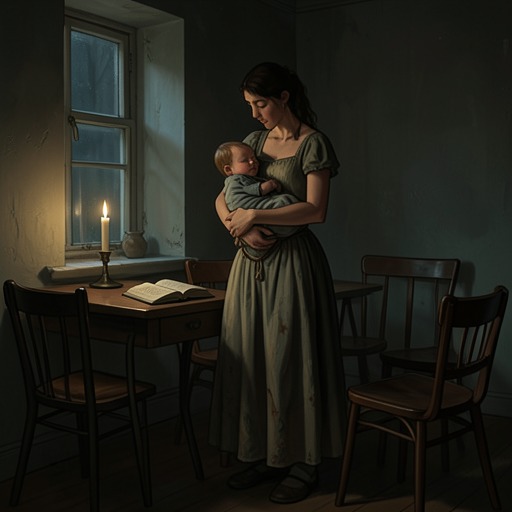
Mélissande du Mouton-Noir
BarkskinsMélissande du Mouton-Noir is the wealthy Frenchwoman brought to New France to marry Claude Trépagny, and her arrival turns his inflated promises of seigneurial grandeur into an immediate public embarrassment. Though her marriage gives her a lawful place in his household, Claude continues to live with Mari; Mélissande’s demand to leave and reclaim her dowry exposes the financial and political consequences of his divided domestic life. Her later death in a shipwreck is met not with an open report but with a calculated silence.
Identity and Arrival
Mélissande arrives at Claude’s estate in a fur-lined cart, preceded by the sound of her angry voice carrying through the forest. She protests that she has been deceived, threatens to return to Paris, and accuses both Claude and her guardian uncle of having been duped. By the time Philippe Bosse’s cart reaches the allée, the company has already heard her refusal and watched three deer scatter at the sound.
The scene sharply contrasts the expectations under which she has travelled with what she finds. Looking at Claude’s fine house, she calls it a shack and asks how he could describe the forest hut as a grand manor and the site of a rich city. Her arrival therefore makes visible the deception behind Claude’s marriage prospects: the wealth and connections attached to Mélissande’s family are real, but the urban grandeur Claude promised her is not.
Marriage and Conflict
Mélissande is identified as Claude’s lawful wife, while Mari remains the woman with whom he continues to live. The arrangement is not merely a private slight. Monsieur Bouchard receives a letter in which Mélissande complains that Claude rarely visits the mansion where she is lawfully installed, and Père Perreault explains that she wants to return to her uncle’s house in France and demands the return of her rich dowry because Claude has broken his marriage pledge.
The claim puts Claude’s seigneurial position at risk. Père Perreault warns that Mélissande’s uncle is powerful and has taken up the matter, making Claude’s conduct a serious concern for his standing. Bouchard and Perreault go to find Claude at the marriage house; when Claude asks what they are doing there, they explain that he ought to be living with his wife. He follows them silently along the west trail to meet her. The scene gives Mélissande’s complaint force through its legal and financial stakes, even though she is not present in it.
Disappearance and Narrative Significance
Mélissande’s uncle writes several letters to her, which Bouchard keeps on the corner of his worktable as though she might someday appear to claim them. When the uncle eventually addresses Bouchard directly, demanding news of his niece, Bouchard must answer that the ship carrying her struck rocks a few miles downstream from Wobik and that everyone aboard perished. The disaster had happened some time earlier; Bouchard pretends astonishment that news of it has not reached the uncle in Kébec, concealing how long the truth has been withheld.
Mélissande’s brief trajectory—from outraged bride, to a wife asserting her right to leave and recover her dowry, to the subject of unanswered correspondence—links domestic betrayal to the power structures of the colony. Claude’s promises draw a wealthy bride into the forest, but his failure to honor the marriage leaves her claim in the hands of officials and distant family. Her death does not resolve the conflict so much as make its final truth another matter for concealment.