Outger Duquet
BarkskinsOutger Duquet, the legitimate son of Charles Duquet and Cornelia Roos, is a natural-history enthusiast whose self-imposed isolation at the Duquet house on Penobscot Bay conceals both an intellectual life abroad and a daughter whose existence unsettles the family’s assumptions about inheritance. Long regarded by his relatives as an eccentric, he leaves the colonies for Leiden and names Beatrix Duquet as owner of the house and its contents, making his departure a turning point in the family’s history and in the recognition of Charles Duquet’s blood descendants.
Identity and Background
Outger is one of two children born to Charles Duquet and Cornelia Roos after Charles had adopted Nicolaus and Jan. His sister, Doortje, and her son Lennart Vogel belong to the legitimate line as well; Lennart’s death without marrying eventually ends Doortje’s branch. Outger’s position in the family is therefore different from that of the adopted sons who were treated as Charles’s children and received his goods in equal shares. That distinction becomes consequential much later, when a family genealogist identifies the descendants of Outger’s daughter as the only living bloodline descendants of Charles.
Charles Duquet adopted Jan and Nicolaus, both nine years old, in 1713, after Cornelia agreed to select boys for him to inspect. They began schooling and training in manners and business. Outger was born later that year, after the adoption. Charles then considered adding another boy from the streets of La Rochelle to his household, but Outger’s birth already placed a legitimate child alongside the adopted sons. The family thus carried two different kinds of descent from its early years: formal adoption, which made the boys heirs in practice, and blood relationship, which later became the basis of a competing claim.
The House and the Family’s View of Him
Outger spent decades at Charles Duquet’s house on Penobscot Bay. By the time younger relatives had seen him, their impressions were of a thin, wild-eyed man who spread sheets over a table and swung them about as if raising sails. They later learned that this disconcerting figure was their famous uncle, known abroad for corresponding with men of science and sending them plant specimens. What seemed to his relatives like aimless eccentricity was, to his distant scholarly contacts, an exchange about unfamiliar New England flora.
The house was also a place from which Outger’s relatives understood him primarily as a burden kept apart from the family business. When they learned that he had a daughter and had made her the house’s owner, Nicolaus protested that the property belonged to the company and claimed they had allowed Outger to remain there only to keep him from interfering with business. That dispute reveals how the family’s practical understanding of property could conflict with Outger’s own decision about what the house and its contents should become.
The house’s fortunes did not end with Outger’s departure. Beatrix remained there, and later, after she had died, Elise and her family occupied the property. As newer houses appeared around the bay, Charles Duquet’s old log house deteriorated and was derided by white settlers as the “wood wigwam.” Its decline contrasts with the importance it had held for Outger and Beatrix, and with the company’s readiness to treat it as an asset over which it could assert control.
Scholarship and the Name Etdidu
Outger maintained correspondence with scholars of natural history for decades without meeting them. He planned to spend only a few days with his mother and sister in Amsterdam before going to Leiden University to meet his correspondents. They did not know him by his family name: he had used the concealed name Etdidu, created by writing the alphabet in a circle, selecting the letters opposite those in his last name, and reversing their order. The name turns his scholarly connections into another private world, one that his relatives know little about even while he sustains it over many years.
His interests ranged beyond plants. He described studying the flora of the New World, Indigenous artifacts and accounts of Indigenous rites, weather phenomena particular to Penobscot Bay, and mathematical problems. He also mentioned an invention aboard a ship, but declined to discuss it. The evidence identifies the invention without explaining its purpose; the boundary he sets around it is part of the portrait of a man who offers an expansive list of intellectual pursuits while reserving some matters from his family.
Outger’s learning also changes how his relatives interpret his odd behavior. They had taken his agitated encounter with bedsheets as evidence of madness; the news that scholars valued his botanical specimens makes the same man legible as a correspondent and observer of the natural world. The comic gap between his family’s dismissive view and his standing among learned people does not erase his eccentricity, but it gives that eccentricity a wider context.
Beatrix and the Departure for Leiden
Outger’s departure becomes definitive through a letter delivered to Cornelia. She had received his message that he had been invited to join the Leiden faculty and that he would send for his possessions after finding a furnished, well-staffed house. He enclosed a separate letter for Bernard, explaining that he would not return to the colonies or to the Penobscot Bay house. The news makes his scholarly ambitions a concrete relocation, not simply a proposed visit abroad.
In the letter, Outger identifies Beatrix as his daughter and declares that the house and all its contents are her property. He says her mother was a Passamaquoddy woman who helped him study Indigenous ways and beliefs, and that after her mother’s death he raised Beatrix and gave her a good education. Beatrix is living at the house when he writes; he says he has told her what he is telling the family and may visit her on future trips, though he does not plan to stop in Boston. The letter therefore joins an account of his intellectual life to a personal disclosure and a transfer of property. It establishes Beatrix’s place in his life while making clear that he intends her, rather than the company, to control the house.
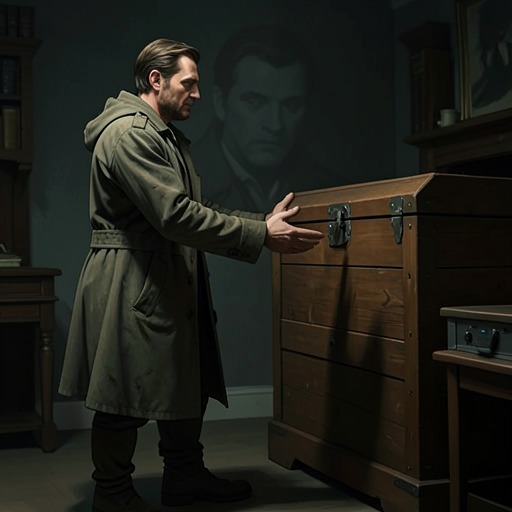
The news shocks the family. Cornelia leans back with her hand over her heart, while Nicolaus immediately challenges Outger’s ownership and urges Bernard to return to the house. Their reaction emphasizes the stakes of the disclosure: Beatrix is not only a previously unknown daughter but also the person Outger has named as heir to the home and its contents. The family’s dispute over the Large Table, a prominent possession in the house, gives the conflict a material focus.
Lineage and Narrative Significance
The family genealogy later places Beatrix at the center of a challenge to the adopted sons’ presumed inheritance. Outger’s daughter married Kuntaw Sel, a métis descended from Mi’kmaq people and a French habitant; their sons were Josime Sel and Francis-Outger Sel. When a genealogist reports his findings to Lavinia Duke, he concludes that the living descendants of Charles Duquet’s bloodline are the grandchildren of those two sons. By contrast, Lavinia descends from Nicolaus, whom Charles adopted. The genealogist argues that the adopted line has a stronger claim to the fortune if possession is the governing principle, even as his account identifies the Sel descendants as Charles’s blood heirs.
Outger’s letter is an early revelation of the family history that the later investigation makes explicit. By identifying Beatrix, her mother, her education, and her place in the Penobscot Bay house, he supplies a personal record that the family’s business-oriented account of ownership would otherwise obscure. His choice to recognize his daughter and leave her the house gives the genealogical question practical force: descent is not merely a matter of names, but of who is acknowledged, who inherits, and whose claim the family accepts.
That conflict continues across generations. After Beatrix’s death, the house is associated with her daughter Elise and the Sel family, while the old building itself deteriorates as settlement transforms the bay. Later, when Jinot Sel seeks information about his relatives, Francis-Outger Sel replies from Penobscot Bay and confirms that Elise lives in Boston. Outger’s daughter’s descendants thus remain connected through family correspondence and movement between places, even as the original house loses its standing. Outger’s legacy lies in that double inheritance: a scholarly record created through letters and specimens, and a family line whose existence forces later generations to confront the difference between adoption, blood, and possession.