Armenius Breitsprecher
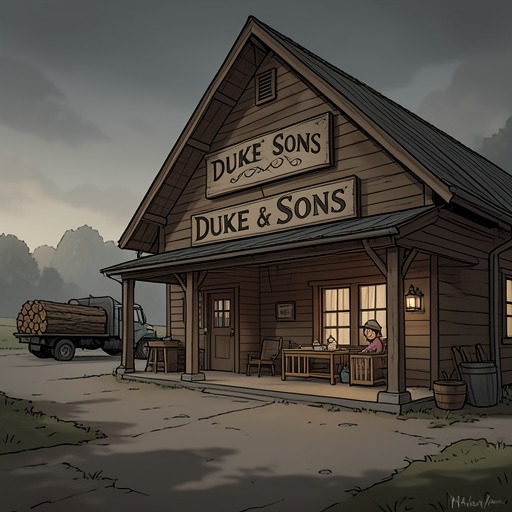
BarkskinsArmenius Breitsprecher is a German-born forester whose knowledge of timber and terrain helps Duke & Sons find and acquire one of the most valuable stands of white pine its leaders have seen. He is at once a skilled participant in the timber trade and a troubled observer of its logic: the company’s Michigan discovery promises immense wealth, while revealing to him how readily commercial ambition can become continent-wide destruction. His life ends after he leaves the timber business to seek gold in California, a decision Dieter Breitsprecher remembers as a disastrous abandonment of what had been good.
Identity and Expertise
Armenius works as a landlooker and surveyor, assessing forests for their commercial value. His expertise is practical and precise: in Michigan, he identifies terrain and tree stands, measures an acre’s yield, and marks sections and townships. The work makes him useful to Duke & Sons, but it also places him between the forest as a living world and the forest as a quantity of saleable wood.
His judgment is expressed in concrete measurements. At a stand of white pine, he explains that the trees yield about twenty-five thousand board feet per acre. The estimate turns the forest’s scale into a business calculation, but the surrounding scene underscores what the number cannot contain: old, towering trees are being translated into a prospective harvest.
Michigan Survey and the White Pine Discovery
The journey that brings Armenius to Michigan begins with concern about the company’s future. Lennart Vogel tells James Duke that Duke & Sons has had several lean years and few good stands remaining in New England and New York. The pine has been cut out, and the Ohio property that James’s father purchased has been transformed by incoming settlers, who have burned and cut the forest. The warning makes the search for timber both an urgent business problem and a response to depletion elsewhere.
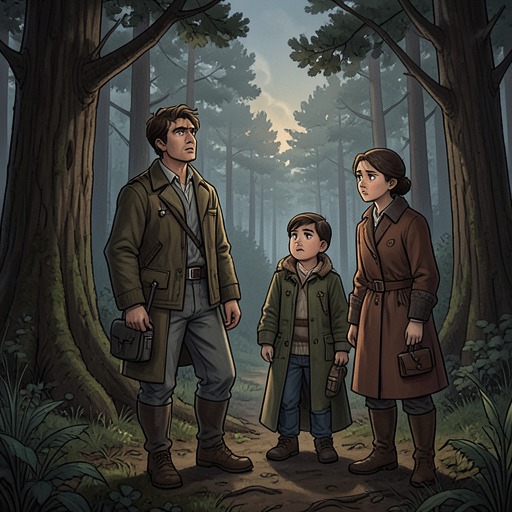
In early September, Armenius travels northwest with James and Lennart in a hired coach. Their route moves through clearings, bracken, red pine and hemlock before reaching mixed forest. On the next morning’s ascent, Armenius reads the terrain and identifies the area where white pine becomes dominant. The paths complicate their search: hemlock stands and intersecting trails make it uncertain which route leads to the densest growth.
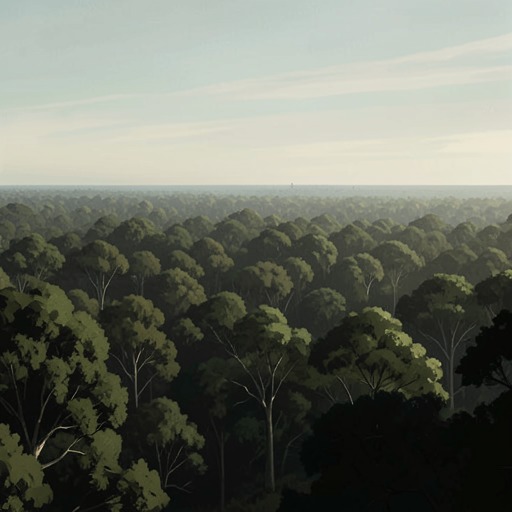
The uncertainty gives way when the party reaches the Shiawassee and joins the Saginaw Trail. There they find a remarkably extensive stand of white pine, with trees four or five feet in diameter and heights of roughly 150 feet, some exceeding 200. The timber’s fine grain and its accessibility for river transport or storage in bays and pounds make the stand exceptionally attractive to the company. Armenius’s estimate of approximately 25,000 board feet per acre sharpens that discovery into a commercial prospect.
Ambition, Complicity, and the Land Purchase
The find intensifies Armenius’s misgivings about the enterprise he is helping. By the fire, he recognizes that Duke & Sons’ acquisitive hunger appears capable of clearing the continent. He condemns the waste of sound wood, the damage to soil, the erosion of gullied land, and the destruction of the forest world without regard for the future. The choppers, in his view, behave as if the supply must be endless because another forest can always be found. The Michigan stand therefore brings not only opportunity but a troubling escalation: rapacity, present since the company’s beginnings, may now become its driving force.
Despite those reservations, Armenius continues the work that makes the acquisition possible. James returns to Detroit and, after three days working with a land-office clerk, secures all the timberlands Armenius surveyed on the exploratory trip: 100,000 acres. James also buys three city lots and hires carpenters to build an office and three houses, while Armenius remains in Michigan to survey and mark sections and whole townships. The transfer from reconnaissance to ownership is swift; the company’s interest in the forest becomes a claim to a vast tract of land.
A later report from Michigan emphasizes that the timberland is still standing and that government surveyors are working across the territory. Armenius has heard allegations of connivance and foul play in land offices, though he regards the Detroit officials as reasonably honest. The uncertain surveying system, including the existence of two base lines because some early surveyors lacked expertise, gives the acquisition a complicated administrative setting. His report does not establish wrongdoing in this purchase, but it shows the land’s value being pursued amid imperfect surveys and suspicion around public land transactions.
After leaving an overheated office, Armenius returns home to Frau Stern, eats the food awaiting him, and sleeps for sixteen hours. The small domestic interval contrasts with the expansive scale of the land dealings: the surveyor whose labor has helped secure a hundred thousand acres returns to a private household exhausted by the work.
Family, Rivalry, and Lavinia Duke
Armenius is Dieter Breitsprecher’s cousin and, in Dieter’s view, one of his best traveling companions. When the two prepare to enter the forests together, Dieter carries a heavy .60-caliber jaeger rifle, while Armenius brings a new .50-caliber plains rifle with a beaver-tail cheek piece. Dieter admires the weapon enough to order one from a Missouri gunsmith before their departure. The episode places their professional journeys within a close companionship marked by shared interests and familiar banter.
Armenius’s business connections are not limited to Duke & Sons. RBB is formed from the names Rotstein, Breitsprecher, and Breitsprecher, and its landlooker becomes a formidable competitor to the company. The name itself records the transformation of a surveying connection into a rival business organization. Armenius thus occupies a position within a timber world where expertise, family ties, and corporate competition overlap.
His attitude toward Lavinia Duke exposes the limits of his openness to newcomers in the trade. When she writes asking how to learn log scaling, Armenius laughs and dismisses her request as a rich woman’s passing fancy. He crumples the letter and throws it into the woodbox. Dieter retrieves it the following day and replies, offering to teach her personally if she can come to Monroe for a week. The contrast is consequential: Armenius’s authority in timber knowledge does not make him willing to share it with a woman, while Dieter’s response gives Lavinia a route into practical instruction.
California and Death
Armenius later leaves the timber business for California, where he seeks gold. Dieter recounts that Armenius displayed and boasted of his nuggets before two men attacked and robbed him in an alley behind a saloon, leaving him unconscious and apparently near death. He survived the assault long enough to be taken inside and treated, but Dieter believes the doctor who first attended him caused his death. His account is explicitly an interpretation of what happened, not an independently confirmed explanation.
For Dieter, the loss is bound up with Armenius’s choice to abandon timber for gold. The cousins had been doing well in the lumber business, he says, while Armenius left that success to pursue tiny particles of gold in a distant mountain stream. The contrast recasts the forest trade as both a source of wealth and a source of danger: Armenius had helped locate an immense resource, yet his later pursuit of another kind of riches ended in his death. His story also leaves his earlier ecological unease unresolved. The man who saw that timber companies could destroy forests without thought for the future never escapes the commercial world that made such destruction possible.