Theotiste Sel
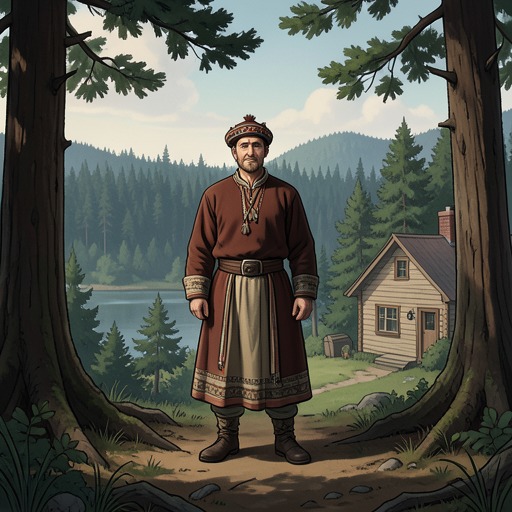
BarkskinsTheotiste Sel is Mari and René Sel’s son, an elder brother who tries to reunite his family across distance and colonial dispossession. His life follows the narrowing of choices for his people: he leaves Odanak to bring his siblings toward Mi’kma’ki, learns the country’s waters and livelihoods, and eventually fights the English settlement of Halifax. His death at the hands of an unknown assassin, with his head claimed as a bounty, makes the cost of that resistance intimate and familial.
Identity and Family
Theotiste belongs to a generation of Mari’s children growing up in a world far removed from the Mi’kmaw past she described. He is the eldest alongside Elphège, and his younger siblings are Achille, Noë, and Zoë. The siblings’ lives are divided between René Sel’s house and other communities; the question of where they belong is inseparable from who has the power to define home, kinship, and inheritance.
For several years Theotiste lives at Odanak, a village shared by Abenaki, Mi’kmaq, and people of mixed communities. Its residents have joined forces after once being enemies, fighting for the French and raiding New England settlements for bounty captives, while lamenting that white settlement is submerging their ancestral lands. Theotiste’s adulthood begins within this political and social landscape, where alliance offers a response to a common pressure but does not restore the territory being lost.
Reuniting the Siblings
Theotiste proposes that he and Elphège go to bring Achille, Noë, and Zoë to live with them. He does not treat the younger siblings’ separation as merely a temporary inconvenience: they are part of the same family and, in his view, belong together wherever the family goes. Elphège first asks whether Theotiste means they should live together at Odanak or simply visit. Theotiste’s answer is more consequential: he wants them united as kin and increasingly does not want to remain at Odanak.
He develops a destination as well as a plan. First the brothers should bring the younger children to Odanak; from there, the family can travel to their mother’s country and make a home there. Theotiste imagines others joining them: Mi’kmaq at Odanak, including Sosep, wish to return, and the community might find wives and establish a life together. He recalls that he was happy when his own wife was with him, so the proposed homecoming is not an abstract claim about territory alone; it includes the possibility of family life and companionship.
Theotiste knows that the land they seek may have changed. At René’s house, he tells Achille that they intend to find their mother’s country and that there must still be a place for them among their people, perhaps with relatives still living there. He says he has spoken with Mi’kmaq at Odanak and that some will come. His vision of return gives the family a purpose, but its hope is tested by the distance between remembered country and present conditions.
Elphège eventually joins his plan. He agrees that they should first go to René’s house and then continue to Mi’kma’ki. Their route asserts family connection against the competing claim that a French title and colonial records can settle who belongs. When Renardette Meillard and Démon Meillard declare René’s property hers and dismiss the Sel siblings’ claim to be his children, the conflict makes the family’s vulnerability explicit: their kinship is real to them, but colonial property language can deny it legal force.
Work and Adaptation in Mi’kma’ki
The return does not restore the country of the stories. Before they leave Odanak, Noë and Zoë listen repeatedly to accounts of the berries, trees, crayfish, beaver, eels, walrus, and abundant food of their mother’s homeland. Theotiste and Elphège carry these stories with them, only to confront a changed place. Sosep warns that the French king has given their lands to the British. Theotiste answers that the king had no right to give away a land that belonged to them. His response rejects the premise of royal ownership rather than accepting the transfer as a misfortune within French or British law.
In Mi’kma’ki, Theotiste and Elphège learn the water-world of the region. Its rivers are linked currents, runs, rapids, cascades, and tides, each with particular habits that people must understand. The brothers acquire fish lore as practical knowledge of their homeland; an elder insists that as long as Mi’kmaw people remain, knowledge of fishing will remain too. The scene places cultural continuity in learned relations with the land, not simply in memories of a past abundance.
Settler demand also changes the work available to them. New arrivals want trees cut to build heavy, square houses. Theotiste and Elphège make ax handles for money, while Achille hunts; the income helps them buy metal pots, utensils, nails, wire, tools, and weapons that were not needed in earlier times. Theotiste sets aside an ax handle when Talis invites him to help mend a weir, moving from repetitive paid production to collective work maintaining a fishery.
The family also takes temporary wages as chainmen for surveyors and laborers on a road into the interior. Sosep interprets the roads as part of an effort to push the Mi’kmaq inland. A sawmill brings further paid work, and Père Crème urges people to favor it over trapping and fishing so they can buy salt pork and flour; bread has become desirable even though the salt pork is not. Theotiste, Elphège, and Achille already know the axe from years of clearing forest with René, and they are hired by Duquet et Fils. The work is useful for immediate needs, but it ties the brothers to the same industry clearing the country they have returned to inhabit.
Resistance and Death
The growing settler presence is not only a change in employment or landscape. Sosep describes animals destroying food, boats and nets taking fish, and introduced plants displacing local ones. Although many newcomers may not intend harm, they are numerous while the Mi’kmaq are few; he fears that they will sweep over the people like a great wave. He urges the community to keep Mi’kmaw ways alive in thought and practice, a world in which plants, animals, birds, and people are persons who help one another. Theotiste’s life in Mi’kma’ki therefore holds together adaptation for survival and an effort to preserve a different understanding of human relations with the living world.
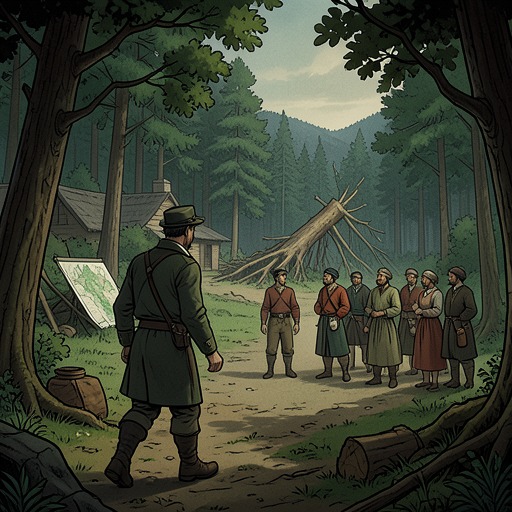
In August 1749, when Cornwallis declares Halifax an English settlement without regard for Mi’kmaq territorial rights, Theotiste has become a warrior. His band attacks English tree-choppers. He escapes the rangers seeking vengeance, but the reprieve lasts only a week: an unknown assassin kills him, and a bounty hunter takes his head. The account gives no identity for the assassin, leaving the killing unresolved while making clear the lethal context in which Theotiste’s resistance takes place.
Legacy
Theotiste’s death is remembered by Elphège, now sixty-six and half-blind, as a defining wound. Six years later, Elphège still thinks of the day he knelt beside his brother’s headless corpse, and he composes his own death song. The memory links the violence of colonial expansion to a private act of grief: Theotiste was not only a warrior killed during resistance, but the brother whose plan had been to gather the family and make a home in their mother’s country.
Theotiste’s arc does not culminate in the secure homecoming he hoped to build. The land has been politically transferred without the consent of its people, family claims are challenged through colonial property rules, and earning money often means laboring within the extractive economy transforming Mi’kma’ki. Against these forces, his decisions preserve a practical form of belonging: bringing siblings together, seeking kin among the Mi’kmaq, learning the waters, and resisting settlement. His life’s unfinished promise survives in the kinship and cultural memory his journey was meant to strengthen.