Monsieur Bouchard
BarkskinsMonsieur Bouchard is a government deputy and militia captain whose public office gives him a practical role in the lives of René Sel and Claude Trépagny. He appears at moments when private arrangements meet colonial administration: he delivers a letter from France, challenges Trépagny over his household, and later uses the settlement’s ledger to acknowledge René’s long service and prospects for land. His attention to Mari’s medicinal knowledge also makes him a conduit between Mi’kmaw expertise and French scientific interest.
Office and First Appearances
Monsieur Bouchard is introduced as a figure of government authority in New France. When René first arrives, the newcomers wait in the rain to make their marks in a great ledger; a man directs them toward a house, and the ledger and its record of settlement life become part of the administrative world in which Bouchard later operates. The novel thus places him within institutions that register people and service, as well as within the militia that polices the colony.
A few days after Mari returns from the mission, Bouchard comes up from the river on snowshoes. His duties are not confined to an office: he travels to deliver a letter from France whose red wax seals and coat of arms suggest urgency. Claude Trépagny asks whether the visit concerns corvée, a militia muster, or an Iroquois advance. Bouchard’s answer is more immediate and personal: he has brought Trépagny the letter because it appeared pressing.
Authority and Trépagny’s Household
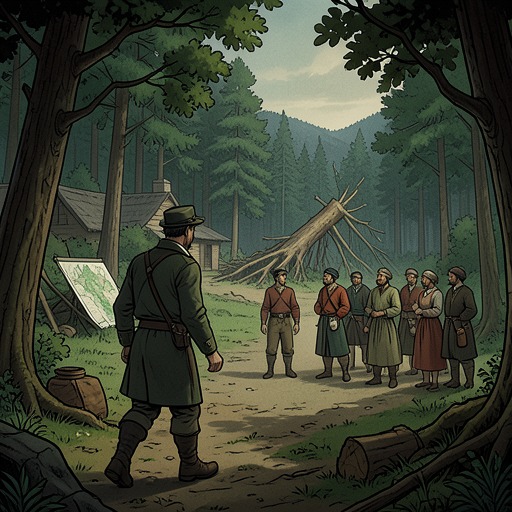
Bouchard’s authority becomes more direct when he and Père Perreault arrive at Trépagny’s clearing on an old plow horse. René, carrying a basket of fish, sees them pass the storehouse toward Trépagny’s marriage house. Trépagny, who has been working at his forge, comes out to challenge their destination. Bouchard dismounts and confronts him over the difference between his lawful marriage and his actual domestic life.
Speaking as both deputy and militia captain, Bouchard tells Trépagny that Madame Trépagny has written to complain that her husband continues to live with Mari and is rarely present at the marriage house where his lawful wife resides. The episode shows Bouchard acting on a complaint from France, and it places the authority of marriage and colonial administration against Trépagny’s conduct. Bouchard does not merely carry correspondence: he brings its claims into the settlement and demands that Trépagny answer for them.
René’s Service and Prospects
Bouchard’s ledger becomes a means of recognizing René’s labor. When René says that Trépagny has not granted him land, Bouchard takes down the large book and checks the record. He concludes that René has worked for Trépagny for five years and four months and that wages are owed. He says he will send Trépagny a note with Philippe, turning an overlooked claim into an administrative action.
Bouchard also asks whether René has found land on which to settle. René identifies two possibilities west of Trépagny’s property: an old Indigenous clearing near the river and a forest site with a spring beneath a yellow birch and a mixture of hardwoods. Bouchard responds that René will certainly have land. His exchange shifts René’s situation from years of dependent work toward the prospect of establishing a place of his own, while showing how records, wages, and land grants mediate that change.
Mari’s Knowledge and the Forest
Later, after Theotiste leaves by ship, René visits Bouchard in his familiar office. The aging captain tells him that a respected doctor from France, now in Kébec, is interested in the plants of the forests and has been collecting information from Indigenous people about their uses. The doctor has written to ask whether Mari will meet with him and show him the medicinal plants growing nearby; he is willing to pay her, though Bouchard does not know how much.
The offer gives Mari’s knowledge a possible place in a colonial exchange, but Bouchard presents it as a request rather than deciding for her. René asks who the doctor is and whether he will come to them. Bouchard’s role here differs from his intervention in Trépagny’s household: he relays an opportunity that might compensate Mari for knowledge the doctor seeks. In both cases, he stands between local people and larger institutions, translating a letter or an official interest into a concrete possibility within the settlement.
Narrative Function
Bouchard’s appearances are brief but consequential, linking otherwise separate strands of the narrative: René’s arrival and work, Trépagny’s marriage, and Mari’s plant knowledge. The ledger makes his authority tangible, while his travel between the river, the office, and Trépagny’s property shows administration operating through personal visits and written messages. He can press a powerful seigneur to answer a complaint, recognize a laborer’s claim to wages, and carry a request that may bring payment for Indigenous expertise.
That combination makes Bouchard more than a background official. His interventions do not resolve the colony’s inequalities, but they expose the procedures through which they are negotiated: a complaint sent across the Atlantic, years of work tallied in a book, land described by its water and trees, and knowledge sought by a doctor from France. His place in the story is that of a mediator whose practical decisions make those structures visible.