Bren Sel
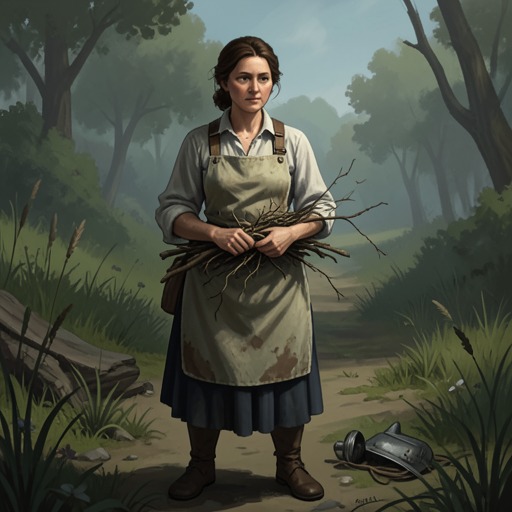
BarkskinsBren Sel, also known as Brenda Hingham, is Egga’s wife and the mother of Marie and Sapatisia. She insists that her husband’s Mi’kmaw heritage cannot be discarded, and that their daughters must inherit knowledge of it; at the same time, she pursues education and economic independence for them as a way beyond the restricted work available to women. Her role links cultural continuity to the practical labor of raising children, financing their schooling, and helping them define futures beyond the limits imposed on their parents.
Identity and Background
Egga met Bren after leaving the residential school at Shubenacadie as a runaway boy and finding work as a fisherman on Martha’s Vineyard. When he proposed, she accepted while describing him as an enemy: she understood the Mi’kmaq and the people of her own community, the Wôpanâak, through a history of conflict. That history complicates their marriage from its beginning, but does not prevent her from choosing a life with him.
The marriage is an awkward match in part because Bren believes Egga refuses to understand what his rejection of Mi’kmaw identity means. He answers that being Mi’kmaw made his life painful and that he has put that identity away. Bren challenges the idea that ancestry can be shed at will: his parents, siblings, generations of family, and people remain part of him, and that inheritance is also part of their children. Her position does not erase the harm Egga associates with his past; it asks him to distinguish refusing that harm from denying the people and history to which he belongs.
Family, Work, and Education
Bren wants her two daughters to grow into a new kind of woman, combining Wôpanâak and Mi’kmaw inheritance with the ideas, careers, and independence available to them. Her commitment to that future takes material form in a plan for university. Although she had wanted to study linguistics, with the hope of helping revive the Wôpanâak language, her family could not afford such an education. When Sapatisia begins school, Bren takes the only job available to her, working nights at a fish plant and putting almost all her pay into an education account for the girls. She tells Egga that they will not have to work in a fish plant or tourist motel.
That ambition is not a vague confidence that the next generation will fare better. It depends on Bren’s paid work and sustained saving, while the daughters’ education remains a family responsibility she actively organizes. The contrast between her own unrealized study and the schooling she tries to secure for her children makes education both a personal sacrifice and a means of widening the choices available to women in the family.
Raising Sapatisia
Bren and Egga find their first child, Sapatisia, unusually intense from the start. She fixes on people and subjects, and waits at the window when her father is late returning from the water. Bren describes how Sapatisia clings to Egga when he comes home and worries about how the child will manage school. Egga’s fishing work, subject to weather and the sea’s rhythms, means he cannot always predict when he will return.
At school, Sapatisia’s behavior does not match Bren’s fear that she will be overwhelmed by separation. She does not cry when Bren leaves her in the kindergarten chair, and she refuses to move to another chair when asked. The teacher finds her difficult to understand; Bren answers with the wry familiarity of someone who recognizes the pattern. Sapatisia can manage when left alone, but resists being commanded. Bren’s account of her daughter therefore presents intensity not simply as a problem to be corrected, but as a force that parents and teachers must learn to meet.
Heritage and Intergenerational Change
Bren sees Egga’s refusal of Mi’kmaw identity as a central obstacle between them. She presses him to tell the children about his earlier life, and the daughters respond by wanting to write to his parents and visit the Sel family in Shubenacadie. Their interest surprises Egga; he begins to wonder whether he, too, wants that connection, and whether being Mi’kmaw can mean something beyond the pain and humiliation he remembers. Bren’s insistence thus helps turn a suppressed family history into a possible relationship across distance and generations.
Her influence is not presented as an instant resolution. Egga continues to react ambivalently, and Bren’s account of identity remains distinct from his experience of institutional abuse and rejection. What changes is that his past becomes speakable within the family, and the children are allowed to approach relatives and heritage that he had left behind. Bren’s effort makes continuity a choice to be practiced—through stories, correspondence, and family connection—rather than a demand that suffering be forgotten.
Sapatisia’s Departure and Bren’s Limits
As an adult, Sapatisia develops a strong interest in plants and forests and feels personal responsibility for environmental damage. She tells her parents that she wants to go to Shubenacadie, meet the Sel family, and learn who she is. Her search for identity accompanies her concern for damaged land and waterways, joining family inheritance to an ecological sense of responsibility.
Bren supports her daughter’s decision, but does not treat support as freedom from practical consequences. She tells Sapatisia that she will need work to live on and a scholarship to finish her studies, reminding her that Marie also needs consideration. Sapatisia leaves the next day on a northbound bus. Bren’s response holds together two demands that cannot be reduced to one another: her daughter must be allowed to pursue her own life, and the family’s resources and responsibilities remain real. Across the generations, Bren works to make room for women’s choices while confronting the economic limits that continue to shape them.