Jeanne Sel
BarkskinsJeanne Sel’s path into forest restoration begins with a loss she cannot yet explain and a forest she never forgets. After her mother’s death, her cousin Felix Mius becomes the one child with whom she will talk and play; years later, the two pursue education together and discover a way to turn their concern for the damaged boreal forest into work. Meeting Sapatisia Sel gives Jeanne’s longing for action a direction, joining her personal search for purpose to Mi’kmaw knowledge and the patient labor of restoring trees.
Identity and Early Loss
Jeanne grows up alongside Felix, her cousin, in a relationship that changes as they age: their childhood understanding of each other gives way to different interests and temperaments, though they remain close. The book presents this divergence as gradual rather than a break. Their shared history will continue to make Felix a companion in the decisive transitions of her life.
Jeanne’s childhood is marked by the loss of her mother, Marta. She remembers her mother leaning over a ferry rail and waving goodbye until the vessel disappeared in heavy fog. Hours later, the ferry collided with a coal barge, and both sank. Jeanne’s father, Paul Sel, tells her that her mother cannot return, but his weeping communicates the terrible scale of the loss. Jeanne withdraws from other children, speaking and playing only with Felix.
Paul’s sister, Mary May Mius, responds by inviting Jeanne to stay with her family and suggesting a picnic to help both Jeanne and Paul. Paul doubts that anything can help him, yet he does not resist Mary May’s plan. The cousins’ closeness becomes a means of care: it does not undo bereavement, but it gives Jeanne a relationship in which she can begin to re-enter the world.
A Forest Remembered
Mary May takes the children to Kejimkujik Provincial Park, explaining that the place had long been Mi’kmaw land. After hours in the truck, Jeanne and Felix run beneath old-growth hemlocks. The forest is presented through the children’s close attention: silver light under the branches, maidenhair fern, dark curved stems, and tiny leaves. Felix studies the hemlock, while Jeanne wishes that her mother could see the place with her.
Jeanne’s memory of that outing gathers around the living detail of the forest. Beside the water she sees ebony spleenwort and an array of greens, and the day remains vivid to both children. The scene is more than a consoling excursion after grief. It establishes a durable attachment to a particular landscape and a way of noticing it—an attachment that later helps Jeanne understand forest work as something more than a career.
Education and a Shared Direction
In high school, Jeanne learns about botany and the world of stems and leaves. Felix, meanwhile, sets his sights on forestry school, encouraged by the example of Jackson Mius, who had logged in Maine with a horse team before studying at the University of Maine and entering state forest research. The cousins decide to aim for university, though they first need two years of community-college credits and know the odds are against them.
After graduation they move into Alice Sel’s home in Dartmouth, which also serves as a child-care center and a place for young Mi’kmaw people trying urban life. They enroll at community college and work part-time. Their studies are demanding, and neither speaks Mi’kmaw fluently: English came first. Some mornings they practice Mi’kmaw words at the computer, using pronunciations from Listuguj speakers, while Alice criticizes their attempts. Their education therefore unfolds amid both aspiration and an unsettled relationship to language and inheritance.
A newspaper profile gives Jeanne a new lead. While doing laundry at the Bucket O’ Suds, she finds an article about Sapatisia Sel, tears it out, and later shares it with the family over tea and store-bought cake. The article says Sapatisia collects medicinal plants and trees. Jeanne is drawn to the report that old Mi’kmaw medicines can no longer be used and suspects that Sapatisia may know how to help the forest. She proposes finding her on Cape George, although the cousins have no car and initially leave the idea unresolved.
From Helplessness to Fieldwork
A lecture by Dr. Onehube sharpens Jeanne’s frustration. He describes the boreal forest as a source of bird habitat, clean air, and nutrients carried toward the ocean, then warns that people are destroying it. As the audience leaves, Jeanne hears someone dismiss the speaker as an environmental crank. She tells Felix she feels stupid and helpless, asking what they can do when they are only filling their heads with words. The scene marks a shift: study alone no longer seems an adequate response to what they have learned.
Jeanne returns to the profile of Sapatisia and decides they should seek her out. When Alice becomes ill with flu, Jeanne stays home from class to run the child-care center and cook. Alice’s friends bring Mi’kmaw medicines, and Jeanne is delighted to see them used and to hear their names, even though she does not understand them all. This domestic episode makes her interest in Indigenous plant knowledge concrete: it is living practice, present in care for a sick person, rather than simply a subject to be studied.
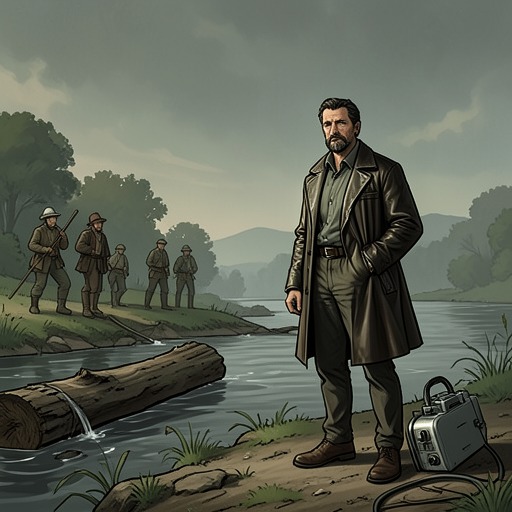
At the lighthouse on Cape George, Felix spots Sapatisia on the rocks. She is digging with a trowel beside an open notebook whose pages are moved by the wind. The image brings Jeanne’s search into direct contact with the kind of work she has imagined: observation and attention grounded in a particular place. Sapatisia later explains that the Breitsprecher Tree Project is a small restoration group, working with conservation organizations, planting trees and monitoring test plots. Their records follow plots for as long as ten years; one had shown substantial chlorosis, and another tests how mycorrhizal fungi affect seedlings because burned soil may lack the fungi seedlings need to take up nutrients and minerals.
For Jeanne, meeting Sapatisia gives new meaning to the education she and Felix have pursued. Felix considers soil types and the future generations of tree cutters; he sees himself at the edge of the forest, finally beginning the work he hoped to do despite the barriers of college and university. Jeanne experiences the change as a sudden, concentrated joy, like sunlight entering through heavy cloud. Her life, she feels, has acquired leafy meaning because of Sapatisia Sel.
Narrative Significance
Jeanne’s story links bereavement, education, and ecological commitment without treating the forest as a mere backdrop to her recovery. The hemlock grove at Kejimkujik becomes an enduring memory, while the damaged forest described in the lecture demands action in the present. Her development moves from a child who can scarcely speak outside her bond with Felix to a young woman who asks how knowledge can be put to use and seeks out someone practicing that work.
The novel’s wider account of forestry repeatedly contrasts rapid extraction with the slow processes on which future forests depend. Dieter Breitsprecher argues for holding and managing cutover land; he insists on planting seedlings for people not yet born. Later, Conrad Breitsprecher recognizes that seedlings alone may fail on logged-over sites: companies must prepare the land and accept costs if they expect future timber. Jeanne’s movement toward restoration belongs to this larger ethical struggle, but the evidence of her own life is grounded in learning, relationships, Mi’kmaw medicinal practice, and field observation rather than corporate policy. Her final moment in the supplied narrative is not a completed career or a solved crisis; it is a beginning, made consequential by the work she has found and the forest she has learned to see as worth sustaining.