Blony Jacko
BarkskinsBlony Jacko is a young Mi’kmaq logger whose movement from eastern river drives to the giant trees of the American West ends in a fatal climbing accident. His story gives individual form to the risks assigned to logging laborers: the industry’s machines and markets may expand, but the workers who fell, move, and rig timber remain exposed to lethal danger.
Identity and Life in the Woods
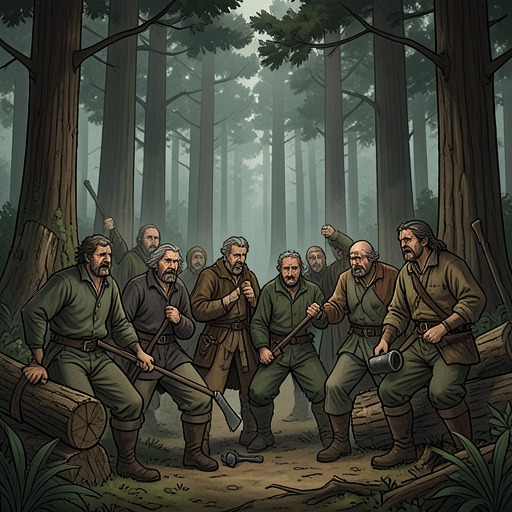
Blony enters the narrative as one of the young men who leave after the community’s talking stick is thrown into a fire and take up woods work. His father, Mike Jacko, and Etienne Sel try to keep watch over their sons, but the young men resent parental oversight and head for increasingly distant camps. At fifteen, Blony begins on a cutting crew in Queens County alongside his younger brother, Pollo. He has a natural aptitude for the ax; when he is not chopping, he and a young Swedish worker named Erto use spudding irons made from old carriage springs to peel bark.
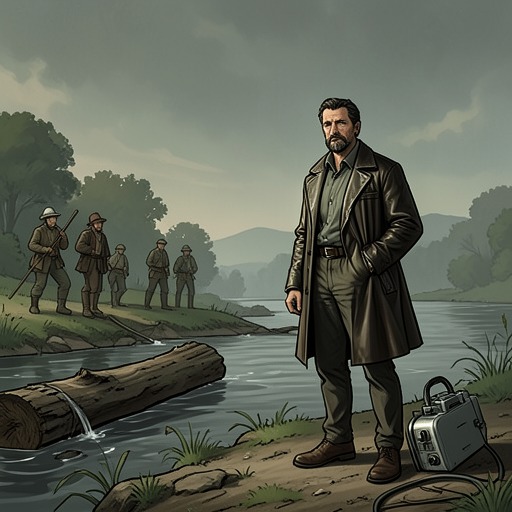
On his first river drive, Blony discovers that he enjoys the work of dodging and steering among the logs. He learns to read the geometry of jams and take them apart. Twice he falls among the moving timber, but understands that fighting toward shore is dangerous and that he must travel downstream with the logs. The skill is inseparable from risk. Across the logging world described in the novel, water work is among the most dangerous tasks, and Mi’kmaq workers are disproportionately assigned to it under the assumption that they are suited to violent rivers.
Moving West and Seeking a Trade
The reservation feels constricting to Blony and Pollo, and the brothers move west. They spend a winter in Idaho, where river driving still carries logs to sawmills, while other camp workers talk of forests in California, Oregon, and Washington with trees said to reach three hundred feet. A logger known only as Shirt tells Blony about the immense timber of the Pacific coast and says he is going there. That account helps draw Blony farther from home, toward work on a scale unlike the eastern woods.
In Washington, river driving is tidal rather than the familiar inland work, and Blony starts in a high-lead camp as a choker setter, the lowest position. He soon sees a more daring occupation: climbing and rigging enormous Douglas firs. He watches Napoleon Tessier ascend a tree with climbing spurs, rope, saw, and ax, cut its limbs, and remove its top before preparing the rigging needed to move the timber. Blony wants to become a climber. The change in his ambition is also a change in the kind of danger he accepts: from negotiating moving logs on a river to working high above the ground among the trees he is helping bring down.
Climbing and Death
Blony presses the camp boss to let him try climbing. The boss’s prejudice against the brothers—as East Coasters and as mixed-race workers—makes permission uncertain, but Tessier argues that climbers are scarce and that Blony should be given a chance. The boss finally allows him to climb, addressing him with a racial slur. The episode shows both the gatekeeping Blony faces and the practical value the camp places on a worker’s skill.
Tessier coaches Blony through his first climb, warning him not to cut his rope. Blony reaches the top and takes the swinging ride of the trimmed spar as his reward. Tessier praises the effort, and Blony becomes increasingly absorbed in climbing, trying to move faster and surpass his mentor. For his final climb, he plans a stunt: after topping the tree, he will stand on his head and whistle. The plan turns fatal when the heavy top he has cut hinges over and the spar splits, trapping him in its cleft. Tessier must climb back up and cut below him to free the tree. Blony falls still held by the Douglas fir, and the loggers bury him in that position.
Relationships and the Cost of Logging
Blony’s story is shaped by family ties and by the hazards shared across the camps. His father and Etienne try to protect their sons, but distance and the boys’ resistance limit their influence. His departure with Pollo gives their westward move a familial dimension; Blony’s later death leaves Pollo among the people who survive to carry news and grief home. The brothers’ experience belongs to a wider pattern in which young men leave constrained circumstances for dangerous work, while parents can do little to control where the work takes them.
The camps’ changing technology does not eliminate the danger borne by workers. The Sels and their fellow laborers witness the shift from axes and river drives to saws, engines, locomotives, and roads; in the western forests, climbing and rigging make the enormous trees accessible to industrial logging. Blony’s death is not presented as a triumph of skill over nature, but as the consequence of a perilous job in a system that turns giant trees into movable timber. His ambition and competence cannot make that system safe.
Narrative Significance
Blony’s short trajectory links the timber industry’s expansion to its human and ecological costs. The forest appears to the lumber companies as a vast supply to be cut, while workers encounter it as a workplace whose risks are immediate and personal. His fatal climb gives that contrast a precise human outcome: the tree is prepared for removal, but the climber does not survive the work.
Elsewhere, Armenius Breitsprecher recognizes that Duke & Sons’ hunger for Michigan pine could become a force of continental clearing, accompanied by waste, soil destruction, and erosion. The novel sets that corporate scale beside workers such as Blony, whose bodies and lives are spent in the labor that makes extraction possible. Later generations turn toward managed forests, nurseries, and planting seedlings; Dieter Breitsprecher argues for planting trees whose maturity the planters will never live to see, and Conrad Breitsprecher studies how to make reforestation work in practice. Against those long horizons, Blony’s death marks the short, dangerous time imposed on the people who work among the trees.