Beatrix Duquet
BarkskinsBeatrix Duquet is Outger Duquet’s daughter and the only child of Charles Duquet’s legitimate line to establish a lasting bloodline. Educated by her father and rooted in the Penobscot Bay house, she becomes Kuntaw Sel’s wife and the caregiver and benefactor of a wider family. Her story makes inheritance more than a question of property: the Duquet estate passes through adoption and commerce, while its biological descendants remain in a Mi’kmaq-connected family whose claim the Duke business chooses not to pursue.
Identity and Background
Beatrix is born to Outger Duquet and a Passamaquoddy woman whom Outger describes as kind and gentle, and as someone who helped him study Indigenous ways and beliefs. Outger lavishes attention and education on his daughter. When he moves to Leiden, she remains in Maine at the Penobscot Bay house, which she later owns and inhabits. The account of her life thus links a formal European education to an Indigenous maternal inheritance, without reducing her to either side of that history.
Her existence exposes a fault line in the family’s understanding of descent. Charles Duquet had adopted Jan and Nicolaus from an Amsterdam orphanage and Bernard from the streets of La Rochelle; they were treated as sons and received equal shares of his goods. Outger and Cornelia Roos later had two biological children, Outger and Doortje. When R. R. Tetrazinni traces the family’s lines for Lavinia Duke, he explains that Lavinia descends from Nicolaus and therefore has no Duquet blood. Doortje’s line has ended, while Beatrix’s sons, Josime Sel and Francis-Outger Sel, carry Charles Duquet’s only living bloodline into the future.
Meeting Kuntaw and Making a Household
Beatrix first encounters Kuntaw Sel in Catawamkeag, on the west shore of Penobscot Bay. He has given up searching for Achille and, after six months in the woods, is ready to enjoy being alive and strong. In the settlement, where timber is loaded for export and a small Penobscot community survives among the shipyards and white settlers’ houses, Beatrix calls to him from horseback and offers him work splitting wood. She identifies herself as needing a worker; he answers that he knows how to split firewood and follows her to the large house.
The meeting begins as an employment arrangement, but Kuntaw experiences it as a decisive change in direction. He is enchanted by Beatrix and understands the encounter as the start of an unexpectedly different life. The narrative places that private turn within a landscape already being remade by timber commerce: the bay is a shipping and logging center, and the house that becomes their home sits amid the growth of white settlement.
The later family history confirms that Beatrix and Kuntaw are legally married. Their sons include Josime and Francis-Outger, and their household also becomes a place of refuge for Kuntaw’s son Tonny and Tonny’s children, Elise, Amboise, and Jinot. When Tonny arrives with the children after their mother’s death, he asks his father to help them. Beatrix welcomes them, gives them food, and lifts the youngest, Jinot, onto a chair. Her house and care extend beyond her own children, making kinship there a practice of shelter as well as descent.
The House, Its Decline, and Her Care
After Outger leaves for Leiden, the Penobscot Bay house remains Beatrix’s central possession. It is also a contested inheritance: in a letter, Outger tells his almost-brothers that the house and its contents now belong to his daughter, and that he has informed her of this. Jan and Nicolaus nevertheless travel to retrieve the great pine table, arguing that their father had intended it for the company office. Their visit reveals how the adopted sons’ business claim collides with Beatrix’s ownership; the table, an emblem of the family’s commercial history, is part of a home that she regards as her own.
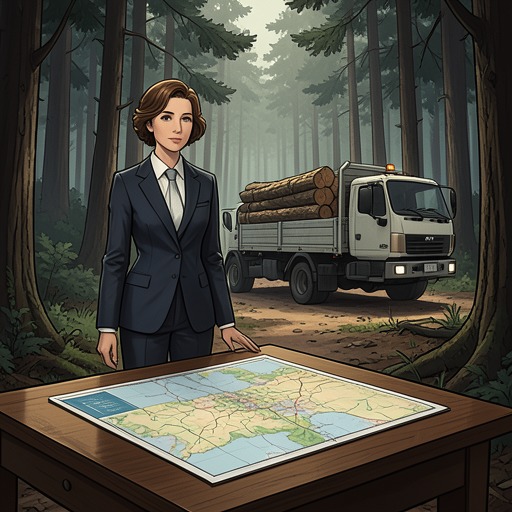
The property changes as the surrounding forest is cut. The old log house, once a substantial family residence, is derided by white settlers as “the wood wigwam,” while larger painted houses rise around the bay. Beatrix sells the stumpage from the woodlot; after the trees are gone, the house stands exposed and decaying. With its roof and sills in need of repair, she sells the remaining large pines to pay for the work. The forest’s removal is therefore not an abstract backdrop: it alters the house itself and forces a decision about the land’s remaining value.
When Dr. Mukhtar visits, he recognizes that Beatrix has advanced stomach cancer and tells Elise that nursing her alone is exhausting. His questions extend beyond Beatrix’s illness to the family’s circumstances, their food, and how they came to live in the house. Elise understands from the diagnosis that the illness will end fatally. Beatrix’s final period is thus shown partly through the labor of care around her, especially Elise’s, which she later acknowledges in her will.
Will and Family Legacy
Beatrix is buried in the plot Outger had laid out behind the house. After the funeral, the judge reads her will to the assembled family. She leaves the house, furniture, and property to Elise, both in gratitude for Elise’s care and in atonement for having sent her into an unhappy marriage when she was young. Her books go to Dr. Mukhtar. A secret pine woodlot in northern Maine, forty thousand acres in extent, goes to her sons Francis-Outger and Josime. The distribution distinguishes the home and its daily contents from the large forest property, placing responsibility for each in different hands.
Kuntaw receives two of the family’s five horses, a red English wool blanket he had always liked, and a letter. He laughs briefly after reading it, then falls silent; the letter puzzles him even as it makes him laugh. Her bequests to Amboise and Jinot are smaller but intimate. Amboise receives a watercolor Beatrix painted of him, Elise, and Jinot beneath the apple tree, along with five gold pieces in a deerskin sock. Jinot receives the four-inch stuffed horse she made for him the day after Tonny brought the children to her house, as well as coins and a note in her unsteady hand: “Remember me.” The objects preserve particular acts of attention: the children’s shared portrait, the toy made at their arrival, and the written request that Jinot remember her.
Bloodline and Historical Significance
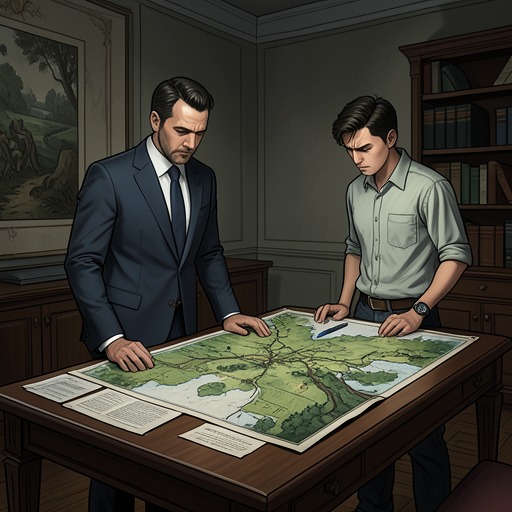
Tetrazinni’s investigation gives Beatrix’s family a significance its members do not necessarily exercise as a claim. He identifies her sons’ grandchildren as Charles Duquet’s only living bloodline descendants and says they would be the rightful heirs if blood relationship alone determined inheritance. He favors the adopted sons’ lines as having a stronger claim to the family fortune, invoking possession as a practical legal advantage. Lavinia, confronted with the report, tells him not to disturb the Canadian situation and closes the investigation. Beatrix’s descendants’ blood claim is therefore disclosed but deliberately left unpursued by the family that controls the business.
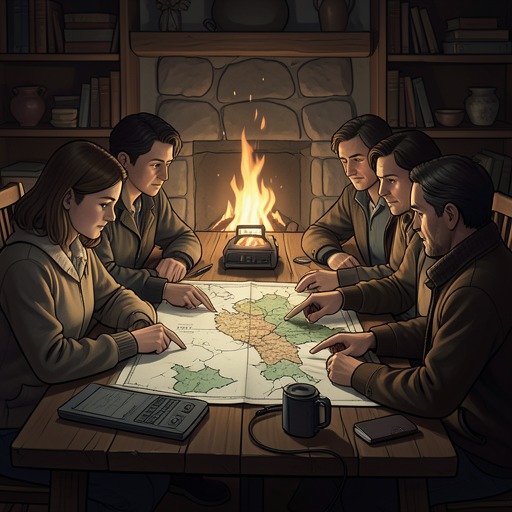
The family’s later movements show that this lineage persists through separation, loss, and attempts at reconnection. After the death of Amboise, Jinot writes to Francis-Outger seeking news of Elise and Josime. Francis-Outger replies that Elise and Dr. Hallagher live in Boston and welcomes Jinot to visit; he also notes that Josime has not written to him. The correspondence turns Beatrix’s children’s scattered households into an active network again, though it cannot undo the distance between them.
Beatrix’s legacy also reaches Aaron Sel, Jinot’s only surviving son. After Jinot leaves for New Zealand, Aaron goes to Mi’kma’ki and the family band of Kuntaw, who had returned to Nova Scotia after Beatrix’s death. Aaron arrives hoping for acceptance but lacks the practical knowledge of the community’s life. At a family gathering, Kuntaw uses a bowl of water and mackerel oil to describe the mixed identity he and Aaron share: the oil rises above the water, and he imagines a future in which Mi’kmaw and white identities might blend without erasing either. Beatrix does not speak in this later scene, but her marriage and family history stand behind the kinship through which Aaron seeks belonging. Her descendants embody a line that the Duke business can describe in terms of blood and property, while the family’s lived inheritance also consists of care, memory, and the difficult continuity of Mi’kmaw identity.