Felix Mius
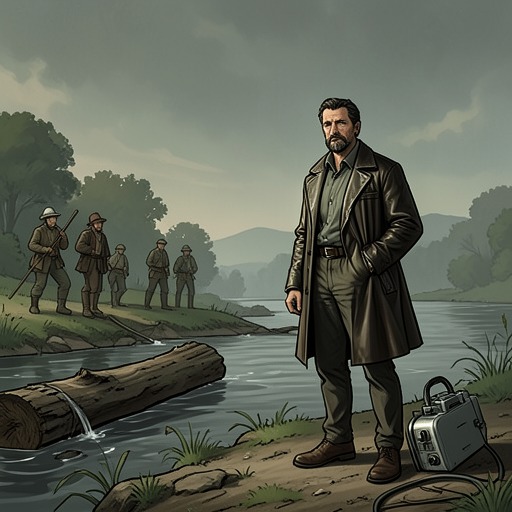
BarkskinsFelix Mius’s story follows a young Mi’kmaw man from an ambition to study forestry into the first work of forest restoration. Beside his cousin Jeanne Sel, he moves from books and uncertainty toward fieldwork with Sapatisia Sel’s team. His defining turn comes when the destruction described by a conservationist ceases to be only a subject of study: a fellowship and a place in a replanting project make it possible for Felix to begin acting on what he has learned.
Identity and Early Formation
Felix grows up alongside Jeanne, a year older than he is, in a relationship shaped by familiarity and difference. They know one another’s childhood thoughts, but as they mature their paths begin to diverge. Felix’s quiet manner belies an agile, exploratory mind; his early romantic interests tend toward older women who do not return his attention, while Jeanne considers herself apart from romantic entanglements. Their closeness is a durable feature of his life, but the narrative does not make it a romance.
One formative shared memory takes place at Kejimkujik Provincial Park, where their aunt Mary May explains that the land was once Mi’kmaw territory. Beneath old-growth hemlocks, Felix attends closely to the undersides of branches, the ferns growing in deep shade, and the trees themselves. Jeanne remembers the day as satisfying and unforgettable. The scene establishes the cousins’ shared attentiveness to the living world, while giving Felix a particular early experience of looking closely at forest life.
Education and Shared Ambition
In high school, Felix decides to pursue forestry. The example of Jackson Mius, who had logged in Maine and later earned a forestry degree and worked in state forest research, makes that path seem achievable. Jeanne, meanwhile, discovers an interest in botany. Both hope to attend university, although they must first complete two years at community college, and the odds seem against them.
After graduation they move into Aunt Alice Sel’s home in Dartmouth, enroll at community college, and take part-time jobs. Alice’s house also serves as a child-care center and a temporary home for young Mi’kmaq adjusting to urban life. The crowded household is a setting for the cousins’ demanding studies as well as their mutual support. Alice describes them as trying hard at school and says it is good that they have each other, like brother and sister; she dismisses another relative’s worry about their closeness as misplaced.
The academic route is difficult. Felix dislikes the required remedial English grammar and composition because he sees it as irrelevant to forestry, though he is not opposed to learning. He and Jeanne work intensely, including early-morning sessions at the computer to learn Mi’kmaw words from Listuguj speakers’ pronunciations. Their efforts are imperfect, and Alice sometimes interrupts to criticize them, but the attempts show them trying to reconnect with a language neither speaks fluently.
From Environmental Concern to Action
A rare break from studying brings Felix and Jeanne to a lecture by Dr. Alfred Onehube, a militant ecoconservationist. Several people connected to timber production leave, but the cousins listen as he describes forest damage, including the effects of postwar DDT spraying during a spruce budworm infestation. The insect outbreak had once been part of a cycle in which dead trees fell, fire followed, and new growth emerged; spraying DDT instead killed small aquatic organisms that fed salmon in the Miramichi River. Onehube’s account makes the scale and consequences of forest management hard for Felix and Jeanne to treat as abstractions.
Afterward, when Felix hears a dismissive remark about Onehube, Jeanne says she feels helpless and asks what they can do beyond filling their heads with words. Felix cannot offer an answer. Their uncertainty becomes a turning point rather than a resolution: Jeanne revisits a profile of Sapatisia Sel and suggests that they seek her out, believing she may know how Mi’kmaw medicine plants and knowledge could help the forest.
They eventually find Sapatisia working among rocks near a lighthouse, with a trowel and an open notebook. Felix is the first to spot her. Their meeting connects their environmental concern to a person engaged in practical knowledge and conservation, and it changes the scale of what seems possible for them.
Fellowship and Fieldwork
The opportunity takes concrete form when Felix receives a letter from the Breitsprecher Tree Project. It awards him a five-thousand-dollar fellowship and instructs him to contact Dr. Sapatisia Sel within ten days. The check is made out to Felix Sel. He reads the letter repeatedly, retrieves the check from beneath the table, and realizes that the woman Jeanne had urged him to find is the project’s doctor. Jeanne receives an identical letter. Felix urges her to make the call because she was the one who connected them with Sapatisia.
Sapatisia explains that the project works with as many as thirty conservation groups. Its Nova Scotia crew has six members and a substantial season’s work ahead: planting trees, visiting ecoregions, and monitoring test plots for as long as ten years. The work includes tracking chlorosis in a plot planted three years earlier and investigating how mycorrhizal fungi affect seedlings. Burned soil can lack these fungi, which help seedlings absorb nutrients and minerals. Felix and Jeanne take notes as Sapatisia lays out a program that joins field observation with sustained scientific monitoring.
For Felix, the fellowship is more than financial assistance. As he considers soil types and the millions of future tree cutters who may depend on forests, he recognizes the project as the beginning of a vocation. He has reached forestry work without yet crossing the conventional barriers of college and university. The conclusion is deliberately a beginning: he stands at the edge of the forest, starting work that he believes cannot simply be taken away from him.
Relationships and Longer Ecological Vision
Jeanne is Felix’s closest companion in the transition from study to action. They share ambition, difficult coursework, language-learning efforts, and the disquiet produced by Onehube’s lecture. Yet the narrative gives them distinct responses: Jeanne initiates the search for Sapatisia, while Felix later recognizes the fellowship and fieldwork as his own entry into forestry. Their bond helps make that transition possible without erasing their separate aims.
Felix’s developing outlook also belongs to a larger argument about the timber industry and time. Earlier forest businesses treat the forest as an apparently inexhaustible supply: the discovery of Michigan pine prompts James Duke to imagine a thousand men cutting it, while Armenius Breitsprecher sees the acquisitive hunger behind that response and fears clear-cutting, waste, soil erosion, and the assumption that another forest will always be available. Felix’s eventual work stands in contrast to that extractive logic. The story does not claim that he has solved the industry’s problems; it gives him the more limited, practical task of learning how seedlings survive and how restoration can be made effective.
The novel develops that contrast across generations. Dieter Breitsprecher argues for setting aside and managing cutover land, while his correspondence with George Perkins Marsh sharpens attention to what happens to soil, water, and birds after trees disappear. Dieter’s insistence that seeds should be planted for a world and for people not yet born gives the same long view a personal form. Felix’s first forestry work continues that horizon in another generation: he thinks beyond the immediate job to the future demand for timber and to the conditions seedlings need if a forest is to return. His arc makes ecological responsibility an apprenticeship, measured not by a single victory but by the work of learning, planting, and sustaining forests over time.