Vernon Roby
BarkskinsVernon Roby is a logging contractor whose changing relationship with Lavinia Duke brings the hierarchy of the lumber camp into direct contact with her claim to manage Duke & Sons’ business. He first challenges her authority as a woman, but her practical competence and the power to retain or dismiss him alter the terms between them. When her father, James Duke, dies in a shipwreck, Roby responds to her request for help with an act of loyalty that refuses payment.
Identity and Work
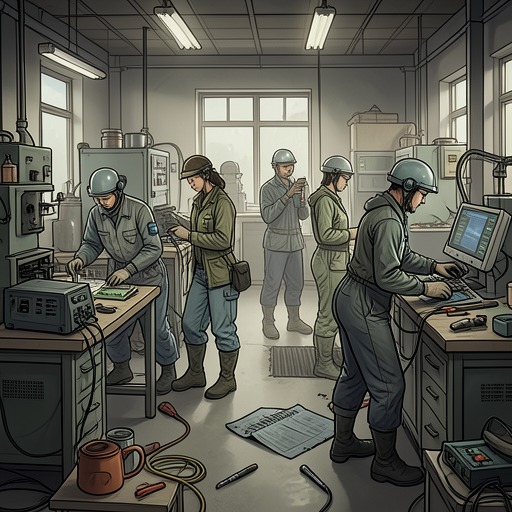
Roby runs a logging camp for Duke & Sons, where the landscape itself records the scale of the operation: when Lavinia visits, the clearing is ringed with forest except along the shore, and stumps extend as far as she can see. The camp office is empty, and the cook is occupied preparing a meal for the arriving workers. In this working environment, authority is practical and immediate: the spring log drive, the landings, the cutting, and the daily management of the crew are the matters Lavinia has come to inspect.
Roby’s business belongs to a dangerous system of extraction and transport. Logs have to be moved from the woods to the sawmill, and water is central to that chain. A camp boss elsewhere explains that the company must bear the cost of the drive because there is no other way to get logs to the saw house; the scene shows Mi’kmaq and Montagnais workers guiding logs on the river. The broader trade changes as technology advances: axes give way to saws, oxen to horses and engines, and river drives to roads and trucks. Roby’s camp is part of this labor system, where production depends on workers facing substantial risks and where Indigenous people are assigned especially dangerous river work.
Lavinia’s Inspection
Lavinia arrives at Roby’s camp with Andre Roque after the death of her uncle Lennart Vogel, who had previously worked with the contractors for Duke & Sons. When Roby appears, he is a short, heavyset man with an eye patch and thin scars. Rather than greet Lavinia as the person sent to inspect the operation, he asks Andre what she is doing there and insists that logging is not women’s business. He tells her to pack her things and leave, and asks where Vogel is.
Lavinia answers by establishing both the change in personnel and the scope of her authority. She says she has already written to Roby that Vogel died in a fire, and explains that she is assuming some of his duties. She does not claim expertise she lacks: she acknowledges that she may be ignorant at first and says she hopes they can speak frankly and honestly. But she is clear that she has come to know the men cutting for the company, inspect the cut and landings, hear Roby’s plan for the spring drive, and learn about present or anticipated problems. She also makes plain that she has authority to fire or retain him. Roby takes a moment before answering, then agrees formally, while trying to restore some familiarity with Andre, whom he recognizes as a former worker.
The meeting makes their contest over authority concrete rather than abstract. Lavinia cannot yet assess every technical detail of the operation, but she can insist on being shown the work and can question the contractor who manages it. Roby’s initial dismissal meets a woman who is prepared to learn the business and has the power to act on what she finds.
Judgment and Camp Authority
Lavinia’s attention to the crew is not limited to production figures. She asks Roby to identify a chopper wearing a red tuque, whom he calls Rattle, and tells him to dismiss the man. Roby later explains that Rattle is a source of agitation among the workers, pressing for higher wages, shorter hours, and better food. The order shows Lavinia exercising authority over labor relations as well as the inspection of timber and the coming drive.
Roby initially treats Lavinia’s presence as an intrusion, but her decisions change his assessment. When she later counts and sizes logs, she recognizes that a total number of logs and an average diameter cannot establish how many boards the timber will yield. She wants to learn scaling: how bark, the saw kerf, and the taper of a log affect the estimate. No rule, she understands, can perfectly account for every tree. Her willingness to pursue the technical knowledge she lacks, alongside her capacity to judge people, shapes the way she approaches the camp.
By the time Lavinia leaves, Roby has accepted that she will return in spring to watch the drive carrying her logs to the mill. He catches the proprietorial force of her language and responds with a smile. After she and Andre disappear among the trees, he calls Rattle over and dismisses him, telling him that the lady does not like his looks. The dismissal follows Lavinia’s request, but Roby’s explanation is his own; his decision demonstrates that her authority has become effective within the camp.
Loyalty at the Wreck
Roby reappears after the shipwreck in which James Duke is killed. Lavinia and Cyrus Hempstead make the difficult journey to the shore, where they find the frozen bodies of passengers and crew. Lavinia recognizes her father among them and turns to a man salvaging wreckage, then realizes that he is Roby. She asks him to help have James brought to Detroit for burial and offers to pay him.
Roby is shocked to learn that the dead man is Lavinia’s father. He agrees to help as soon as they can, but refuses payment. His response contrasts with the commercial relationships that ordinarily define his work: the contractor who had challenged Lavinia’s right to direct him now offers personal assistance at a moment of family loss. Lavinia tells him she will never forget the kindness.
Narrative Significance
Roby’s arc is brief but marked by a clear reversal. At first, he treats Lavinia’s gender as a reason she cannot belong in the camp’s business; then he acknowledges her authority, carries out her decision about a worker, and later answers her appeal with generosity. The shift does not erase the harsher structures surrounding the camp. Logging remains a system organized around timber extraction, dangerous transport, and unequal assignments of risk. Instead, Roby’s encounters with Lavinia show how authority can be contested and renegotiated within that system—and how a working relationship can become an occasion for loyalty beyond payment or contract.