Etienne Sel
BarkskinsEtienne Sel, a Mi’kmaw man and Jinot Sel’s uncle, joins Joseph Dogg on a journey from Mi’kma’ki to New Zealand to find his nephew and, if possible, return him to his homeland. The search does not end in reunion: Jinot is dead. Instead, Etienne’s encounters abroad and his return home expose a larger struggle over kinship, land, and the knowledge needed to sustain a community under colonial pressure.
Identity and Family Background
Etienne identifies himself as Jinot’s uncle, though Jinot is many years older. Their family history reaches back to Kuntaw, Etienne’s father, who left the Penobscot area after his first marriage to a white woman and returned to Mi’kmaw people near the Sipekne’katik River. Kuntaw later took two wives, one of them Etienne’s mother. Etienne’s account makes kinship a record of movement: the family’s connections survive even as successive generations are separated from their places of origin.
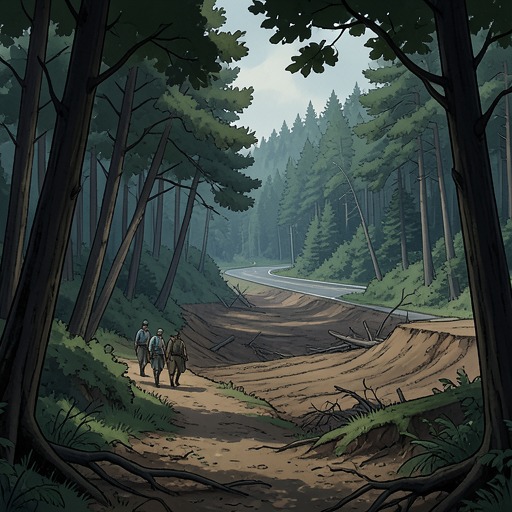
Etienne explains that settlers destroyed the family’s eel weirs and burned their wikuoms. When the government gave their reserve to Scottish settlers, Kuntaw led his family across the water to K’taqmkuk, where they found rivers suitable for eels, other fish, and Mi’kmaw people. The rough country offered some protection because white newcomers were less interested in it as a source of profitable development. This history informs Etienne’s distinction between land that sustains Mi’kmaw life and land valued by outsiders chiefly for what can be extracted or sold.
The Search for Jinot
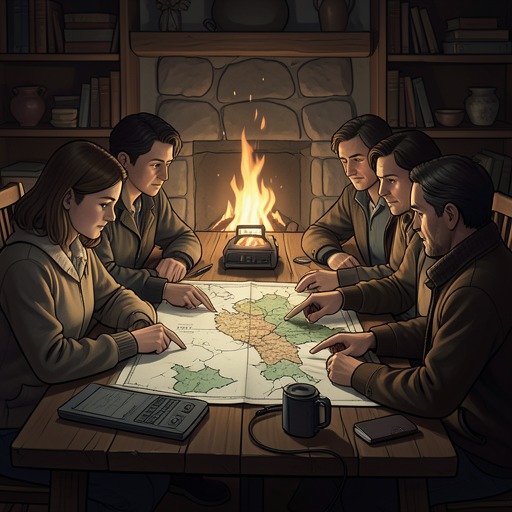
Etienne travels with Joseph Dogg to recover Jinot and take him back to his home country. In New Zealand, Joseph explains to the trader that Jinot was not merely Albert Bone’s servant: Bone had favored him as a friend and business associate and left him his works and possessions, including an axe factory in Massachusetts. If Jinot is dead, Joseph reasons, Bone’s holdings may pass through Jinot’s estate to Jinot’s son, Aaron. Etienne’s purpose is not reducible to inheritance, however. He insists that Jinot’s remains should be found so that he can be returned to the land where he began.
The pair learns that Jinot died of blood poisoning after injuring his foot while working as a bushman. Arana Palmer, who knew him, supplies a fuller account: Jinot had wanted to return but had no money, and the work of cutting kauri was beyond what his age and impaired mobility could comfortably sustain. Jinot knew how to use an axe, yet he did not want to cut the kauri trees; he regarded them as trees of power. Etienne and Joseph are directed to Arana, who may know where Jinot was buried, but the evidence does not establish that they recover his grave or remains.
Etienne’s narration of the family’s migration also explains how the search became difficult. Aaron had spent two years with the Mi’kmaw community before going to Boston; Etienne and Joseph could not find him there. Etienne therefore continues the journey to New Zealand without Jinot’s son, carrying the family’s claim and the responsibility to report what happened.
Encounter with Māori Knowledge
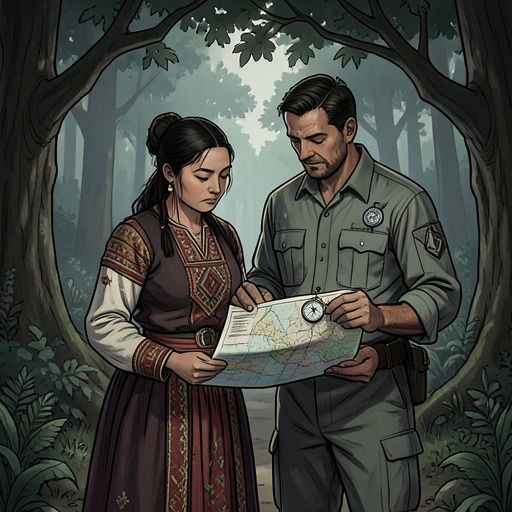
Arana offers to show Etienne and Joseph the forest with his sister Kahu and their young cousin Aihe. In the forest of Tāne, Kahu identifies the layered canopy, while the visitors observe how the rata grows from other trees and eventually incorporates its host into its own trunk. The excursion introduces Etienne to a landscape interpreted through a dense body of Māori knowledge rather than treated as anonymous timberland.
At a lookout, Aihe explains the mist through the story of Papatuanuku, the earth mother, and Ranginui, the sky father. Their children separate them to let in light, while Tāne, the forest god, holds them apart with trees. Aihe also shares stories connected to dangerous plants and small creatures. Etienne is impressed that what the group sees, hears, and smells is linked to the lives of Māori gods. Asked for Mi’kmaw stories, he remembers several imperfectly and stays silent, feeling that they would seem diminished beside Aihe’s accounts. He thinks that the Mi’kmaq have lost their spirit world to the missionaries’ God.
That contrast becomes a prompt rather than a conclusion. Etienne resolves that, on returning to K’taqmkuk, he will seek out elders and ask for ancestral stories. His attention to Māori traditions turns the encounter into an occasion for recognizing the importance of his own community’s knowledge, and for acting before its remaining bearers disappear.
Return, Community, and Land
Etienne and Joseph work their passage to Port Jackson, wait for a ship to London, and continue to Boston. Etienne’s stated aim remains finding Aaron. The journey thus closes not with a recovered past but with a renewed obligation to the living family and community left behind.
Years later, Aaron returns to the Mi’kmaw community after years at sea. Etienne receives him, but Aaron has difficulty fitting into a life whose practical knowledge he lacks: he cannot repair an eel weir, identify local plants, or hunt the animals he expects to find. Etienne offers to teach him by taking him to the river, but even the work of fitting rocks and placing stakes defeats him. The episode sets inherited belonging against the skills that make belonging workable; kinship gives Aaron a place, but it cannot by itself supply the knowledge he has not learned.
At a community gathering, people pass the traditional talking stick through a day and into the following night before naming their problems: food, lost territory, oppressive laws, and the disappearance of skilled canoe makers. Etienne takes part in the discussion about the scarcity of women and the need to welcome women into the community. When the group learns of Louis and Sarah Paul, Peter recognizes Louis as a younger, able fisherman and proposes bringing the couple to the community. Etienne joins that practical response to dispersal: sustaining a people requires more than lamenting losses; it requires finding and welcoming those who might strengthen communal life.
On the way toward Sydney, Etienne is struck by a white man’s shot. Later, as Aaron removes the pellet from his shoulder, Etienne identifies the men as land-seekers who clear and burn whatever they can obtain, then sell it to settlers unwilling to do the clearing themselves. He warns that outsiders remember routes into a country and may later come to want the land they were first shown. Yet Etienne also describes the community’s cooperage: its workshop, forge, oak planks, steamer, and plane produce barrels, washtubs, kegs, casks, and tubs for sale. The contrast is important. Mi’kmaw people are not outside economic life; they make and sell goods while trying to protect the land and forms of life that sustain them.
Narrative Significance
Etienne’s arc links family search, cultural memory, and the defense of place. He travels far to bring Jinot home, but the journey reveals a loss he cannot reverse and a living responsibility he can still accept: seek the elders’ stories, teach and welcome relatives, and remain alert to the economic practices by which outsiders turn access into possession.
His encounter with Māori forest knowledge also complicates any simple equation of cultural continuity with isolation. Etienne learns from another Indigenous community without treating its traditions as his own, and the comparison makes him more conscious of what has been interrupted among the Mi’kmaq. His narrative consequently measures loss not only in territory or deaths, but in weakened access to stories, skills, and relations with the natural world. The work of recovery remains collective and practical, carried by memory, teaching, migration, and the effort to keep a community together.