Kuntaw
BarkskinsKuntaw’s coming-of-age begins with a small bow and the promise of a hunt, but his passage into adulthood is interrupted by the destruction of his home and family. As Achille’s eldest son, he learns to hunt and travel as a Mi’kmaw man; after English settlers occupy the family’s home place and his mother and younger siblings are killed, he is driven from Mi’kma’ki into a life of separation, wage work, and searching. His arc links a formative apprenticeship in the land to the repeated losses of displacement, while later generations know him through fragments of news about his journeys and family.
Identity and early apprenticeship
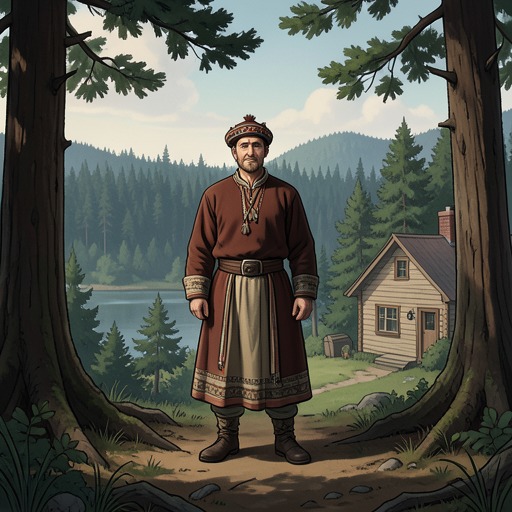
Achille names his eldest son Kuntaw after a powerful stone marked with bright copper specks. When the boy has survived three winters, Achille makes him a tiny bow and miniature blunt-ended arrows. At first Kuntaw imitates his older cousin Auguste, who already knows how to kill birds and frogs. His arrow travels only as far as his shadow, but later in the summer he manages to shoot a grasshopper. Achille and the family treat this modest success as a hunter’s first achievement: the grasshopper is displayed on birch bark, and the family celebrates with a feast and dance. The scene establishes an education in which skill is learned through practice and recognized through communal ritual.
By eleven, Kuntaw longs to marry Malaan, but he must first kill a moose. Auguste jokes that he could find a giant grasshopper instead; Achille instead takes both boys north, toward the taiga and tundra. The expedition is not simply a test of strength. Achille guides them into unfamiliar hunting country, teaching them how to read its conditions and live from it. Before they leave, he packs flint and fire-starting fungus and seals hot coals from the home fire in three clay-lined clamshells, so each traveler can carry a coal and quickly rekindle a fire. He insists they hunt with bows, arrows, and spears, not European firearms: the journey is a deliberate practice of Mi’kmaw identity as well as a hunt.
The northern hunt and coming of age
The journey begins with successful hunting. On the third day, Auguste shoots a swimming beaver and dives to retrieve it; before he reaches shore, Kuntaw shoots another. The boys and Achille eat well that night, and the party continues through a country that renews their attention to the living world. Achille gathers willow and kinnikinnick leaves as they walk, allowing the stems to cure on his pack basket. At night the travelers smoke their pipes and tell stories. Kuntaw sees his father’s knowledge as more than practical expertise: Achille understands the forces that bind animals, spirits, people, fish, trees, ocean, winter, and clouds together.
The hunt also teaches Kuntaw the physical demands of taking and carrying large game. When the party is short of food, Achille, Kuntaw, and Auguste bring down a large black bear. Achille guts it, leaves what the wolves can use, binds its hind feet to its front feet with sinew cords, and carries the animal back to camp across his shoulders. He makes the boys examine his deep footprints, explaining that a track can disclose the burden a person carries—supplies, fur packs, or a bear. The lesson makes attention to traces part of Kuntaw’s apprenticeship.
The defining test comes at a lake near the northern edge of the birch forest. Kuntaw and Achille approach a young female moose slowly, but she hears them at a distance. Achille tells Kuntaw to wait until the animal is sure no one is nearby, then signals that she will feed along the shore and come within range. Kuntaw raises his bow and kills her. Achille declares him a man and shows him how to bring the animal back: father and son tie sinew cords around its neck and tow it through the water along the shore. Auguste gives Kuntaw a new name, Moose Killer, replacing Grasshopper Slayer. The recognition fulfills the condition that had stood between Kuntaw and marriage, while marking his entry into adult responsibilities through skill and shared labor.
Dispossession and separation from Achille
The summer journey ends with early frosts warning the hunters to turn back. It remains in their memories, but its recollection is marked by grief as well as the wonder of the north. On returning to Achille’s home place, the hunters find two hundred English settlers cutting trees and building log houses where his wikuom had stood, with thirty armed soldiers guarding them. Achille’s wife Isobel and his younger children have been killed, and the family dwelling burned. The soldiers seize the moose meat; Achille is wounded, and Kuntaw recognizes his mother’s hand among the remains. He pulls his father away and urges him to run, understanding that they too may be killed.
After reaching Elphège’s wikuom, Kuntaw weeps as Achille withdraws into shock and grief. The violence destroys more than a household: it overturns the world to which Kuntaw had just returned from the northern hunt. Several days of funerals, mourning, and deliberation follow. Kuntaw passionately says he will go with his father, and Auguste also offers to join them. Achille, however, decides to leave alone first and tells the young men to stay with Elphège until he sends word. He has to find a safe place and be alone with the memory of what happened. Kuntaw’s wish to remain beside his father is thus met with another separation, imposed by the need for survival and Achille’s isolation.
Search, work, and family
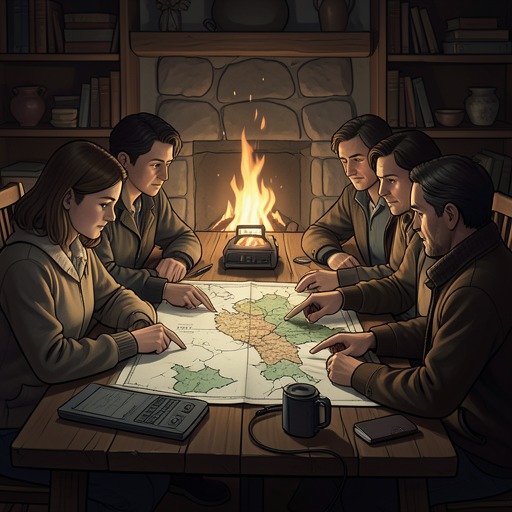
Years later, after difficulties with his wife Malaan, Kuntaw leaves her and their son Tonny in Mi’kma’ki and travels south to search for Achille. He follows rumors through the Maine logging camps, where he hears of a hunter and skilled axman called Sheely, whom he suspects might be his father. He learns that Sheely is working in New York State, cutting pine on the Raquette River, and imagines joining his father’s crew. If they met, they might drive logs to Montreal and then return together to Mi’kma’ki by trade canoe, walking when the river became impassable. The plan reveals how Kuntaw’s hope of reunion is bound to the routes and labor of the logging economy.
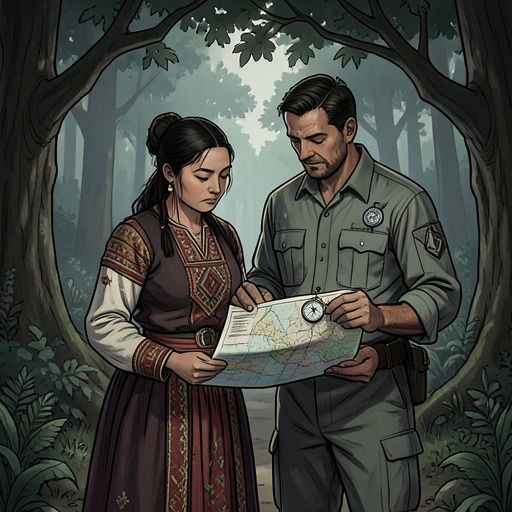
In the spring of 1758 he sets out for the Raquette River, but the changing snow and mud make the journey slow. When he reaches the river, French loggers tell him Sheely has already gone with the first logs, perhaps toward Montreal, New Brunswick, Newfoundland, or somewhere more distant. Kuntaw turns back toward Maine to find work on the spring drive. He does not find Achille; the text makes the failure of the search a consequence of the mobile logging camps, where a rumor can be accurate and still arrive too late.
Kuntaw eventually marries Minnie Boss. Their twin sons, Amboise and Aaron, resemble Kuntaw more than Minnie’s father, Hugh Boss. Their birth briefly gives Kuntaw a sense that he has become like other men and can nearly understand truths that once seemed mysterious. That confidence does not last. The family’s later story is marked by loss: Jinot tells Elise that Amboise died in the Great Miramichi Fire, though he does not mention the circumstances that surrounded the death. The children’s lives and the family’s separations extend the consequences of Kuntaw’s earlier displacement into the next generation.
Family memory and narrative significance
Kuntaw remains important even when absent from the scenes that concern his descendants. In a conversation with Elise, Jinot recalls hearing that his grandfather returned to the old place, now occupied by English settlers except for areas called Frenchtown and the Diggins, where the remaining Mi’kmaw people lived. The account says Kuntaw married a Mi’kmaw woman there and had more children. The news enlarges Jinot’s understanding of his family history: the grandfather he had known chiefly through stories had made a life elsewhere, with another household in the homeland from which Jinot’s own family had become distant.
A later encounter in New Zealand brings Kuntaw back to Jinot through an image rather than a confirmed reunion. At a shore station, Jinot sees Māori people selling tattooed enemy heads to European sailors and thinks of Kuntaw, imagining that his grandfather would laugh at the grim sight as though it were nothing. Jinot walks away, afraid that one of the heads might be Mr. Bone’s. The moment does not establish what Kuntaw would actually have said; it shows instead how his remembered character—his capacity to meet horrors with laughter—has become part of Jinot’s private inheritance. Across the family narrative, Kuntaw is at once a hunter shaped by Achille’s teaching, a displaced son who searches without finding his father, and an ancestor whose later life survives in uncertain reports and remembered gestures.