Bernard Duke
BarkskinsBernard Duke, adopted into the family of Charles Duquet and Cornelia Roos, becomes the Duke enterprise’s specialist in naval stores and northern timber operations. Across his life, he is at once a capable builder of the family fortune and a critic of the violence, exploitation, and waste that sustain it. His unfinished search for a successor, his reservations about colonial violence, and his death on a voyage home make him a figure through whom the family’s commercial inheritance appears both powerful and precarious.
Identity and Background
Bernard enters the family from a different beginning than Charles Duquet’s biological sons. After adopting children, Cornelia gives birth to Outger; Duquet then chooses Bernard, an impoverished eleven-year-old boy he finds in France, and takes him to New France to learn about its forests. He writes to Cornelia and Piet Roos that the clever boy is with him in New France and that he intends to bring him to Amsterdam to meet his mother and siblings and receive a proper education. The adoption offers Bernard a route out of poverty, but it also places him within a family whose care is closely bound to its business plans.
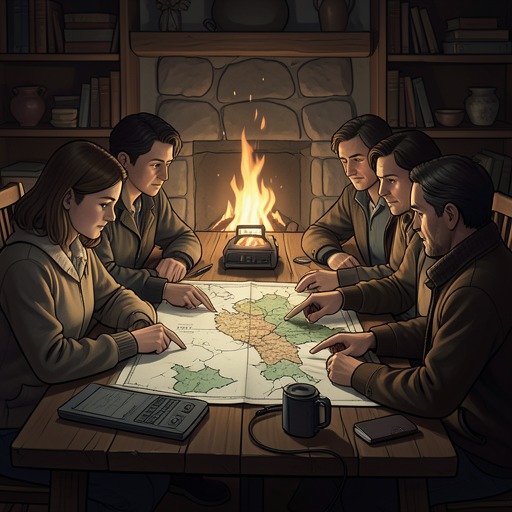
As an adult, Bernard is trained for a specialized role in the company. He travels from the Baltic, where he studies the technical manufacture of pitch and tar, and learns some Swedish and Danish. He is also, like Nicolaus, experienced at sea: both have made several China voyages aboard ships belonging to Piet Roos. In the family’s division of labor, Jan and Nicolaus take responsibility for merchants, contracts, and shipping; Bernard is assigned naval-stores production, while Charles Duquet acquires land and organizes woodsmen and sawmills. Bernard’s expertise is practical and international, built from technical study, travel, and work across the family’s expanding operations.
Building the Business
Bernard’s contribution to the enterprise is not confined to the role Charles assigns him. When he arrives from the Baltic with his Danish wife, Birgit, he recommends that the family enter the Carolina pitch-pine business. The northern company has pitch pine, he observes, but the superior trees grow farther south; he proposes buying and operating a plantation there, using enslaved labor. Charles approves the proposal. The episode makes clear that Bernard’s commercial judgment can be effective while also locating the family’s growth within slavery and plantation exploitation.
Years later, Bernard is still connected to the Carolina operation, though he says he has always preferred the Quebec end of the business. The northern logging enterprises continue, while his nephew Piet manages the plantation and its two hundred enslaved people, producing pitch and tar despite English restrictions. Bernard’s answer to questions about the enterprise is matter-of-fact, but the arrangement reveals how the family’s business has spread across distinct systems of labor and law, with Bernard’s own technical specialty persisting as responsibility passes to the next generation.
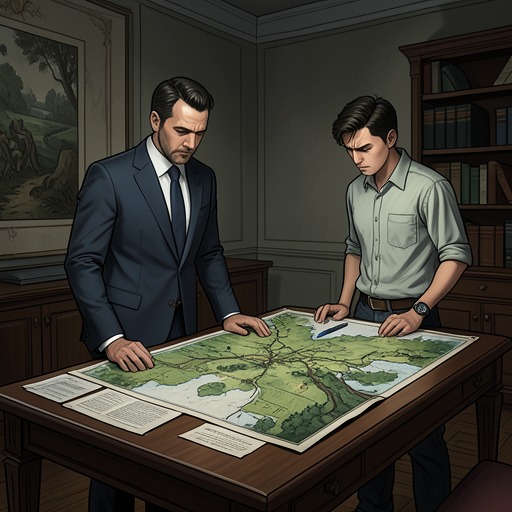
The company also depends on Bernard’s skill in judging timber. At fifty-five, he worries that no family member can take over the landlooker’s work: assessing stands, estimating cubic volume and board feet, and distinguishing usable timber from defective trees. Sedley has accompanied him, but the technical calculations defeat him. Bernard distrusts outside surveyors because some submit false reports, accept bribes, misrepresent rotten trees as sound, or claim to have surveyed land they never visited. In one case, Duke cutters arrive to find a thousand old stumps left by timber thieves; in another, a supposedly forested township has been reduced to ashes. For Bernard, careful measurement is not an abstract skill but the basis of the company’s decisions and a defense against fraud, theft, and costly mistakes. His concern for succession is therefore also a concern about whether the family can preserve the knowledge on which its land empire depends.
Marriage and Family Standing
Bernard’s marriage to Birgit surprises the family. He had been remembered as an exceptionally handsome young man, and Cornelia imagined that he might be the child of a French aristocrat and a seamstress. Birgit comes from a Baltic or Scandinavian country—the family never settles which—and tells Mercy she was born near Denmark’s Kongeegen tree. Though Bernard’s appearance changes with age and he limps, the marriage lasts nearly thirty years and remains childless. Birgit keeps an orderly household and is known for her cooking, which she undertakes herself rather than leaving entirely to enslaved workers.
At a Boston gathering after Forgeron’s funeral, the brothers’ different attachments to family and company come into view. Jan, Nicolaus, and Bernard carry the pine casket with the bookkeeper Henk Steen, while Outger refuses to leave Penobscot Bay or surrender the enormous pine table he says he needs for his work. Bernard regards Outger as unreliable, but the contrast is telling: Bernard’s identity is bound to the measurable, practical business of timber, while the table—an object made from a remarkable tree—has become, for Outger, something other than company property. Bernard’s own authority is substantial, yet the family’s succession is already fractured by different ideas of what its inheritance means.
Colonial Violence and Moral Conflict
Bernard’s commercial position does not erase his awareness of the violence around the timber economy. At a discussion of Indigenous land use and settlement, he hears the claim that Indigenous people fail to use land properly because they hunt and roam instead of clearing and cultivating it. He does not openly challenge the speaker, but privately recalls that King Philip’s War was not a whim: Indigenous people fought to retain their land and lost it. He questions why hunting and gathering should not count as using the land. His silence marks a limit as well as a recognition: he sees the injustice in the argument, yet remains inside the business and colonial society that benefit from dispossession.
He also remembers Forgeron as a contradictory figure—someone who took part in scalping Indigenous people for bounty while maintaining Indigenous friendships. Bernard repeats Forgeron’s view that the fur trade had hindered New France by drawing capable men away from settlement and development, but also notes that Forgeron urged the company to retain a small stake in fur trading. Bernard’s recollection refuses a neat division between commerce and conscience. The same business can criticize one economic system as an obstacle to development while continuing to profit from other forms of extraction and colonial power.
When war threatens the company’s Quebec woodlands, Bernard argues that New France has strong militia forces, capable regional troops, and Indigenous allies, and contrasts local woodland tactics with the European-style sieges and rigid lines he associates with Montcalm. His defense of New France is both strategic and personal: he resists the assumption that the territory will simply fall, and speaks with a familiarity that makes others suspect his attachment to French Canada. The exchange shows how his divided commercial and cultural position can itself become politically suspect in Boston.
Death and Legacy
Bernard’s technical authority makes the question of succession urgent, but the family’s arrangements are overtaken by the war and by his own mortality. In 1758, he travels with Nicolaus, Jan, Outger, Piet, and George Pickering Duke aboard the Dutch merchant frigate Bladwesp, which is carrying the company’s dike timbers from Boston to Amsterdam. Bernard hopes to stop at La Rochelle for business, but wartime danger rules that out; the party must make for Amsterdam. Sedley remains in Boston because his wife Eugenia is gravely ill after giving birth, a private family crisis unfolding alongside the company’s hazardous voyage.
During the crossing, Bernard’s already bad leg worsens. Hot-water soaks fail; sores develop, and he becomes too ill to leave his bunk. The ship’s surgeon says the leg must be amputated, but disappears after his medical supplies are found missing. Nicolaus returns to Bernard and understands that his brother will not reach home. Three weeks out from Amsterdam, Bernard is buried at sea. Back in Boston, Nicolaus sends word to Jan, Piet, and George Pickering and demands their immediate return.
Bernard’s death ends the life of the family member most capable of evaluating its timber holdings and leaves his central concern unresolved: there is no prepared successor for the landlooker’s work. His career also anticipates the company’s later conflicts over the future of forests. The broadening enterprise is described as driven by an acquisitive hunger to clear more land, with waste, soil loss, and the assumption of endless timber treated as consequences to be ignored. In later generations, Dieter’s conservation division and planting plans, and Conrad’s effort to connect forestry knowledge with seedling production and site preparation, offer a contrasting time horizon: forests must be managed for people who will not live to see the trees mature. Bernard’s own story does not resolve that conflict, but his expertise, misgivings, and uncompleted succession place its human and institutional costs in view.