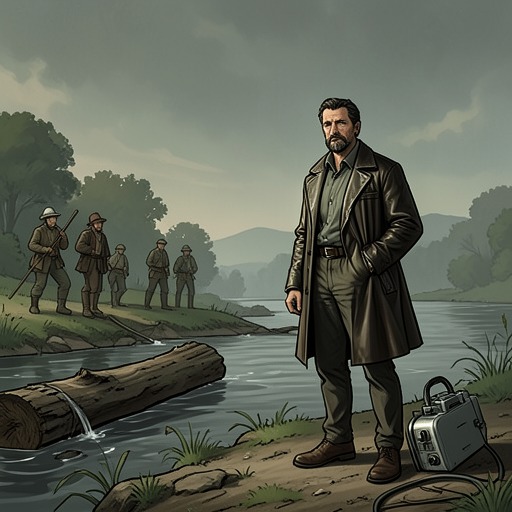
Simon Marchand
BarkskinsSimon Marchand is a Maine logging subcontractor who hires Jinot Sel and directs his work in a camp built around cutting oversized trees and driving logs down the Penobscot. Through Marchand’s decisions and camp routines, the novel presents lumbering as both a skilled, tightly organized trade and a system that exposes workers—especially Indigenous rivermen—to persistent danger.
Identity and Work
Marchand has taken on a tract of aged, exceptionally large trees that most lumbermen consider too difficult to reach and handle. The timber stands on a gullied ridge, and he estimates that preparing access will take two seasons: the crew must cut a track for an ice road before the largest logs can be moved. His judgment is practical rather than romantic; the trees are valuable, but getting them to market requires time, planning, and coordinated labor.
The narration depicts Marchand as a self-made, physically hardened woods boss who has worked his way upward and remains combative. He is also religiously strict about profanity. He will not permit holy names to be used as curses in camp, and he explains misfortune among loggers as punishment for swearing. The men adapt by using substitute curses, making his rule part of the camp’s everyday discipline.
Jinot and the Camp
After a year working as a swamper and limber in a worn-out Penobscot camp, Jinot signs on with Marchand as a chopper and riverman. Marchand’s operation gathers workers from across the region and beyond: coastal and northern men, French Canadians, Passamaquoddy and Mi’kmaq workers, and others moving between Maine and Quebec. Its rough, temporary buildings and crowded sleeping arrangements reflect an industry in which the workforce assembles around a contract rather than a settled community.
The camp’s daily schedule is demanding and repetitive. Men rise before daylight, eat simple meals, walk to the cut with sharpened axes, and return near dark to sleep on the crowded floor. During the coldest mornings, they keep their axe heads beneath their jackets so the steel will not freeze. After the spring drive, many spend their wages in nearby towns and wait for another contractor to hire them; Jinot, too, alternates camp work with returning to his family home.
Marchand’s operation also reveals how racialized assumptions shape the assignment of work. He puts Indigenous and mixed-race workers on the river, claiming that their balance and reflexes suit them to moving logs. His description treats that aptitude as innate, while the novel sets it against the river work’s known fatality risk. The apparent compliment therefore helps justify a labor arrangement that places Mi’kmaq workers in especially dangerous conditions.
River Work and Its Risks
Once the cutting is done, Marchand sorts the rivermen and identifies the dead-water workers, who maneuver logs with long pike poles. Other men use a swinging tool to shift jammed timber. The work requires constant movement and balance: workers run, jump, and ride logs as they try to keep them moving through the river. Marchand points Jinot toward the bateaux, assigning him to the water side of the operation.
The danger is not incidental. Wooden crosses mark the banks, and Marchand acknowledges that workers drown there, Indigenous men no less than white men. The narrative also records injuries and deaths as regular features of logging, and describes one worker’s death in an accident involving shifting logs; the men recover his body and bury him in flour barrels. The incident gives concrete weight to Marchand’s allocation of river labor: the skills on which the operation depends are exercised in a workplace where a mistake or shifting log can be fatal.
A later account of logging expenses makes the economic logic explicit. A camp boss tells a bookkeeper that water moves the logs and powers the mills, and that a company seeking its timber must pay for the river drive because there is no alternative. The river is thus not just a setting for Marchand’s crew but essential infrastructure in the timber chain, and the rivermen’s dangerous labor is a cost the business cannot avoid.
Characterization and Significance
Marchand appears chiefly through his management of labor: he chooses a difficult tract, plans access by ice road, enforces a rule about profanity, and assigns Jinot to river work. His authority is practical and direct, exercised through work orders and camp rules rather than through a larger personal history. When Jinot’s mother dies, Jinot tells Marchand he must leave; Marchand curses at him, but the scene also shows that Jinot informs his employer before going to his family.
Marchand’s camp connects the novel’s account of timber wealth to the people and systems that make extraction possible. The distant market for wood depends on trees felled in difficult terrain, logs moved by river, and workers hired under hazardous conditions. The narrative later shows the industry changing through new tools, machines, and transport, but the underlying dependence on labor—and the unequal distribution of risk—remains visible in the river work Marchand oversees. His role is therefore modest in the broad family history but revealing: through him, the novel makes the logging camp a working system, not merely a backdrop for the forest’s removal.