Conrad Breitsprecher
BarkskinsConrad Breitsprecher is Dieter Breitsprecher’s heir to a small seedling nursery, but he makes it the basis of a different kind of forestry enterprise. By studying propagation, experimenting with tree species, and asking lumber companies to pay for site preparation, he tries to make future forests part of the timber industry’s plans rather than an afterthought. That work also sets him apart from Breitsprecher-Duke: the company uses forest knowledge to expand extraction, while Conrad treats his uncle Charley Breitsprecher’s notebooks and Dieter’s nursery as resources to be protected and used for renewal.
Inheritance and Early Direction
Conrad enters the family story through a divided inheritance. Charley Breitsprecher dies in Manaós after years of work in the Brazilian forest, leaving instructions that his last notebook be sent to Conrad and that his fortune inherited from Lavinia, along with Dieter’s seedling nursery, be held in trust for the boy until he turns twenty-one. The gift is more than money or property: it links Conrad to an uncle he has never met and to an unfinished body of knowledge about tropical trees.
As a child, Conrad is drawn to Charley’s notebooks precisely because they are unlike ordinary boys’ adventure stories. Their pages are grimy and marked with the remains of insects, and their originality makes them compelling to him. Years later, James Bardawulf finds the notebooks full of useful information about tropical tree properties and shows them to Andrew Harkiss. Conrad immediately asks for them back. His attachment is personal, but the papers also carry the danger of becoming commercial intelligence: Breitsprecher-Duke uses them as the company enters the extraction of tropical forests.
Conrad’s relationship with the nursery begins as an alternative to a conventional company career. After the 1929 crash, Breitsprecher-Duke is struggling, and James Bardawulf offers Conrad work without salary, pointing out that he can live on his own money. Rather than simply accept, Conrad thinks about Dieter’s old nursery, which has continued to operate with Alfred McErlane managing the greenhouses. A childhood inheritance that once seemed peripheral becomes the work he chooses to investigate.
Building a Forestry Practice
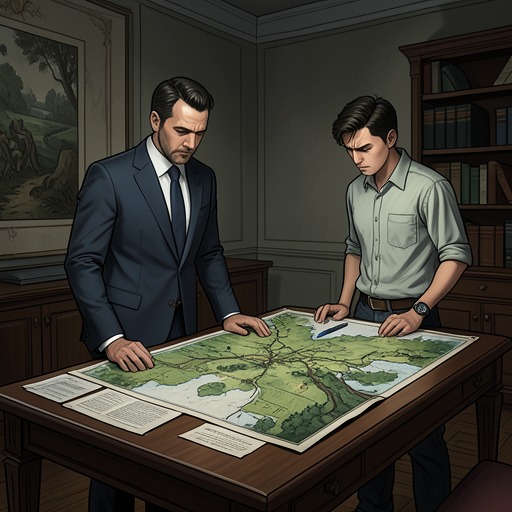
When Conrad returns to the nursery, the operation is still modest: its customers are local parks and private landscaping concerns, its seedlings are mostly spruce and pine, and its five glasshouses are old and in poor condition. The account books show a small but steady business. But Conrad recognizes that keeping it alive will require knowledge neither he nor McErlane possesses, including current research into propagation, cloning, forest genetics, and site preparation. He does not pretend to have an answer. He decides the greenhouses can continue serving existing customers while he goes to forestry school.
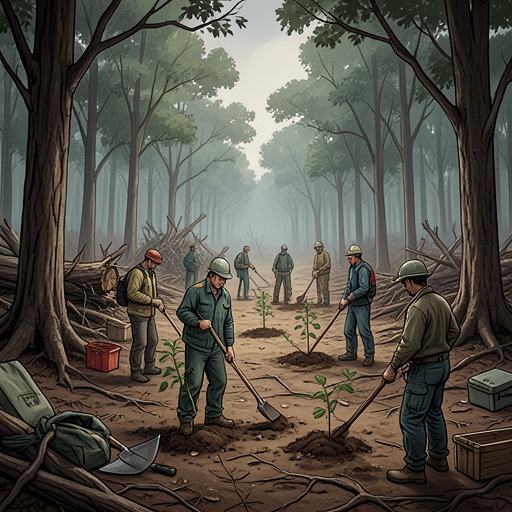
His questions arise from the conditions seedlings will actually face after logging. The nursery has been selling bare-root spruce and pine advertised as able to grow anywhere, yet many die on rough, logged-over ground. Site preparation might improve their chances, but it requires labor and machinery that companies may be reluctant to fund. Conrad considers which species will be needed, how disease affects them, where seedlings should be planted, and how the ground should be prepared. He also studies the consequences of fire, one of forests’ means of regeneration, and asks which species can thrive on burned land and what competing grasses and plants may follow.
Forestry school turns those questions into a business problem as well as a scientific one. Conrad concludes that leaving a few trees on a clear-cut to provide seed is not a dependable substitute for planting: experience shows poor regeneration. For forests to remain available to future timbermen, logging companies must plant among the stumps and learn to think across decades and even centuries. Because site preparation is essential, he decides Breitsprecher should offer it as a service, making the cost of renewal part of the work companies already undertake.
He also considers how seedlings themselves should be grown. A forestry-school example of seeds planted in soil-filled kraft-paper cylinders suggests that container-grown seedlings may fare better than bare-root stock, but Conrad treats this as a question for experiment rather than an immediate solution. He weighs nursery space, species, labor, time, maintenance, seedling size, and price, and considers putting Charley’s legacy toward research even if the venture brings little profit. His plans join practical calculation to an emerging philanthropic commitment.
Research, War, and Recovery
By 1939 Conrad has developed a long-range plan. He builds new greenhouses and establishes an experiment with eleven tree species. McErlane now works with two new employees, Pedro Vaca and Hank Stone, while a separate building serves as a small laboratory-office. Conrad has not yet found the research horticulturist or plant breeder he wants. Elsie Guderian, one of the few women in forestry school and interested in plant heredity, appears suited to the work, but she still has a year before graduation.
The plan is interrupted by war. Unlike Raphael and Claude, who have connections that help them avoid military service, Conrad is called up; growing nursery seedlings is not considered a vital agricultural occupation. He returns from the South Pacific in 1945 changed in body, thoughts, ideas, and beliefs. Back among the greenhouses, he regards the young pines as beautiful in a way he had not before. The nursery is no longer only an inherited project or a difficult technical business: it is the work to which he returns after war, and its living seedlings offer a different measure of value from the company’s immediate commercial calculations.
Family Claims and Corporate Conflict
Conrad’s commitment to the nursery is tested when the family discusses selling Breitsprecher-Duke to International Paper. The question of Charles Duquet’s descendants has resurfaced. R. R. Tetrazinni’s report explains that Charles adopted Nicolaus and Jan from an Amsterdam orphanage and Bernard from the streets of La Rochelle, while his Dutch wife, Cornelia Roos, later bore two children, Outger and Doortje. The adopted sons’ descendants have inherited and managed the company, but Tetrazinni identifies the descendants of Outger’s daughter Beatrix Duquet and Kuntaw Sel as the living bloodline descendants of Charles Duquet.
In the company discussion, Conrad reacts with striking alarm to the prospect that the Canadian heirs could disrupt the business. James Bardawulf is surprised, and Claude attributes Conrad’s agitation to his belief that Breitsprecher-Duke’s reputation depends on the nursery, a division legally separate from the company. Yet Conrad’s own response is not merely concern about corporate stability: when told that a court would probably give the heirs little consideration, he says he gives them that consideration and leaves the room. His stance interrupts the family’s attempt to treat the heirs’ claim as a remote legal nuisance.
That moment sharpens the contrast between inheritance as possession and inheritance as obligation. Conrad’s nursery comes from family wealth, but Charley’s instructions placed it and his fortune in trust for the next generation; Conrad, in turn, sees the heirs’ claim as deserving attention even when the company expects to prevail. His actions do not resolve the dispute, but they reveal a moral independence within a family enterprise accustomed to assuming that long possession settles questions of ownership.
Forest Stewardship and Its Limits
Conrad’s project belongs to a broader conflict already visible in the company’s history. When James Duke first sees Michigan’s white pine, he imagines a thousand men cutting it, while Armenius Breitsprecher recognizes the appetite to clear a continent. Armenius objects to waste, erosion, soil damage, and the assumption that another forest will always be available. Conrad’s work offers a practical response to that extractive horizon: plant new trees, prepare the sites, test what survives, and persuade the people who harvest timber that future supply depends on present care.
But the novel does not present the nursery as a simple correction to the company’s conduct. Breitsprecher-Duke later uses Charley’s intimate knowledge of tropical trees to help plunder tropical forests. Conrad’s notebooks are valuable both as a record of close attention to the natural world and as tools that can be turned toward commercial exploitation. His own efforts to restore and replenish forests therefore unfold inside a business whose reach and purposes he cannot wholly control. The difference is not between knowing and not knowing, but between knowledge used to accelerate extraction and knowledge used to accept responsibility for the forest’s future.
Dieter’s conviction that seeds should be planted for people not yet born provides the clearest ethical premise behind Conrad’s work. A seedling cannot replace a mature tree within a human lifetime, and successful planting requires planning on a scale far longer than ordinary business returns. Conrad’s research, willingness to reinvest Charley’s legacy, and decision to make site preparation a service all give that premise concrete form. His achievement is not a completed reconciliation between family business and forest conservation, but a sustained attempt to make the future visible within an industry organized to take from the present.