Fernand Trépagny
BarkskinsFernand Trépagny, the bearded voyageur brother of Claude Trépagny, moves through the novel as a forceful storyteller and fur trader whose bravado gives way to caution when partnerships and loyalties fracture. His adventures trace the routes of the fur economy, but his encounters with Charles Duquet also expose the human violence and opportunism beneath the romance of the wilderness.
Identity and Introduction
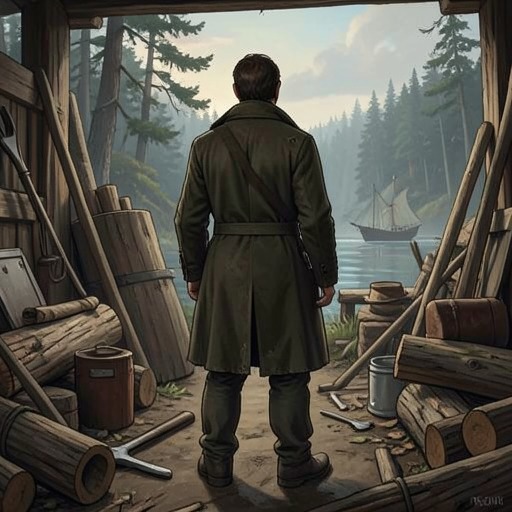
Fernand first appears with Toussaint, travelling to attend Claude’s wedding. The brothers have followed René Sel’s trail blazes from Wobik, where boatmen are camped, and arrive with bottles of spirits and the confidence of experienced voyageurs. Fernand is distinguished by his short beard and by his exuberant talk: he claims mastery of more than fifty songs, begins one, and stops after seven verses to insist that their lives involve far more than singing and walking through the forest. He describes a hard life of loving, sleeping, and eating, presenting himself as a man formed by demanding travel rather than settled work.
The brothers’ reunion with their uncle Chama is noisy and emotional. They embrace, weep, drink, curse, and slap one another’s backs. Fernand and Toussaint condemn the clearing around Claude’s settlement: in their account, their own movement along waterways leaves the land without scars, and the wake of a passing canoe quickly disappears. Their invitation for Chama to return to the high country meets a sad refusal. A worsening spinal deformity has made him unable to bear the voyageur life, a limit the brothers answer with boasts about journeys of twenty or thirty hours of paddling and tales of the physical extremity of their world.
Encounters with René and Claude
Fernand and Toussaint’s arrival draws René into their revelry. They pass him their bottles, sing, and boast about life on the move. Their ease and appetite for celebration contrast with Claude’s possessive view of the people around him. When Claude learns that Duquet has been discussed, he recognizes him as the man who fled a three-year labor contract and vows to pursue him. Fernand confirms that it is the same Duquet and reports that Duquet called Claude cruel. Toussaint warns Claude that Duquet is dangerous, but Claude orders his horse saddled and prepares to go after him. The brothers’ remarks thus help bring an old grievance into the open, even as they warn against the consequences of acting on it.
Fernand’s relationship with René is also a channel through which the novel presents the brothers’ values. Their affection for Chama is sincere, but their invitation cannot overcome the physical change that has ended his ability to travel. Their own stories turn hardship into a measure of identity: endurance, movement, and shared recollection bind the brothers together, while the clearing at Claude’s home represents a way of life they reject.
Partnership, Trade, and Forests
When Duquet looks beyond the unstable fur trade toward timber, he briefly presents his plan to Fernand and Toussaint, hoping they will join him in a future business. He considers fur an unreliable basis for lasting wealth: beaver and other animals may disappear, and demand may fluctuate. Forests, by contrast, seem to him an enduring commodity that can supply ships, houses, and fuel. Fernand and Toussaint do not embrace this vision. Their hesitation foreshadows the conflict between Duquet’s ambition to convert forest into permanent fortune and their own attachment to a mobile life that, as they understand it, leaves the forest standing.
The brothers’ later reunion with Duquet takes place near their old hut on the Rivière des Fourres, where they are tearing out a beaver dam. They have returned to the fur trade amid Queen Anne’s War, but Fernand’s account makes clear that their travels have extended far beyond the immediate region. He describes western hunters who brought furs obtained through trade with northern peoples living near the world of ice. Toussaint produces eight sea-otter pelts and four Arctic fox furs; Fernand then reveals a striped tiger skin said to have come from Russians. He explains that the northern people were sick and reluctant to trade, and acknowledges that persuasion could be severe. Toussaint turns away as Fernand continues. When Duquet asks about the tiger’s head, Fernand says the Russians did not have it and may have eaten it to survive. The exchange exposes both the reach of the trade and the violence concealed within the acquisition of prized goods.
Fernand’s disclosure changes the brothers’ relationship with Duquet. The old, easy partnership has weakened: they have been keeping their evening fire apart and speaking mostly to one another during the day. As Duquet prepares to return to La Rochelle and China, the brothers insist on holding their share of the furs unless he pays a high price immediately. Fernand explains that they need ready money and intend to rejoin Pierre LeMoyne, who is preparing a Caribbean expedition in France. They cannot afford to wait years for Duquet’s return, particularly if pirates might again leave him empty-handed.
The Break with Duquet
Negotiations last two days. Duquet secures a bargain for most of the furs, but Fernand and Toussaint keep the tiger skin and white fox furs. Fernand’s practical demand for immediate payment and the brothers’ decision to pursue other prospects make their separation from Duquet more than a personal quarrel: it is a break over time, risk, and control of the goods they have gathered. Their ignorance of the furs’ value in China leaves Duquet room to negotiate advantageously, but they do not surrender the most coveted skins.
Duquet leaves near midnight without alerting them, taking the tiger skin along with the fox and otter furs. Fernand curses when the loss is discovered. The brothers have obtained some hard money, but the stolen furs turn the transaction into a betrayal, and they toast Duquet’s departure with bitter mockery. Fernand’s earlier willingness to deal with him has become a clear parting of ways: the partnership ends not with reconciliation but with a concealed taking and the brothers’ anger.
Narrative Significance
Fernand’s scenes set two relationships to the forest against one another. He and Toussaint describe the voyageurs’ passage as temporary, leaving waterways and woods apparently unchanged; Duquet instead sees the forest as an inexhaustible resource and the foundation of a fortune meant to endure for generations. Fernand does not develop a timber enterprise with him, and his lack of enthusiasm makes the divide visible before it becomes final. The novel later shows what the competing extractive vision can entail: in New Zealand, logging camps and trading stations consume shore forests, leave deep waste, and move on to the next profitable site.
Fernand is also a vivid but partial witness to the global commodity chain. His stories carry the reader from the Rivière des Fourres to the western hunters, the northern trade, and the tiger skin, while the later trade in timber links forests to distant buyers such as Sydney, Australia. His exuberant self-presentation makes him a memorable figure, but the consequential details are less celebratory: the reported deaths surrounding the northern trade, the brothers’ reluctance to part with particular furs, and Duquet’s theft after the bargain. Through Fernand, travel and trade appear not as uncomplicated adventure but as systems in which mobility, knowledge, bargaining power, and violence determine who controls the value taken from the forest.