François Toppunt
BarkskinsFrançois Toppunt is Charles Duquet’s cabinmate aboard Captain Outger Verdwijnen’s ship to China, a nimble and resourceful sailor whose brief appearance links the practical preparations for a dangerous voyage with its first personal cost. His planned trip to Paris ends in a reprimand: after the ship sails, the captain repeatedly finds fault with him.
Identity and Background
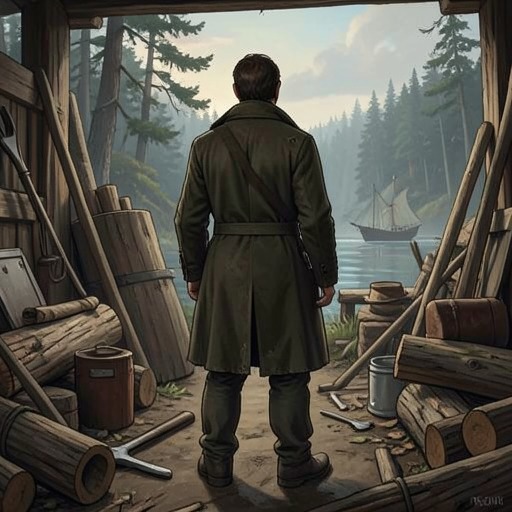
Toppunt is a pockmarked man with narrow arms and a gaunt face, an appearance that suggests frailty until his agility becomes apparent. He dresses smartly, in contrast to the crew’s tarry red trousers and knitted caps, and moves with the quickness of a dancing master. He is also decisive, sharing with Duquet a speed of body and mind.
He believes he was born in Bourgogne and brought as a young boy to Amsterdam. After both his parents died of plague, watchmaker Willem Toppunt and his childless wife adopted him. His uncertain early history and adopted surname are the fragments of biography he offers Duquet; the narrative gives no further account of his family or life ashore.
Aboard the China-Bound Ship
When Captain Verdwijnen agrees to take Duquet on the voyage, he assigns him a cramped, rank cabin and tells him he will share it with Mijnheer Toppunt. At first, Toppunt is present only through the practical signs of an occupant: a roll of grey blankets, a large leather bag, sea boots, and heavy gloves. The later introduction turns this sparse inventory into a portrait of a lively, capable companion.
Toppunt and Duquet can converse in French, although Toppunt’s has deteriorated through long disuse and is interspersed with Dutch words and phrases. He is devoted to collecting natural rarities, a sailor’s pastime that extends his attention beyond the immediate business of the voyage. He tells Duquet about a cabinet of curiosities at home containing spider teeth and a stuffed bird of paradise, which he describes as a strange bird born without feet. He also recounts that the captain’s mastiff climbs into the rigging and barks when it spots pirates, an anecdote that places the ship’s daily life between curiosity and danger.
The Paris Excursion and Its Cost
A few days after coming aboard, Duquet confides that he wants new clothes and a wig ready for his return from China. Toppunt proposes a hurried excursion: he knows a tailor in Paris and wigmakers on the same street, and wants a wig himself for special occasions. He warns that the work must be paid for in advance, then urges Duquet to seek leave from the captain. With only five days before sailing, the plan turns the cabinmates’ shared circumstances into a short-lived partnership.
The coach journey is so rough that Duquet repeatedly gets out to run alongside it. In Paris, the two find an inn near the wigmakers and tailors, and spend time walking the city before attempting the difficult return to La Rochelle. That return is worse: a coach horse dies in its traces, the axle breaks on a rough detour, and the men finish the journey on saddle horses. They reach the ship with only hours to spare.
The delay has a consequence for Toppunt. Verdwijnen is furious and accuses him of neglecting his duty, warning that the episode will count against him and that he will soon feel the captain’s displeasure. Duquet does not learn what formal punishment, if any, Toppunt receives, but observes that the captain thereafter finds fault with the mate constantly. The episode gives Toppunt’s brisk initiative a cost: the excursion he suggests for their personal ambitions strains his position in the ship’s hierarchy.
Narrative Role
Toppunt is a companion rather than the center of the China voyage, but his distinctively practical and curious character helps make the shipboard world concrete. He offers Duquet access to useful Paris tradespeople, shares a cabin and a language with him, and brings the naturalist’s impulse to collect into a narrative otherwise propelled by commerce. His easy alliance with Duquet is tested not by a quarrel between the two men but by the consequences of arriving late under a captain who controls their working lives. Once the ship departs down the Channel and out into the Atlantic, Toppunt remains aboard as the voyage proceeds toward the monsoon route to China, while the account supplied here leaves his later fate unstated.