Tonny Sel
BarkskinsTonny Sel is Kuntaw Sel and Malaan’s son, a father who leaves the trading post with his children in search of kin and a safer home. His life traces the costs of displacement across generations: separated from Mi’kmaw community and knowledge, he struggles to care for his children, then enters the lumber camps as one of the Indigenous workers treated as expendable labor. His story ends before he can collect his season’s wages, with his death in the river.
Identity and Background
Tonny is born after Kuntaw and Malaan marry as children. Kuntaw has insisted on the marriage after returning from a moose hunt to find ruin, although Elphège had forbidden it; Malaan gives birth to Tonny at thirteen, after a long and painful labor. Before Tonny is three, Kuntaw leaves for the lumber camps, and Malaan becomes dependent on alcohol and on the men who keep her at the trading post. The women from the Mi’kmaw village urge that Tonny be raised among Mi’kmaw people, but Malaan refuses, saying he will stay at the post and learn white ways.
The post is where Tonny grows up, running with a loose group of children and making a shelter beneath old canoes. The older women sometimes bring him into their wikuoms to feed him moose meat and tell him about his father, known as Grasshopper Slayer for his skill with bow and arrow. That inheritance is remote: by Tonny’s youth, guns have largely displaced bows, and easier hunting leaves fewer reasons to track and stalk game. Tonny has neither bow nor gun, and lacks the knowledge of animal behavior that the narrative identifies as a man’s customary work. Instead, he survives through thieving, begging, errands for white men, and improvised shelter in the broken woods.
Family and Departure
At fourteen, Tonny begins a relationship with Hanah, whose mother also lives around the post. They have three children while young: Elise, Amboise, and Jinot. Hanah later goes with white men, and when she is twenty she is killed by the trader Henry Clefford. Tonny is left to care for the children without a stable home or reliable means of support.
He tells Malaan that he is leaving and taking the children with him: he is grown, he says, and a father. Malaan answers that she always knew he would leave. Tonny feels hatred and sorrow toward her, but recognizes that her life has become bound to the post. His decision is also a judgment on his own circumstances: he has grown strong, yet has no hunting skills or weapons and does not feel that he belongs to the community whose customs have been falling away. Still, he believes his children should live among their blood kin rather than remain at the post.
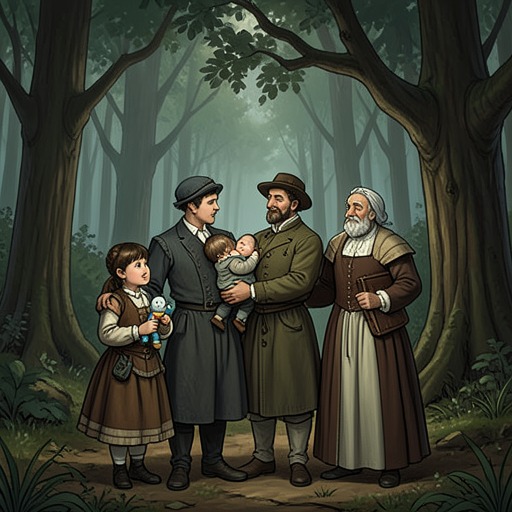
Tonny knows only that Kuntaw lives at Penobscot Bay. He travels there in a stolen canoe and on foot through mud and old snow, sometimes carrying Jinot, the youngest. At the house he identifies himself as Kuntaw’s son and introduces the children as Kuntaw’s grandchildren. He says their mother is dead and asks for help, admitting that he is not a good man and that he cannot make a good life for the children in a Mi’kmaw place as things now stand. The gesture of touching each child on the forehead as he names them makes the request concrete: he has brought them to their grandfather rather than abandon them.
Work and Death
After leaving Kuntaw’s household, Tonny finds little work beyond the lumber camps, which hire Indigenous men as disposable labor. He considers whether he might move deeper into the forest or go to Boston, but has neither a gun nor the animal knowledge needed to live by hunting. He chooses the camps as the available way to try to begin again.
Tonny works through the winter limbing felled pine. In spring, the boss orders him into a bateau, assuming that an Indigenous worker will be skilled with a paddle. Tonny’s experience of bateaux is instead as shelter: as a child, he had used them as roofs against the rain. He is not a riverman. Before he can collect his season’s pay, he drowns below Wolf Falls. His death leaves the children’s effort to find family and security as the central consequence of his brief working life, and places him among the many fathers who, in the novel’s account, disappear into the past.
Narrative Significance
Tonny’s movement from the trading post to Kuntaw’s home and then to the lumber camp is not a simple return to inherited identity. His father’s family can offer the children shelter, but Tonny himself has grown up without the skills that would let him resume a traditional livelihood. The older women’s stories about Grasshopper Slayer preserve a memory of Mi’kmaw competence, while Tonny’s dependence on white men’s errands and camp work shows how limited his own choices have become.
The lumber camp presents employment as a narrow opening that is also a danger. Tonny goes there because other work is scarce and because he cannot support himself in the forest through hunting; the same employer who assigns him to river work treats his birth as proof of a skill he does not possess. His drowning before payday makes the cost immediate, while the conditions that lead him there—the loss of community ties, the decline of customary knowledge, and the use of Indigenous workers for hazardous labor—have accumulated over years. Tonny’s story therefore joins family separation to extractive labor: the children reach their grandfather, but their father does not survive the work that was supposed to provide for them.