Jan Duke
BarkskinsJan Duke, adopted by Charles Duke in Amsterdam at the age of nine, grows into a multilingual merchant and strategist whose foresight helps shape Duke & Sons. His ability to read markets and manage contracts serves the family’s expanding timber empire, but an unexpected wish to paint clouds exposes a self that the company’s demands have long kept in reserve.## Identity and Background In 1713, Jan and Nicolaus, both nine years old, became Charles Duke’s sons after Cornelia selected them from among the boys available through an orphanage. Their adoption was part of a deliberate family project: Charles wanted sons he could train for business or the sea, and the boys began schooling and lessons in manners soon after joining the household. Charles told them they had an opportunity to help build a great fortune and escape the poverty he himself had known. The adoption gave Jan a place in a family whose affection and expectations were entangled with commercial ambition.
Jan grew up in Amsterdam speaking Dutch, French, and English, with some German, Frisian, and Portuguese. He excelled at numbers and bookkeeping, and Charles regarded him as unusually forward-looking. This practical talent made him an effective operator, but the novel later reveals that his aptitude for business did not exhaust his ambitions.## Building Duke & Sons When Charles brought his sons to the New World, he assigned them distinct roles in the enterprise. Jan and Nicolaus would handle merchants, contracts, and shipping; Bernard, who had studied pitch and tar production in the Baltic, would oversee naval stores. Charles himself continued securing contacts, buying paper townships, and arranging woodsmen and sawmills. The plan relied on the sons’ abilities, though the narrative makes clear that Charles valued them chiefly as the sons he needed and as proof of the enterprise’s success.
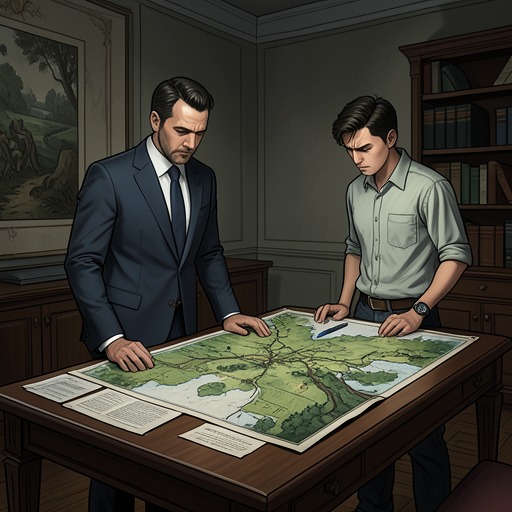
Charles lodged Jan and Nicolaus in Boston. Once a month they travelled to the family’s Penobscot Bay house to spread papers and books across the great pine table and discuss business. Within months, Jan and his brothers were bringing their own proposals to Charles. Noticing the growing settlement of English and Scottish shipwrights along the New England coast, Jan argued that Duke & Sons should enter shipbuilding. Producing vessels locally, he reasoned, would reduce the need to transport lumber, masts, bowsprits, and yards to European ports. Charles acknowledged that he had considered the move but hesitated; Jan’s proposal reassured him. The exchange shows Jan not merely administering the company’s existing trade but identifying opportunities to extend it.
Jan also became one of the family’s principal negotiators. He clinched deals with merchants, arranged complex shipping contracts, and smoothed the feelings of people angered by the firm’s business practices. His detached manner could be mistaken for neutrality, although privately he wished the axe on all royalists. At a family discussion about where Duke & Sons should place its allegiance, Jan asked his son George for a legal opinion on the difficult choice between France and England. The question locates the firm’s commercial decisions within the political contest over New France, where allegiance could not be separated from the company’s prospects.## Family Conflict and Strategic Restraint The company’s reach also made it a target. Dred-Peacock warned Charles that McBogle had been asking about the number of Duke sawmills and ships, the size of its fortune, and the timber tracts and townships it owned. McBogle himself operated several mills on Penobscot tributaries and in New Hampshire and was becoming a serious rival. Jan’s role in managing the firm placed him within this atmosphere of competition, in which information about assets could be as consequential as the assets themselves.
Later, when a Wentworth ally proposed social connections and access to Duke pine holdings in exchange for payment and shared logging costs, the offer appeared to promise the family entry into influential circles. But Jan and the feverish Nicolaus arrived before the agreement was settled. Nicolaus rejected the proposal outright, and the older brothers persuaded Piet and George Pickering Duke that accepting it could have exposed the firm to false accounts, legal manipulation, and the loss of forestland. Jan and Nicolaus then argued for a quieter business policy: avoid entangling partnerships, keep operations within the family where possible, use intermediaries for land purchases, and stay inconspicuous rather than advertise the company’s power. Their caution was shaped not only by commercial risk but also by fear that details of Birgit’s death might circulate in Boston society. The scene presents Jan as part of a family leadership that treats discretion as a means of preserving control.## A Wish Beyond the Company Jan’s most personal divergence from the family business emerges during a return journey with Bernard. At a coffee shop, he says that he has always longed to be a painter and points to the clouds as the subject he wants to paint. Bernard objects that Jan is already an old man and that Duke & Sons needs his services. Jan nevertheless asks to stay for six months to try painting, explaining that he has pictures in his head and wants to do something out of the ordinary.
Bernard recognizes the force of the wish, despite his bitterness, and agrees that Jan may remain for six months if he promises to return afterward. Jan gives his word and offers to bring back his best painting. Bernard, who says that what he needs more than anything is a painting of Dutch clouds, turns the negotiation into an affectionate joke by warning Jan not to get windmills in his mind. The moment makes visible a conflict that business competence had concealed: Jan can imagine a life not measured by expansion, yet he asks permission in the language of a temporary leave and promises to come back.
Jan’s arc therefore joins two forms of foresight. In company affairs, he anticipates new markets, reads the political stakes around the firm, and helps guard its independence through secrecy. In private, his attention lifts from contracts and timber to clouds, a subject with no evident commercial use. The contrast does not erase his importance to Duke & Sons; it shows the cost and incompleteness of defining a person by the work a family enterprise requires. The evidence leaves his eventual return and the fate of his painting unresolved, preserving the wish as an open possibility rather than a completed escape.