Mari
BarkskinsMari is a Mi’kmaw woman whose life joins intimate family history to the longer consequences of colonial displacement. Carried from her childhood country to France against her will, she later lives with René Sel and their children in a forest increasingly altered by settlers. Her practical knowledge and remembered homeland give her family a way to understand the world beyond the settler house and its claims of ownership; after her death, her children carry her bones back to Mi’kma’ki and build a shared wikuom by the sea.
Identity and early displacement
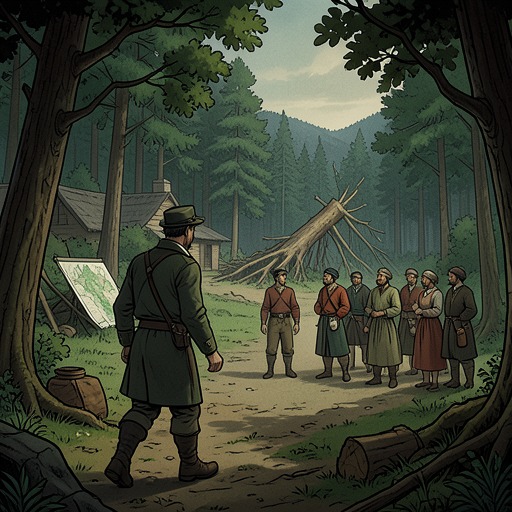
Mari first appears to René Sel and Charles Duquet as the woman living with her children in a bark house near Monsieur Trépagny’s wooden house. She introduces herself as “Mali,” the name René hears when she points to herself, and brings the two men beaver robes and a bowl of hot cornmeal. The small act of welcome establishes her as a provider and a person with a household and knowledge of her own, rather than simply a presence at the edge of the settlers’ clearing.
Years later, Mari tells René why separation from her people and homeland remains central to her life. As a child at an ocean camp, she says, her people welcomed pale newcomers who identified themselves as French, sharing food and showing them how to gather shellfish and berries. After weeks of apparent friendship, the visitors announced that they would return to France and that some Mi’kmaq would go with them. Mari and six others were seized by sailors and taken aboard before the people on shore could stop the ship. The account connects her adult life in the settlement to an earlier forced removal, and makes clear that her knowledge of France came not from a chosen journey but from abduction.
Knowledge of the river and forest
Mari’s knowledge is practical, shared, and grounded in reciprocal relations with the natural world. When René fishes, she asks him to leave the fish intact so she can clean them herself. She buries the entrails in the garden, explaining that this is a sensible practice for people who grow gardens instead of gathering the country’s riches. Her response challenges René’s assumption that her ways need to be explained as merely “Indian.” She also gives him a compact account of her community’s relationship with eels: the river people catch them, and eels are “liking us.”
She weaves three eel traps, supplies fish scraps for bait, accompanies René to the river, and points out places where he might set them. Thereafter, he brings her eels almost every day. She tells him that the Mi’kmaq have many methods of catching eels and that traps are the best approach for him; their sons, when they return from Odanak, can show him others. Her teaching is specific and adapted to René, but it also locates his new skill within a body of knowledge shared across generations.
Her understanding of the forest differs sharply from René’s. To Mari, it is a living presence and a source of medicine, food, shelter, and materials for tools—gifts people learn to find and remember, and for which they should be grateful. She opposes the repeated cutting of trees in the name of clearing land. René instead sees the forest as limitless and the land beneath it as useless until men subdue it and plant crops. Their disagreement is personal, but it also gives the novel a clear contrast between living with the forest and treating it as land awaiting improvement and possession.
Marriage, family, and memory
Mari’s marriage to René begins through coercion, not mutual choice. Monsieur Trépagny orders René to marry her immediately, with Père Perreault present to officiate. René objects that he does not want to marry her and had imagined marrying a young woman arriving from France. He also begins to protest about Trépagny and Mari, but Père Perreault dismisses their earlier union as a country custom. The later account confirms that Trépagny forced the marriage to avoid losing his French wife. Mari’s family life with René thus takes shape inside decisions made by powerful men, even as the relationship grows into a substantial exchange of knowledge and understanding.
René comes to recognize Mari’s composure as a form of acceptance and knowledge formed through life’s upheavals, not a lack of feeling. He learns from her over months and years, and their relationship becomes a marriage of minds as well as bodies. That mutual learning does not erase their disagreement about clearing the forest: they remain opposed on what the land is for, and René continues to regard her objection as woman’s talk. Their intimacy therefore coexists with an unresolved conflict shaped by the larger settler economy.
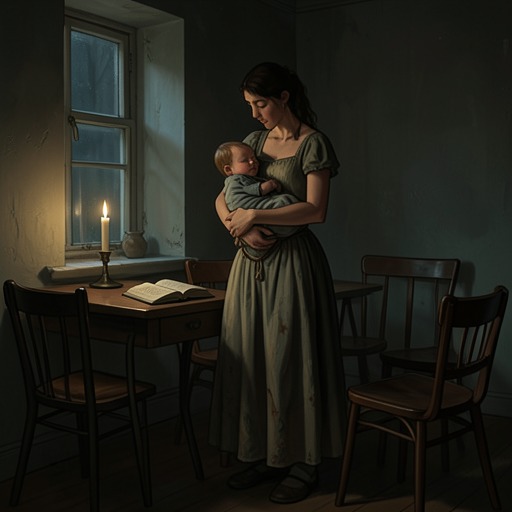
Mari is the mother of Elphège, Theotiste, Achille, Noë, and Zoë. Her children grow up trying to find a place in a world unlike the rich Mi’kmaw past described in her stories. The hardships and separations of their lives do not make her account of home irrelevant; instead, those memories become a guide to where the family belongs. Noë’s life, including her later motherhood, unfolds far from René and Mari’s old house, and she understands the family’s presence at the ocean’s edge as a consequence of her siblings’ journey to Mi’kma’ki, the land of memory.
A changing homeland and the return of her children
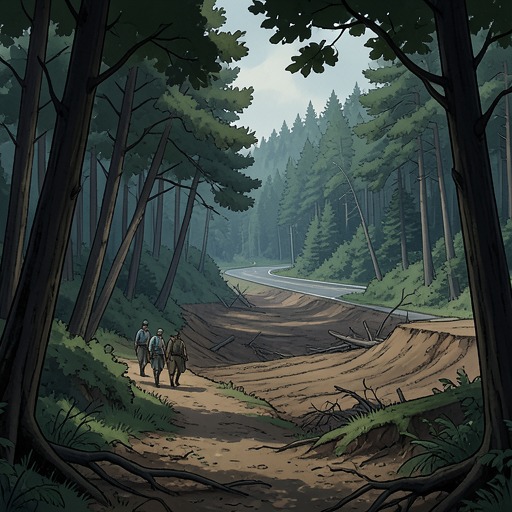
By the time René’s settlement has grown, Mari has become known for healing the sick. At the same time, clearing has changed the area: farms now stand between Wobik and René’s place, and settlers’ work has destroyed woodland grottos where plants once grew. Mari mourns those losses and speaks increasingly against white settlers. This later view, reported by others, confirms that her resistance is not simply a private difference of opinion with René. She sees the loss of particular plants and places as part of a broader destruction of the world on which her knowledge depends.
The children’s return toward their mother’s country is also a decision about what counts as home. One of them argues that René’s house is only a white man’s house, while Mari’s remembered “happy land” is more truly their place than Odanak, despite reports that it has changed and is beset with troubles. The family does not imagine that return will restore an untouched past. Rather, Mari’s stories make reconnection possible even when the homeland has changed.
As the journey approaches, Zoë wishes they had brought their mother’s bones. Theotiste tells her he has brought them. Zoë also regrets leaving behind the small wall basket Mari made to hold René’s comb, a domestic object that links the lost household to the journey. These two forms of remembrance—her mother’s remains and a handmade basket—give the return both a ceremonial and an intimate dimension.
Many Mi’kmaq help the family put up a large wikuom at the edge of the forest, overlooking the sea and beside a path to the shore. There they bury Mari’s bones. After a long search, Achille kills a beaver and places its skin over the burial site in accordance with old practice, but someone takes it away to sell. The contrast makes visible the pressure of the market even within an act of mourning. The family nevertheless remains together: Mi’kmaq women sew the wikuom, Zoë paints its moose-hide door in curves of black, purple, and red, and the reed-mat floor and central stone fire circle turn the new dwelling into a haven.
Legacy across generations
Mari’s legacy is not limited to what her children remember of her. Her family’s history continues through later separations and returns, and her descendants inherit both kinship ties and the consequences of displacement. Kuntaw, her son-in-law, hears from Tonny about the hardship and losses surrounding Malaan and Mi’kma’ki, and admits that he failed to teach his son what he needed to know or to care for him as he should have. He begins telling Tonny the old stories of their people and ancestors, while recognizing the family relationships he had neglected. This later scene does not make Mari the cause of those choices; it shows how family knowledge and responsibility remain matters that later generations must actively recover.
The novel also places her family’s experience alongside institutional efforts to sever cultural continuity. Egga’s father sends him to Shubenacadie residential school believing that education will lead to better work than cutting trees. At the school, Mi’kmaw children’s culture and language suffer sustained harm, and Egga eventually escapes. As an adult he has difficulty speaking about his earlier life, but his wife Bren’s insistence that he cannot disown his family and generations behind him helps him reconsider what being Mi’kmaq might mean beyond humiliation and pain. His daughters want to write to his parents and visit their home in Shubenacadie; Egga begins, gradually, to tell them about his past. The later history of his descendants thus echoes the struggle visible in Mari’s life: displacement can interrupt the transmission of identity, but memory, storytelling, and renewed relationships can carry it forward.
Mari’s decisive significance lies in the alternative she embodies to a world organized around clearing, settlement, and possession. Her knowledge teaches René how to fish, while her account of forced removal reveals the human history hidden behind the settlement’s apparent beginnings. Her children’s return to Mi’kma’ki cannot undo loss, and the stolen beaver skin shows how even mourning can be exposed to commerce. Yet carrying her bones, rebuilding a wikuom, and continuing to tell stories make her remembered homeland more than a vanished past: it remains a source of relationship and belonging.