Amboise Sel
BarkskinsAmboise Sel grows up in Kuntaw Sel’s household after his father, Tonny Sel, brings him and his siblings to their grandfather for help. He matures into a strong, broad-shouldered young man, works in the New Brunswick lumber camps, and later joins his brother Jinot Sel in a journey to find their sister Elise. Through those departures and returns, Amboise’s story traces a family adapting to colonial upheaval and wage labor while holding on to kinship obligations.
Identity and Background
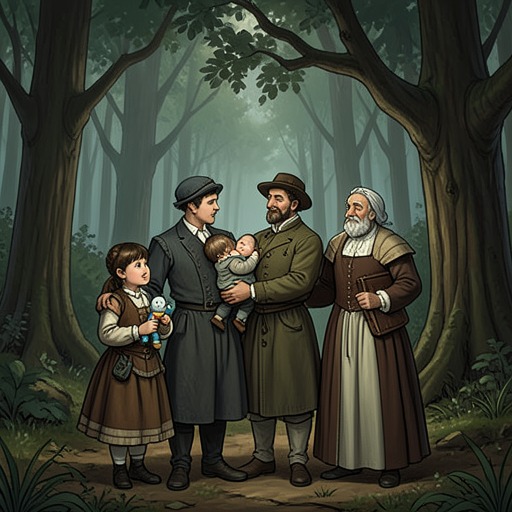
When Tonny arrives with the children, he explains that their mother is dead and asks Kuntaw to help them. Amboise is seven years old, shy, and already distinguished by a winning smile. Beatrix welcomes the family and lifts the youngest child, Jinot, onto a chair; the household becomes the setting in which the children grow up.
The years do not feel equally paced to everyone. Beatrix sees the children pass abruptly from innocence to adulthood, while Jinot experiences the time after his older siblings leave as slow and lonely. Amboise first goes to the woods after Francis-Outger has married and left home and Josime has gone to the New Brunswick lumber camps. He returns broader and stronger, carrying both money and stories, then departs again to work as a swamper for a New Brunswick outfit. His movements establish logging as a practical route into adult life, but also as a force that draws the younger generation away from home.
Work, Family, and Departure
Amboise’s work gives him knowledge of the lumber economy beyond the household. After a drive, he returns with accounts of camp life and earnings; when Jinot grows restless and asks Kuntaw to let him go to the forest camps, the prospect of joining the timber workforce has become an intelligible future for the younger brother. Kuntaw’s response complicates that ambition: he reminds Jinot that the young women around him may hope he will stay and raise a family. The choice between leaving for work and remaining among kin is therefore not merely economic.
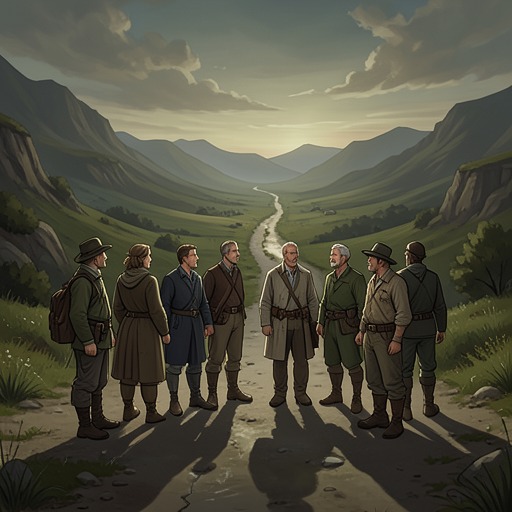
Kuntaw also entrusts the brothers with family inquiries before Jinot enters the forest. He asks them to visit Elise in Mi’kma’ki, find out whether she is well and has children, and learn whether their cousin Auguste is still alive; he wants Auguste brought to the Penobscot house if possible. He warns them to keep distant from fighting between English and Americans. Amboise and Jinot travel up the coast by ship to Halifax, then continue on foot to the post. Amboise carries a small wooden turkey he carved long ago, remembering that it amused Elise when she was young; he hopes her children might play with it. The modest keepsake gives the journey a personal purpose alongside the family’s larger search.
Elise’s Escape and Kinship
The visit becomes a rescue. When Amboise calls Elise to leave, she gathers her few possessions into a turnip sack and runs ahead toward the boat landing. Her husband, Luçon Brassua, is absent and cannot stop her. Elise says he is drunk with his friends and insists that they go at once. Amboise’s intervention turns the brothers’ journey from a search for news into a chance to help their sister escape.
The rescue is not completed without another obligation. Amboise says they must also get Auguste, since Kuntaw wants the old man to live in the Penobscot house. Auguste rises and trembles at the invitation, but then looks around at the men by the post doorway and sits again, smiling slyly. His hesitation leaves the family’s attempt to gather its scattered members unresolved in that moment. Amboise’s part is to offer a route home, not to control whether another relative accepts it.
Later, when Amboise finds Jinot, he proposes work they can do together. Jinot rejects the idea of returning to road-swamping, explaining that he had told Marchand he would be back in November if he could. Amboise instead describes a possibility he heard about from men at a Portsmouth shipyard: shipbuilders would pay well for timber knees. He points to the hackmatack he has seen in the swamp and repeats the phrase, “ships get built in the woods.” His proposal joins his camp experience to a new market for forest products, and offers his brother a way to work with him rather than simply return to the same labor.
Forests, Labor, and the Long View
Amboise’s movement through the lumber economy belongs to a wider contrast in the family saga. On one side stands the extractive ambition of Duke & Sons: after James Duke encounters Michigan’s immense pine, Armenius Breitsprecher recognizes that the company’s appetite could extend to clearing a continent. He condemns the waste of sound timber, the damage to soil, and the erosion caused by clear-cutting, while the choppers behave as if another forest will always be waiting. Amboise’s work and ship-timber proposal are part of the same world in which trees become wages and materials, though the evidence does not make him responsible for the company’s later destruction.
Other characters begin to imagine a different timescale. Dieter Breitsprecher notices how forests shape soil and water, and how birds disappear when ponds are drained. After his marriage to Lavinia Duke, he establishes a Maintenance Timberland division to retain, replant, and manage cutover land. He argues that timber scarcity will make forests more valuable in the future and points to older plantings already growing into sturdy stands. In New Zealand, he defends planting kauri seedlings even though they cannot replace mature trees within a human lifetime: the work is for the health of the world and for people not yet born.
That longer view becomes an explicit practical program when Conrad Breitsprecher studies forestry. He concludes that leaving a few trees to seed logged cuts produces poor regeneration; logging companies must prepare sites and plant seedlings if they expect future timber. Breitsprecher therefore plans to offer site preparation as a service. These later developments widen the meaning of Amboise’s forest work: the woods are not only the setting for migration, employment, and family reunion, but also a contested inheritance, capable of sustaining livelihoods only if people accept responsibilities that extend beyond their own working lives.