René Sel
BarkskinsRené Sel is a woodsman and settler in New France whose life is defined by hard forest labor and whose death makes the human cost of colonial expansion inseparable from the work of clearing land. Arriving at Wobik with little more than a childhood-taught letter and the skill of an experienced axeman, he builds a life in the forest; at forty he is killed while cutting a tree, and his children inherit both his work and the precarious home it sustained.
Identity and Arrival
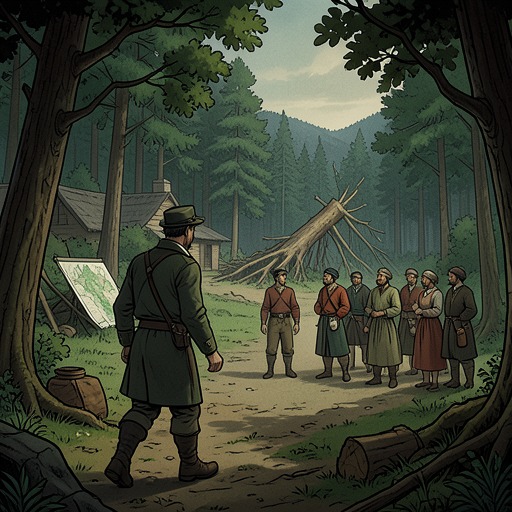
René arrives in New France in rain and twilight, passing Tadoussac, Kébec, and Trois-Rivières before reaching a remote riverbank settlement near dawn. Mosquitoes, mud, and a vast forest shape his first impressions. Among newcomers waiting to mark their names in a ledger, he writes an R rather than an X. He had learned that first letter from an old priest, who died of winter starvation before teaching him the rest of the alphabet. The mark is incomplete, but distinctly his: a small sign of personal identity made in a setting that records arrivals through formal marks.
René’s appearance is described through his stiff black hair and slanted eyes, which the narration associates with a distant ancestral history. His earlier life had included working in the Morvan forest with his brother Achille. When Monsieur Trépagny notices René’s ability with an ax, René explains that experience. The memory of that life, however, is already becoming unmoored. His skill gives him a place in the new settlement, even as displacement loosens his hold on what came before.
Work and Life in the Forest
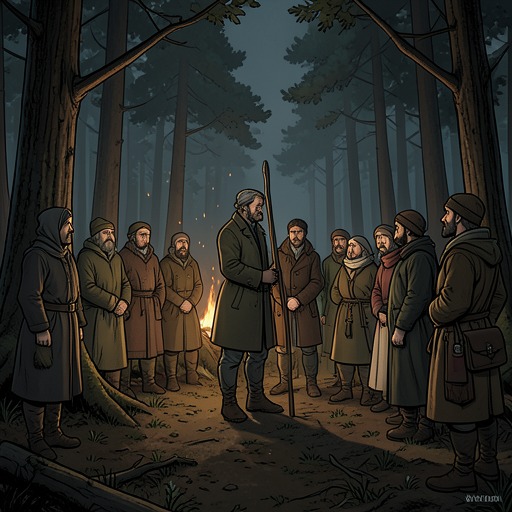
René’s work is not incidental to his identity: the narration presents him as a défricheur and woodcutter whose body and habits are shaped by years of cutting, felling, topping, stripping, splitting, and stacking trees. His labor brings blisters, hardened hands, bruises, insect bites, smoke, and repeated effort. The ax handle leaves his hands permanently curled to its shape. He also uses awkward tools and improvised levers, replaces broken spade handles, and repeatedly lifts heavy trunks. The work is both a means of survival and a lasting physical condition.
When Charles Duquet returns to the region years later, he learns that René lives at Monsieur Trépagny’s former house with a wife and children. René is not the landowning farmer Duquet initially imagines: he remains a woodcutter, keeps a few cows and sheep, cuts firewood, and makes potash. By then several farms have appeared nearby. Monsieur Bouchard describes the settlement’s growth as the clearing and destruction of wilderness, a transformation that Mari openly laments because settlers’ activity has eliminated woodland places where medicinal plants once grew.
Family, Home, and Inheritance
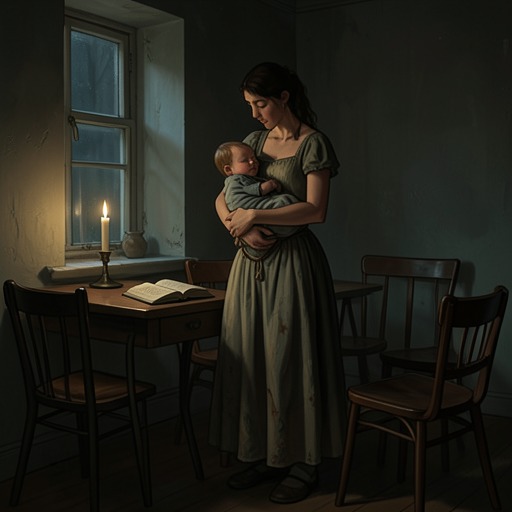
René’s family life is marked by the circumstances of his marriage to Mari. Years later, Monsieur Bouchard tells Duquet that Monsieur Trépagny forced the marriage to avoid losing his wealthy French wife. The arrangement did not preserve Trépagny’s household: he lost Mari, his property, and eventually his life. René’s connection to Mari thus begins within a coercive household arrangement, but their children grow up with her knowledge and memory of Mi’kma’ki as part of their inheritance.
René’s home becomes a focal point for his children after his death. His sons and daughters continue to live there for a time, gathering medicines and food, making maple syrup, keeping livestock, and carrying on some of the work he had done. His old snow snake remains among the objects in the house. When Jean Mague approaches with an interest in the property, the children retrieve the snow snake and a small birch-bark box decorated with quillwork, an object from Mari’s childhood. These objects stand beside the cleared land and potash as evidence that the place is not simply a parcel to possess: it contains family memory and inherited practices.
Death and Its Consequences
René dies at forty in the forest while working. His eleven-year-old son Achille finds him on his knees, his hands gripping the ax handle, with the ax embedded in a cedar. René has also been killed and scalped; the scalp has been taken to claim the bounty. The account joins his death to the work that has occupied his life, but makes clear that this was not an ordinary end to a woodcutter’s labor: colonial violence reaches into the forest and turns the killing into a transaction.
The death leaves Achille, Noë, and Zoë at the house. They continue to support themselves through hunting, fishing, firewood, potash, gathering, basket-making, and tending a cow. Their survival depends on combining René’s practical work with knowledge passed on by Mari. Later, when Theotiste and Elphège return, smoke still rises from the roof hole; Noë is making cornmeal porridge, Zoë comes in carrying milk, and Achille arrives from repairing eel traps. Their reunion shows the family continuing in the place René left behind, even as outsiders scrutinize the property and the surrounding settlement grows.
Narrative Significance
René’s story links individual labor to a wider history of land transformation. His work clears and uses the forest, while the later expansion of farms around Wobik makes the effects of that process visible to Mari. The novel does not present the household as a simple triumph of settlement: René’s children’s claims to the home meet the assumptions of people who see cleared land, a house, and a potash operation as property available for acquisition.
His life also establishes a pattern that outlasts him. The narration observes that his sons and grandsons follow the woodcutter’s path, their lives shaped by the ax as his was. Yet the family’s continuity depends on more than repeating his occupation. His children preserve their mother’s medicinal knowledge and attachments to Mi’kma’ki, while the story’s later generations face increasingly distant consequences of forest exploitation. René’s incomplete R in the arrival ledger and his final grip on the ax frame a life between fragile personal record and repetitive physical labor: he leaves a mark, but the work and the violence around it continue beyond him.