Claude Trépagny
BarkskinsClaude Trépagny is a seigneur in New France whose commission to gather settlers and populate the colony turns wilderness into a project of landholding and clearance. His authority is expressed through the estate of Le Triomphe and the people bound to his household, but his coercive treatment of René Sel and Mari undermines the order he claims to establish. He dies pursuing Charles Duquet, and his former house becomes René’s home.
Identity and Authority
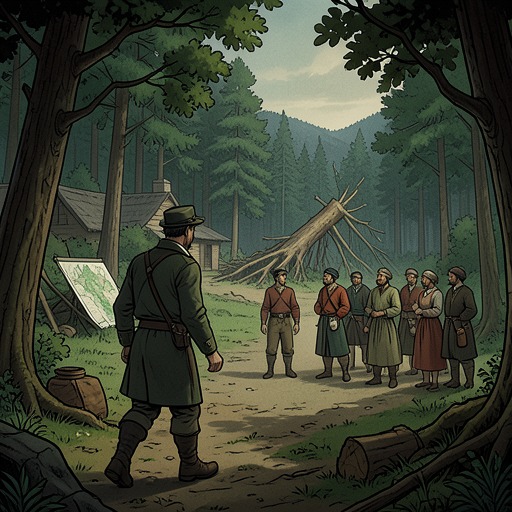
When René arrives in the colony, Trépagny is presented as his new master: a muscular, physically uneven man with a heavy stick, who makes the newcomer wait before taking him into the forest. The scene establishes both Trépagny’s command over the men assigned to him and the unsettled character of his authority. He has brought two servants from the ship, René and the frail Charles Duquet, but his worn cloak offers little outward sign of wealth.
Trépagny explains that he had earlier worked in the fur trade, carrying heavy loads along difficult portages. He says that the labor was beneath his station and recalls that an injury to his right knee, suffered while carrying a large kettle, continued to trouble him. His personal account connects his change of occupation to the burdens of the trade: instead of hauling goods through the forest, he has taken on the task of organizing settlement.
He says the fur company, acting under rights assigned by the King, made him a seigneur and charged him with gathering habitants and populating New France. He describes this as the beginning of a great new city in the wilderness. The claim makes his role more than that of an individual landholder: Trépagny presents himself as an agent of colonial expansion, with settlement and cultivation as the intended result.
Le Triomphe and the Clearing
Trépagny’s ambitions become visible in the land around his household. During the summer, René and Chama clear trees, drag the stumps into lines, and use them to form a bristling fence of roots. The work produces a cultivated holding by transforming the forest rather than simply occupying an already open meadow. René has questioned why they cut trees when clearings are available, but the evidence does not record Trépagny’s answer; the contrast nonetheless places the practical labor of clearance alongside the estate’s larger settlement purpose.
René later learns that Trépagny calls his secret house Le Triomphe and styles himself Claude Trépagny du Triomphe. The name and title make the estate a declaration of status as well as a dwelling. Its significance persists after its founder’s death: the house eventually belongs to René, who lives there comfortably with his wife and children. The transfer carries Trépagny’s physical legacy forward while shifting possession away from the seigneur and into the household of the servant he had controlled.
Household Rule and Mari
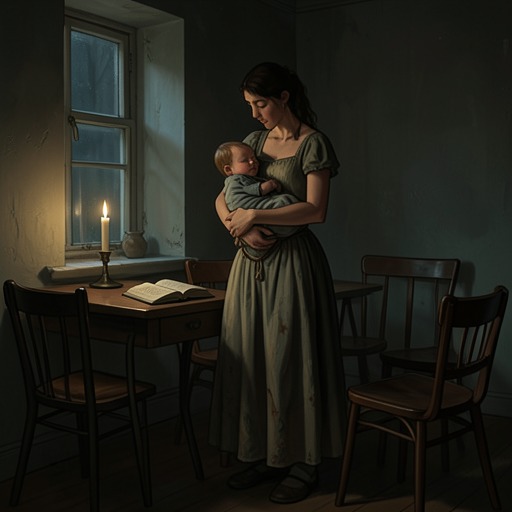
Trépagny’s power reaches into intimate and marital life. When René has been waiting to discuss his land, Trépagny instead orders him to marry Mari immediately, with Père Perreault present to officiate. René objects and says he does not want to marry her; he had imagined a young French bride among the King’s girls. His hesitation also gestures toward Trépagny’s own connection to Mari, which Père Perreault dismisses as a country marriage.
Years later, Charles Duquet learns that the marriage was forced by Trépagny so that he would not lose his rich French wife. The arrangement reveals the purpose behind Trépagny’s intervention: Mari’s marriage to René served his effort to preserve his French marriage. The disclosure recasts the wedding order not as a simple household custom but as an exercise of seigneurial power over René and Mari, shaped by Trépagny’s own interests.
Pursuit and Death
Trépagny’s pursuit of Duquet gives his authority a final, violent consequence. Duquet is told that Trépagny met his untimely end seeking him, determined to punish him for running away. Duquet describes Trépagny as vindictive and unforgiving and says that his treatment justified the escape. The account makes the pursuit an extension of the master-servant relationship: Trépagny continues to claim control over a man who has fled his household.
The manner of Trépagny’s death reaches René indirectly. Elphège tells him that Iroquois women disabled Trépagny and sealed his body, after which he died. Elphège asks René not to tell Mari, believing she would suffer; René, however, thinks she would not, yet cannot bring himself to relay the account. Duquet, when confronted with the suggestion that he had arranged Trépagny’s death through the Iroquois, denies it and says they would have had their own reasons. The narrative thus distinguishes Trépagny’s pursuit of Duquet from the unresolved question of who caused his death.
Inheritance and Narrative Significance
Trépagny’s death leaves the fate of his estate open to the decisions of others. His brothers could, by right, have inherited his large stone house, but they decline it. They say it should go to someone content to live as a woodcutter, and the house passes to René. The outcome overturns the hierarchy that first placed René under Trépagny’s command: the former servant becomes the settled occupant of the seigneur’s property, while Trépagny’s family chooses not to claim it.
The later description of the surrounding country measures Trépagny’s settlement project in farms, firewood, and potash. There are several farms near René’s place and about six between it and the wider settlement; the wilderness has been cleared and diminished. Mari mourns woodland grottos and plants lost to settler industry, while Trépagny’s former household survives as a center of comfortable family life. His legacy is therefore double: a lasting homestead and a landscape reorganized through clearance, accompanied by the loss that Mari remembers. His title promises triumph, but the estate outlives its founder only after passing into another family’s hands.