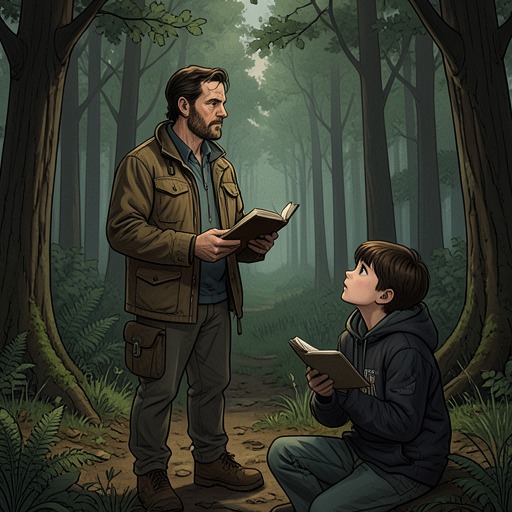
Senhor Davi Fagundes
BarkskinsSenhor Davi Fagundes, a furniture maker in Manaós, is Charley Duke Breitsprecher’s only known guide to identifying the trees he studies in the Brazilian forest. Their relationship grows through Charley’s notebooks and the specimens he brings to Fagundes: the cabinetmaker’s knowledge can give a name to a branch, but its limits also reveal how much of the forest remains unclassified. In their final encounter, Fagundes tries to identify a seven-leaved twig while Charley is gravely ill, and then calls for an ambulance when Charley collapses.
Identity and Introduction
Fagundes is a furniture maker whose shop becomes a practical resource for Charley after Charley settles in Manaós. When Charley asks his habitual question about whether someone speaks English, Fagundes answers that he speaks a little. He is the only person Charley knows who can identify the bark, flowers, and branches that Charley gathers, making him a crucial interlocutor in a project that Charley cannot pursue through books alone.
The story gives Fagundes no extended biography or account of his life beyond the shop. Instead, it defines him through the work of looking closely: he handles branches, consults a dictionary, and tries to connect the material specimens with names. That modest expertise distinguishes him from Charley, whose determination to learn the forest exceeds his ability to recognize it.
Charley’s Study of the Forest
Charley begins by trying to make a catalog of tree species, but after two weeks realizes the task is beyond him. The number and variety of trees overwhelm his initial scheme. He can observe their habits, yet cannot identify most of what he sees; Fagundes is the sole known person who can help bridge that gap.
Charley records a wide range of named woods in his notebooks, including mahogany, Brazilian rosewood, teak, bloodwood, zebrawood, ipe, cambara, anigre, bubinga, cumaru, jatoba, lacewood, and makore. Hundreds more remain unnamed to him. Even with Fagundes’s help, Charley considers himself fortunate to identify one tree in a week, draw its general shape, and list associated epiphytes and strangler vines. The notebooks thus register both knowledge acquired and the scale of what remains unknown.
Fagundes asks why Charley wants to know the trees. Charley explains that he is trying to learn the species of this forest, unlike the forests where he comes from. The exchange makes the difference in their positions explicit: Charley approaches the trees as a newcomer seeking a systematic record, while Fagundes’s craft gives him a practical, local capacity to recognize some of their materials.
Knowledge and Its Limits
Fagundes’s assistance is valuable but not comprehensive. As Charley continues to bring him specimens, the cabinetmaker increasingly raises his hands and says that he does not know. This repeated admission marks a limit in the collaboration, not a failure of effort: the forest contains far more kinds of trees than either man can readily name.
The notebooks preserve the tension between naming and abundance. A name allows Charley to distinguish and record a particular tree, but the accumulating list cannot stand for the whole forest; hundreds of kinds remain beyond his identification. Fagundes’s expertise is therefore significant precisely because it is partial. The scenes in his shop show knowledge as something practical and shared, while refusing to suggest that one knowledgeable guide can make an immense forest fully legible.
Final Encounter and Charley’s Death
Years later, Charley enters Fagundes’s shop clutching a black twig with seven leaves. He is shaking and too ill to speak, so he holds out the branch instead of explaining what he wants. Fagundes takes it, twists a leaf, and consults his dictionary before identifying it as leopardwood, distinguishing it from lacewood while noting that the two look somewhat alike.
Charley sways, reaches for the twig, and drops to the floor in convulsions. Shocked and afraid that Charley may have a serious contagious disease, Fagundes calls the hospital for an ambulance. Charley dies a week later in Manaós of Plasmodium falciparum. The sequence places Fagundes’s act of identification beside his attempt to obtain help: in the shop, the branch is a specimen to be named, but Charley’s collapse turns the moment into an emergency that the cabinetmaker cannot resolve through his craft.
Narrative Significance
Fagundes occupies a small but consequential place in Charley’s forest project. He is neither a comprehensive authority nor a merely incidental shopkeeper: he is the one person Charley knows who can identify the materials he brings, and his willingness to examine them makes the notebooks’ slow accumulation of names possible. His repeated uncertainty, however, keeps that work from becoming a story of mastery over the forest.
The final twig concentrates this relationship into a single encounter. Fagundes can recognize the specimen as leopardwood, but that precise knowledge does not prevent Charley’s collapse or change its outcome. His role is defined by care and attention within narrow limits: he helps Charley see one more tree clearly and, when the crisis exceeds his knowledge, calls for medical assistance.