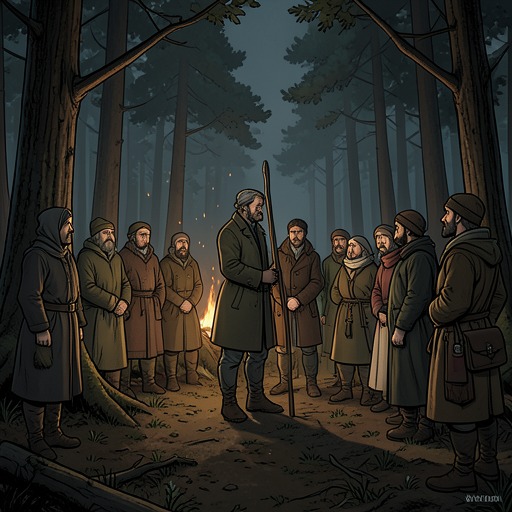
Benton Dred-Peacock
BarkskinsBenton Dred-Peacock is a Boston-connected colonial merchant who turns political knowledge and commercial relationships into a bridge between Charles Duquet’s ambitions and the timber markets of the English colonies and Britain. A practical, well-connected broker rather than a mere adviser, he helps Duquet move from an unstable fur trade toward forest commerce, while his own inheritance ultimately draws him back across the Atlantic.
Identity and Introduction
Duquet meets Dred-Peacock in an Amsterdam coffeehouse. Though dressed in fine clothes, Dred-Peacock has a face Duquet privately finds unprepossessing; what distinguishes him in conversation is his money, his knowledge of colonial forestry, and his intimacy with Jonathan Bridger, the newly appointed New England royal mast contractor. Dred-Peacock recognizes in Duquet a man capable of extracting money from whatever is available. Their mutual recognition is commercial: each sees the other as useful, even while their dealings carry an undercurrent of contempt.
Dred-Peacock is aligned with colonial interests and distrustful of Crown restrictions. He explains that colonists resent taxes and the Royal Board of Trade’s rules governing timber for the Royal Navy, including masts, bowsprits, yards, pitch, and tar. The Acts of Trade and Navigation, in his account, constrain commerce more broadly. He presents himself as someone who understands how business proceeds despite such limits—and who knows the people able to make it proceed.
Broker of Colonial Timber
Dred-Peacock describes the practical means of obtaining large white-pine tracts: buying old township grants and cultivating relationships with politically influential men. He says he has already made those connections. He also identifies the King’s Surveyor as an obstacle, portraying the official scrutiny of licenses and permits as a remote nuisance imposed by men who do not venture into the colonies themselves. His knowledge is more than general expertise: it is a map of property, influence, and administrative evasion that Duquet wants to learn to use.
When Duquet considers how to enter the timber business, Dred-Peacock offers routes and contacts rather than simply endorsing the idea. He points to Boston, Portsmouth, and Maine as places where locally sourced timber could make shipbuilding economical, and notes that colonial shipyards build vessels suited to carrying great pine masts to London. When Duquet hesitates over owning ships and insists on finding English customers for timber, Dred-Peacock connects him with an English shipbuilder and a promising yard on the River Clyde in Scotland. He stresses the short sailing distance and the yard’s need for good timber. Duquet accepts the opportunity, and Dred-Peacock takes a substantial share of the profits as their trade grows.
The partnership links New France’s forests to overseas demand through a chain of intermediaries and transport: timber is cut in the colony, sold into shipbuilding, and carried toward markets beyond it. The arrangement is initially secret, complicated, costly, and dangerous. Duquet’s timber ambitions bring extensive forest cutting, while Dred-Peacock profits from the commercial connection that makes the trade possible. Their work gives practical form to a central contrast in Duquet’s plans: fur supplies wealth that can fluctuate, whereas forest resources appear to promise a durable business.
Advice, Credit, and Family Negotiations
Dred-Peacock’s role extends beyond timber transactions. When Duquet seeks a way to obtain a shipyard, Dred-Peacock proposes several possible colonial ports and points out the advantages of building ships with local wood. Even when Duquet delays acting on that advice, Dred-Peacock keeps the conversation moving toward workable commercial arrangements, eventually steering him toward Scottish buyers instead.
He also discusses Duquet’s proposed marriage to Cornelia Roos with Captain Verdwijnen. Dred-Peacock considers the match valuable as a family connection to Duquet’s money and credit, while recommending terms that would keep Cornelia and any children in Amsterdam until they reached about fourteen. Under such an agreement, Duquet could continue his business in New France and the English colonies, visiting his family when business allowed. Dred-Peacock doubts that Duquet would be a hands-on father, but thinks he might accept the arrangement and may be lonely. The advice treats marriage as both a personal bond and a structure for managing family, money, and distance.
Inheritance and Departure
Dred-Peacock’s colonial identity changes sharply when a packet brings news that his older brother and nephew have died in a fire. He inherits the title, the family house—with its east wing partly charred—and the two-thousand-acre estate called Dred Yew in Wiltshire. His talk of colonial liberty and New England self-rule falls away as he accepts what he describes as his responsibility to his family, estate, and its great yew tree. He leaves for England at once, while saying that their business ventures may continue and promising to write once his affairs are settled.
Duquet reads the departure as revealing the English identity beneath Dred-Peacock’s colonial stance, comparing that change to rot hidden beneath tree bark. Dred-Peacock’s explanation gives the yew a significance Duquet cannot share: the tree has stood on his family estate since before Christ, and he invokes an older history of people who worshiped yews and oaks. Duquet dismisses the attachment as incomprehensible, but does not interrupt their business relationship over it. The episode makes the forest more than a stock of timber: for Dred-Peacock, an inherited tree belongs to family continuity and a long history, while Duquet sees commercial opportunity. His sudden departure leaves the partnership’s future open, but the text establishes that the business relationship is meant to survive his return to England.
Narrative Role
Dred-Peacock is a recurring hinge between places, markets, and systems of authority. His access to political connections and colonial practice helps Duquet move from the fur economy toward timber exports, and his introductions carry that timber toward a Scottish shipbuilding market. Yet he is not simply a mouthpiece for colonial independence: when inheritance calls, he accepts an English title and estate, revealing how quickly public allegiance yields to family obligation and property.
His contrast with Duquet also sharpens the novel’s treatment of forests as both commodities and inheritances. Dred-Peacock can describe white pine as a business asset and help turn it into a trade, but his departure is prompted by an ancient yew that he regards as part of his family’s history. The commercial network they build depends on forests cut and transported for distant buyers; the yew, by contrast, stands for continuity that cannot be reduced to the price of timber. Dred-Peacock’s divided attachments make him an effective intermediary—and expose the differing meanings the same wooded world can hold.