Achille Sel
BarkskinsAchille Sel’s life turns on a rupture between the land as a home and the land as a resource. Raised among Mari’s children, he becomes an extraordinarily capable hunter in Mi’kma’ki; when English settlers destroy his home and his family is killed, he leaves the land he loves and takes up lumbering in Maine, eventually gaining a fearsome reputation in the camps. His arc shows how colonial dispossession can make a livelihood out of the very forest and people it has displaced.
Identity and Background
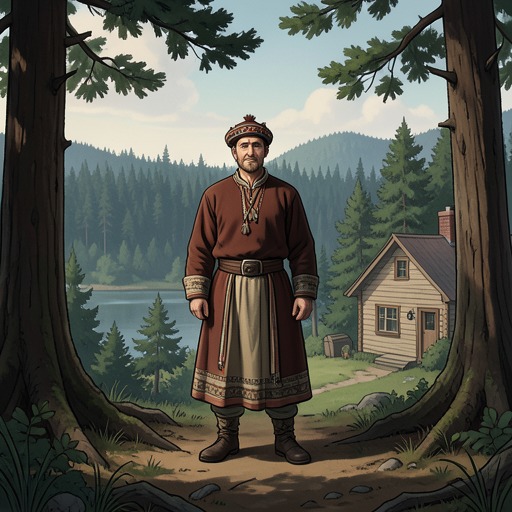
Achille is one of Mari’s children, alongside Elphège, Theotiste, Noë, and Zoë. The siblings come of age in a world increasingly unlike the rich Mi’kmaw past their mother described. Their family memories remain attached to ordinary objects and places: a knife-marked table, wooden plates shaped by René, and the former wikuom where the children had slept. Achille’s adult identity develops against the loss of that remembered home and the unsettled conditions facing his people.
His appearance is recalled as striking: tall, sinewy, and flexible, with glossy hair and warm, dark eyes. The corners of his mouth turn upward like Mari’s, a resemblance that leads observers to think of her. This family likeness connects him to his mother even as his later life takes him far from the household and landscape of his childhood.
The Hunter
Achille’s aptitude for hunting becomes the strongest expression of his chosen identity. He respects Cache Emil but is drawn especially to Sosep, whom he calls Nikskamich, meaning grandfather, and admires as a renowned hunter. Where his father René chopped wood and hunted when necessity demanded, Achille becomes passionately devoted to hunting and stalking on land, leaving others to concern themselves with rivers and the ocean.
He hunts through the seasons, sleeping out in the woods on snowshoes and joining Rouge Emil to hunt seals on winter ice. Before a summer moose hunt, he takes a steam bath and rubs himself with earth and leaves to conceal his human scent. Unlike other hunters, he generally does not rely on dogs to find moose: he can smell them at a distance and understands their habits. Sosep tells Cache Emil that a hunter like Achille appears only once in several generations, comparing his rare ability to that of a megumoowesoo honored by Kluskap. To Achille, however, Sosep jokes that he must marry and learn to play the flute to attract a wife.
His hunting also brings him into contact with ecological loss. On an island, he and Rouge Emil take great white auks for food and use their gullets to make arrow quivers. When they return the following year, the birds are gone; English and Boston whalers have visited first. The changed island anticipates a wider pattern: the resources on which Achille’s life depends are being depleted by newcomers.
Dispossession and the Loss of Home
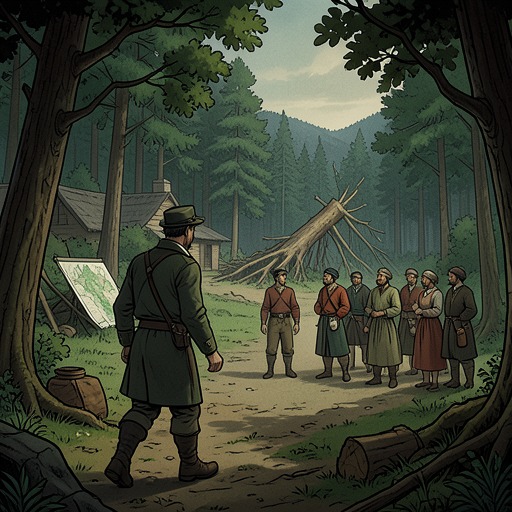
Achille’s great hunting journey with Kuntaw carries the memory of a living, abundant country, but its return brings catastrophe. Approaching home with a moose quarter for a welcoming feast, he and his companions find two hundred English settlers cutting trees and building log houses where his wikuom had stood. Thirty armed soldiers are present, and the remains of his home are still smoking. When Achille demands to know what has happened to his wife and children, the soldiers point their weapons at him; in the ensuing attack, he is wounded and sees evidence that his wife Isobel has been killed.
The destruction ends his life as a hunter in Mi’kma’ki. Achille tells his brothers that the land’s richness has made it a target for those who will take it, and declares that his life there is finished. He resolves to go south and work as a lumberman in Maine, saying that he will despoil the settlers’ land as they despoil his. The decision is at once a response to forced displacement and a bitter reversal: the hunter who had lived by knowing the forest now enters an industry that cuts it down.
Lumber Camps and Reputation
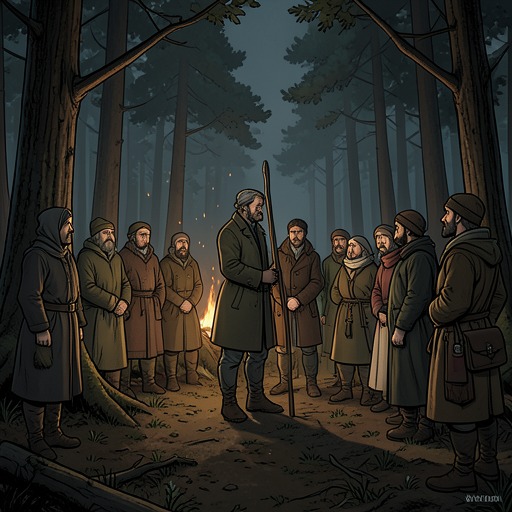
In the disputed border region between Maine, New Hampshire, and New Brunswick, Achille finds Georges Fraude, who offers wages to choppers and work on log rafts after the ice breaks. Achille signs on. The camps are part of an expanding network of pine cutting, with sawmills appearing wherever there are falls. The timber harvest alters the forest: new seedlings grow on cutover land, but the break in the woodland’s density changes the succession of species. Achille recognizes a parallel between the forest and the Mi’kmaq, both used and diminished by white settlers.
He remains in the camps for years rather than returning north to his people. Known as a skilled axman, he keeps to himself, and other camp workers give him space. Accounts of his responses to threats make him feared: an attacker who approaches from behind is stopped before he can strike, and a man who tries to set fire to Achille’s wikuom dies in the blaze. The newcomers call him a killer Indian and associate him with stories of earlier violence against settlers. Their label turns his individual resistance into a colonial stereotype, obscuring the dispossession that has shaped his life.
Family Legacy and Narrative Significance
Achille’s disappearance becomes a lasting absence for his son Kuntaw. Kuntaw hears stories of a skilled hunter named Sheely, thought possibly to be Achille, working in New York State on the Raquette River. He imagines finding his father and perhaps returning with him to Mi’kma’ki. The hoped-for reunion gives Achille’s departure consequences beyond his own life: it leaves his son searching for both a parent and a connection to the older way of living.
Years later, Kuntaw remembers Achille standing with a great dead bear on his back, an image of strength and intimate knowledge of the forest. After losses in his own life, Kuntaw resolves to go north and learn trees as the old people knew them, rather than seeing them only as material for houses or ships. Achille thus persists not through a confirmed return, but through the example of a relationship to the forest that his descendants struggle to recover. His story also holds an unresolved contradiction: forced from his homeland, he joins the extractive labor that damages forests, while understanding that the same logic of use and depletion has been directed against his people.