Dieter Breitsprecher
BarkskinsDieter Breitsprecher is a forester whose expertise and conscience expose the costs of the timber empire he helps build. Trained in European forestry and attentive to soil, water, and regeneration, he recognizes that the American appetite for timber is not simply a matter of cutting trees: it can devastate whole forest systems. His marriage to Lavinia Duke places him inside the company’s leadership, but their alliance never resolves the tension between immediate commercial power and the long future of the land. He works to set aside and replant cutover acreage, argues for public forest protection, and urges a change in the industry’s timescale; his death leaves that unfinished work to his family and successors.
Background and arrival in America
Dieter’s childhood was shaped by loss. His parents died in an avalanche during a holiday in the Jura, and his severe maternal grandmother raised him afterward. He studied privately with Heinrich von Cotta in Saxony and became a forester on the estate of Graf Ernst-August von Rotstein. There he catalogued forest insects and their effects on different tree species, a form of close observation that contrasts with the timber men’s tendency to regard forests as an undifferentiated supply.
His cousin Armenius Breitsprecher’s letters drew him toward North America. Armenius read Dieter’s account of the estate forest with envy and invited him across the Atlantic. Dieter replied in March that he was making the journey; Armenius calculated that he was then at sea and might arrive within two weeks. When Dieter reached the wharf aboard the Hansa, Armenius waited with his dog, Hans Carl von Carlowitz, and searched the arriving passengers for his cousin before Dieter greeted him from behind.
Dieter came not merely to travel but to see North American forests and assess timber investments for Graf Ernst-August, his second cousin. The Graf had been reluctant to let him go, but, after reading Armenius’s letter, instructed him to see everything and report promptly if he found promising investments. The commission thus joined scientific curiosity to commercial reconnaissance from the outset.
Forestry in the logging frontier
Armenius and Dieter set out with large knapsacks: Armenius carried dark tobacco, while Dieter brought a heavy .60-caliber jaeger rifle. Armenius’s new .50-caliber plains rifle, with its beaver-tail cheek piece, fascinated Dieter enough that he ordered one from a Missouri gunsmith before they departed. Their equipment belonged to the practical world of travel, but their attention to the forests soon divided them from the assumptions of the timber business.
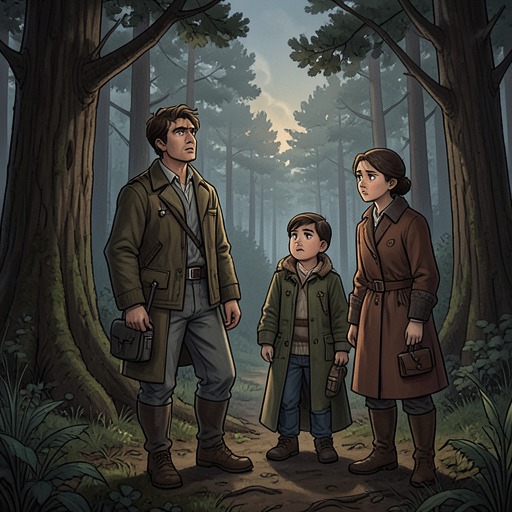
Dieter saw a basic failure of knowledge in American forestry. Shelter belts, thinning, pruning, the relation between soil and forests, the role of water, hedgerows, and coppices were unfamiliar or dismissed. He called these elementary practices as foreign to Americans as Chinese. On a ten-day walk through the great pines he grew quiet, sometimes scraping away the needles to examine the soil beneath the layer of forest debris. His method began with the ground underfoot, not only with the timber that could be removed from it.
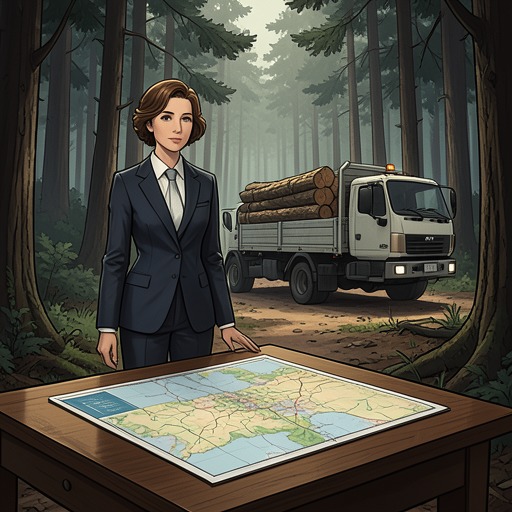
The contrast sharpened as Duke & Sons mapped its holdings around Saginaw Bay. Edward Duke studied thick survey pages against a freshly drawn map, with company sections crosshatched in sepia, and came to believe that the exploration had happened at his urging. Armenius, by contrast, understood the discovery as a turning point in the company’s appetite: Duke & Sons seemed intent on clearing the continent, wasting sound wood, stripping soil, and leaving erosion and forest ruin in its wake. The belief that another forest would always be available, he feared, could turn rapacious extraction into the company’s engine.
Dieter’s expertise also shaped competition. When RBB Timber Company emerged as a rival, Armenius identified its name as Rotstein, Breitsprecher and Breitsprecher, linking the new concern to their former landlooker and to Dieter’s European connection. Dieter’s scouting and his knowledge of forestry therefore served investment and competition even as those same skills enabled him to see what the industry was destroying.
Marriage, management, and conservation
Dieter’s relationship with Lavinia developed amid that conflict. When she wrote to Armenius asking how to learn log scaling, he dismissed her request as a rich girl’s passing fancy and threw her letter into the woodbox. Dieter retrieved it the next day and answered for himself, offering to teach her personally if she could come to Monroe for a week. His response treated her interest as something that could be tested through work rather than dismissed on the basis of gender or class.
Years later, when Lavinia welcomed him, she noticed his height and broad shoulders, his hair beginning to lose its yellow color at the temples, and the openness of his face. She felt awkward and wished the evening were over. Dieter nevertheless asked her to marry him. Their marriage joined the two families’ commercial power, but it did not place them on equal terms in the company: Dieter became its public figurehead while Lavinia continued to manage and control the business, building the Duke empire by whatever means she considered necessary.
Dieter pressed for a different legacy from the company’s cutover lands. He asked that the logged-over pine acreage not be sold to speculators, but held and managed through a separate division, Maintenance Timberland, which he would oversee and replant. He also retained acreage outside the merger. These measures supplied the first evidence of forest conservation within Duke & Breitsprecher’s reputation, though they existed alongside a business still driven by large-scale extraction.
His ethic extended beyond setting land aside. Dieter insisted on planting for a future that the planter would not live to see, locating responsibility in the health of the world rather than in the immediate benefit to people not yet born. The principle makes the seed a measure of time: it asks a company accustomed to rapid returns to accept obligations whose fulfillment lies beyond an individual lifetime. Yet the conservation division remained only a qualified counterweight to the destructive scale of the enterprise.
Family, forests, and competing futures
Dieter’s sons did not share one response to his forestry ideals. Charley Breitsprecher’s preference for wild forests unsettled him; Dieter saw it as evidence that his older son was drifting toward failure and wondered how to draw him into the company. Charley, however, wanted a cause rather than a commercial role. He said he was no businessman and might write a book, but what drew him was the search for the wild forest’s central force. Their disagreement was not simply over a career: Dieter hoped to involve his son in the work of the company, while Charley sought a reason to study forests on their own terms.
Dieter also tried to influence his younger son after Charley wronged Caroline Breitsprecher. He acknowledged the harm and insult, but begged James Bardawulf Breitsprecher to restrain his anger, forgive Caroline, and not blame her. Dieter feared losing another son and embraced him as he pleaded. James pulled away, anxious to return to Caroline and pursue the path his older half-brother had taken. The scene reveals a father attempting to prevent family violence from becoming another permanent inheritance, without being able to command reconciliation.
When Charley left Chicago, Dieter arranged a small house for him in Lugar da Barra do Rio Negro, or Manaós, along with a modest monthly allowance. The wild tropical trees were waiting there, and Dieter understood the provision as the limited help he could offer a child he had once imagined becoming a man of the trees. The arrangement preserved Charley’s independence while acknowledging the distance between his interests and the family company.
Dieter’s own work continued in public and professional life. He pressed politicians for greater funding and authority for the Forest Service, opposed the argument that fires were useful because they opened land to settlers, and protested the refusal to spend money on scenery. Through letters, telegrams, and telephone calls, he sought support for new pine and fir nurseries to replant burned mountains and reduce landslides in damaged soils. He tried, again, to interest his older son in this work, linking forest recovery to both public responsibility and the practical survival of the timber industry.
He also corresponded with George Perkins Marsh, whose attention to ordinary changes in the landscape matched Dieter’s own concerns. Marsh noticed fallen branches, the depth of leaf mold, rain caught by roots, and the absorbent layer of moss and decaying leaves. He observed the damaged soil left when trees were removed and the disappearance of birds when a pond was drained. As their letters continued, Dieter came to recognize Marsh not only as an observant farmer from Vermont but also as a linguist, congressman, diplomat, and traveler. Dieter hoped to visit him and see the landscapes Marsh had studied.
Death and unfinished work
Dieter’s hopes for reform were interrupted by a rapidly worsening illness. Not long after Charley’s departure from Chicago, Dieter went home early with a headache and expected rest to help. The next day he also had a stiff neck; by the end of the week he was partly paralyzed, and a doctor diagnosed polio. He told Mrs. Garfield that it was hard to breathe. By Saturday, pneumonia had killed him.
His death left no simple resolution between conservation and extraction. The land he had set aside and the nurseries he advocated demonstrated that company practice could be altered, but the scale of industrial forestry still demanded a change in what logging firms considered their own future. Conrad Breitsprecher, studying forestry after Dieter’s death, concluded that successful replanting depended on site preparation and that timbermen had to see the work and its costs as beneficial. He decided that Breitsprecher would offer site preparation as a service. Dieter’s legacy thus continued less as a completed victory than as a practical question passed onward: how could forests be made to return within an industry organized around removing them?