Ahorangi Oval
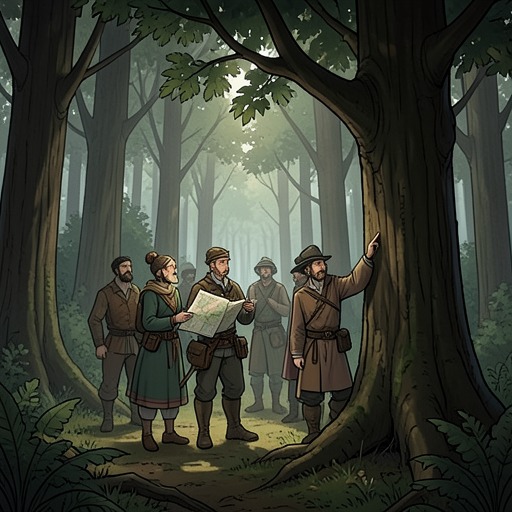
BarkskinsAhorangi Oval is a Māori woman whose forest knowledge and direct appeal to Lavinia Duke make the human and ecological stakes of logging in New Zealand impossible to treat as an abstract business question. As Lavinia and Dieter Breitsprecher prepare to travel through the forests, Ahorangi welcomes them into her country, explains the cultural and practical importance of its trees, and asks Lavinia not to cut them. The encounter puts Māori relationships to the forest in direct conversation with the timber company’s plans, without resolving the conflict between them.
Identity and Introduction
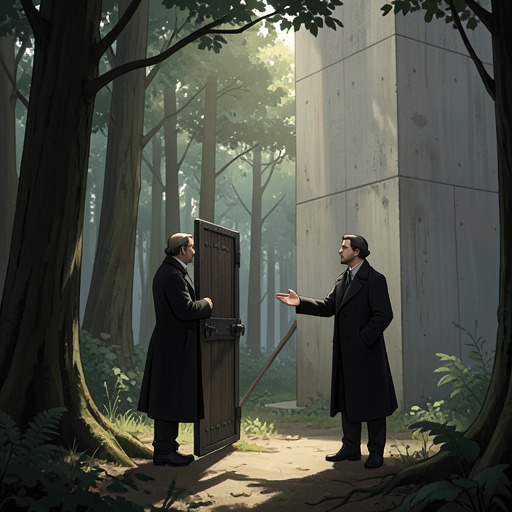
Ahorangi is introduced as Nashley Oval’s wife and as a Māori woman fluent in upper-class English. Lavinia, who has been imagining what an Englishwoman accustomed to riding bareback might be like, is surprised when Ahorangi enters wearing an orange cotton skirt fringed with feathers and a supple flax garment that leaves one shoulder bare. Her long black hair and facial tattoos mark a visible difference from the expectations Lavinia has formed. Ahorangi herself sets the terms of the meeting with a warm welcome to her land, then learns that Lavinia and Dieter are to travel through the forests with her husband and his party.
Her welcome is not simply hospitality. Ahorangi says that she and Nashley have learned about the visitors through their mutual friend George Perkins Marsh, whom they met in Italy. That connection gives her a place in a wider network of travelers and forest advocates, but her authority in the encounter comes from her own knowledge of the place and her commitment to it.
Forest Knowledge and Māori Values
During the visit, Ahorangi identifies totara as the tree her people esteem above all others. Lavinia asks whether it ranks above kauri; Ahorangi answers that Māori revere kauri, but that it is the white men who love kauri to the exclusion of other trees because they prize it as an ideal timber. Totara, she explains, is more deeply entwined with Māori lives and religion. Alongside totara, she names rimu, kahikatea, and rata as chieftain trees, or royal trees.
Ahorangi’s account distinguishes a forest understood through relationships from one ranked chiefly by its usefulness as timber. Other details of the visit make that distinction concrete: totara serves Māori for carvings, war canoes, houses, and structural timbers; its fruit is edible, and a bark decoction controls fever. Rimu, which Ahorangi calls her favorite, also matters to the timbermen. Its berries feed the kakapo, a flightless parrot whose nighttime call Lavinia had heard from the Fern House. The forest is therefore not only a store of saleable wood: it sustains food, medicine, cultural practice, and animal life.
The Appeal to Lavinia
Ahorangi understands that Lavinia has come to inspect trees with cutting in mind. She tells her that the trees are her people’s lives and that living happily in that place depends on them; she asks Lavinia not to cut them. Lavinia says nothing. Ahorangi reads the silence as an answer and spends the remainder of the day with her husband and brothers, making no further effort to speak with Lavinia. The pause records a failure of persuasion without turning Ahorangi’s request into an abstract debate: she has stated what is at risk, and Lavinia has not promised to protect it.
After dinner, Lavinia tries to repair the exchange and invites Ahorangi to call her by her first name. She acknowledges that she is there to look at kauri for cutting, but contrasts that purpose with Dieter’s belief in replanting what is taken. Lavinia proposes planting a young kauri for each large tree felled and caring for the seedlings as they grow. Ahorangi answers that the mature kauri are thousands of years old and that a seedling would need a hundred human generations to replace a fallen tree as large as Kairaru of Tutamoe. Her reply establishes the scale of the loss that a numerical replanting scheme cannot erase within a human lifetime.
Collaboration and Its Limits
Dieter responds that seeds must be planted in faith: people can plant trees they will never see grown, for the health of the world and people yet unborn. Ahorangi does not withdraw her warning, but the conversation moves toward a practical possibility. Nashley plans to empty his glasshouse of lettuces and green peas, collect kauri seeds in February, and attempt to raise young kauri. Ahorangi tells him he will be the first in the world to do so. Dieter encourages the undertaking, urges him to keep growing vegetables and build a separate glasshouse for the kauri, and offers to contribute to the venture.
The exchange gives Ahorangi a role beyond that of a cultural guide: she helps keep the consequences of logging in view while a planting project begins to take shape. Yet seedlings do not answer her central concern about cutting mature trees. Her account of their age and of kauri’s place in the forest keeps restoration in tension with extraction: planting can express responsibility to the future, but it cannot promptly replace what has been lost.
Narrative Significance
Ahorangi’s conversations with Lavinia and Dieter make Māori knowledge an active part of the novel’s discussion of timber, rather than a background detail to an industrial venture. She describes trees through their relationships to religion, food, medicine, and animal life, while Lavinia’s initial interest is explicitly directed toward trees that might be cut. That contrast gives the forest competing meanings and makes the proposed journey a moral as well as commercial encounter.
Ahorangi’s appeal also marks the limits of polite exchange. She welcomes the visitors and shares detailed knowledge, but when Lavinia’s silence leaves the request unanswered, Ahorangi withdraws from conversation for the day. Later discussion of seedlings opens a narrow path toward cooperation without presenting the underlying disagreement as settled. Her presence thus makes both the possibility and the inadequacy of conservation through replanting visible: a future forest can be cultivated, but the lives already bound to the standing trees cannot be reduced to a planting calculation.