James Bardawulf Breitsprecher
BarkskinsJames Bardawulf Breitsprecher is Dieter Breitsprecher’s younger son, the half brother of Charley and the father of Conrad. His story connects the private damage within the Breitsprecher family to the larger questions of inheritance and corporate legitimacy: after a violent break with Charley, James eventually writes to him in remorse, while the old dispute over who has the truest claim to the family fortune returns to threaten the company itself.
Identity and Family Background
Dieter remarried a year after Lavinia’s death. His bride, Rallah Henge, was thirty years younger than he was, and the logging business held little interest for her; she hoped for children. Their son, James Bardawulf, was born eighteen months into the marriage. More than a decade later, Rallah gave birth to Sophia Hannah, but died of breast cancer before Sophia could walk and before James reached his teens. Charley had already left home by then, leaving James among the children Dieter would later regard as both dear and difficult.
The family’s structure carried a consequential distinction between adoption and blood. Charles Duquet had adopted Jan and Nicolaus, and his descendants included Dieter’s line; after those adoptions, his wife Cornelia also bore two biological children. Generations later, R. R. Tetrazinni explained to Lavinia that James’s ancestry, like hers, ran through the adopted Nicolaus, while the living blood descendants came through Charles Duquet’s biological son Outger and daughter Beatrix. James would eventually confront the practical consequences of this old distinction: a family fortune built and held across generations could be challenged by descendants whom its present owners scarcely knew.
Family Tensions and the Assault on Charley
James appears at a family gathering as a sharp-edged presence. When he and Caroline arrive, he pours himself a whiskey highball without asking what anyone else wants, leaving the hospitality to Dieter. At a dinner where the family’s business and forest management are under discussion, James mocks Charley as someone who knows everything about logging but waits for an error before attacking the speaker. The joke stokes an already familiar antagonism. Dieter intervenes directly, warning James and Charley not to start quarrelling and asking Caroline to talk about the children instead.
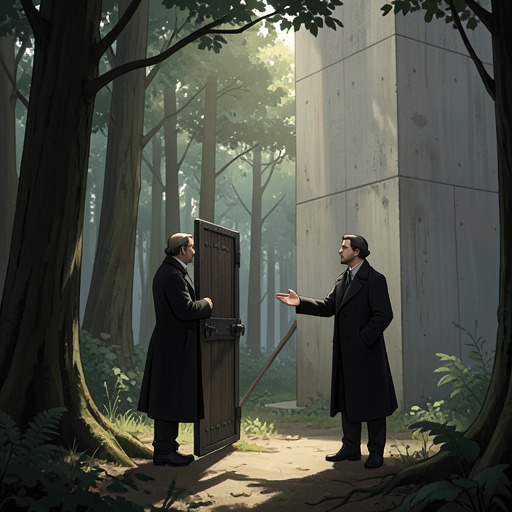
The conflict escalates later that evening. After Charley violates Caroline, James attacks him with a knobkerrie. Servants pull James away, but he continues the assault with a rosebush, and Charley is left unconscious with a grave head injury. Dieter has him taken to hospital under guard because it is clear James may try again. The violence also exposes the danger Caroline faces within her marriage: after the attack on Charley, James assaults her as well. The scene is not a simple contest between brothers; Charley’s wrongdoing toward Caroline and James’s subsequent violence create a household crisis in which her safety is also at stake.
Dieter tries to prevent the rupture from becoming permanent. He acknowledges that Charley wronged Caroline and insulted James’s honor, but says that Charley will leave the family and live abroad if he recovers. He asks James to relinquish his rage, warning that anger and the desire to kill can poison a life, and tells him he cannot bear to lose another son. James pulls away from his father, still intent on returning to Caroline. His rejection of Dieter’s appeal leaves the injury and the family division unresolved for years.
Reconciliation and Inheritance
The eventual opening comes after Dieter’s death. James has been composing an apology in his mind for years; when Charley’s address is found in the correspondence file, James decides to send a personal letter along with the legal papers. He writes that both brothers have matters to regret and resolve, says he is deeply sorry for attacking Charley, and notes that he has suffered remorse ever since. He also refers to their son Conrad as a good born out of the family’s painful history, and offers Charley an affectionate welcome should he return to Chicago.
Charley reads the letter repeatedly and weeps. He replies not with a return home but with a material act of reconciliation: he disclaims most of his share of Dieter’s estate and asks that it go to James and Caroline, for reasons they understand. When the will and letter are read a month later, James catches his breath. The exchange marks a change on both sides: James has acknowledged his violence, and Charley has chosen to direct wealth toward the family he left. Their reconciliation remains expressed through correspondence and inheritance rather than a narrated reunion.
James and Caroline raise Raphael, Claude, and Conrad with an eye to their future. As war begins in Europe, they consider schools for the boys; James chooses a military academy in Indiana for Raphael and Claude and places Conrad’s name on its list for later, although Conrad is not yet nine. This attention to the next generation contrasts with the earlier instability in James’s own family and with the unsettled inheritance that continues to shadow it.
The Heir Dispute and the Company’s Fate
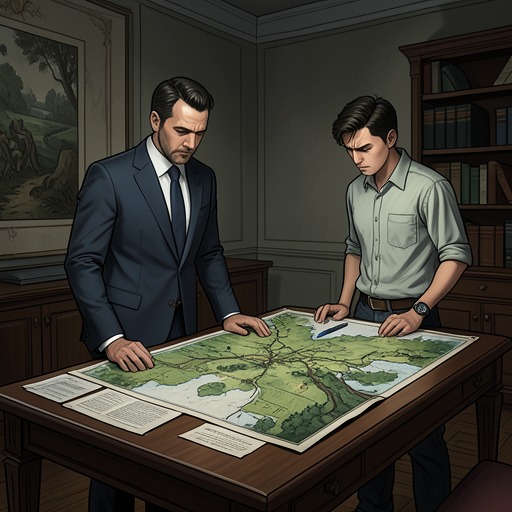
Decades after Lavinia commissioned a search for heirs, the old report becomes an active threat. James tells the company’s directors that Tetrazinni Search Services specializes in tracing unknown heirs and that its head, Chandler Tetrazinni, has located relevant papers. James fears the search may now reach the people identified as Charles Duquet’s blood descendants and that Tetrazinni may offer them a contract based on a share of any inheritance. He points out the irony that Lavinia herself initiated the investigation, even though the discovery could undermine her family’s claim if blood descent is treated as the decisive criterion.
The question is not merely genealogical. Tetrazinni had argued that the descendants of the adopted sons possessed a stronger claim in practice, invoking possession as a principle; the report nevertheless identifies the grandchildren of Josime and Francis-Outger as the living bloodline descendants. James’s account makes clear that renewed attention to the file could turn a nearly forgotten family history into a legal and financial dispute over the company’s assets.
James later reports that Tetrazinni has been killed in a fight with a burglar and that the office was ransacked, with papers and files disturbed and the safe open. The information comes to him through Hazelton Culross and a newspaper report, and James is still waiting to see whether Chicago papers confirm it. His final reported remark is that the company can proceed with the sale. Soon afterward Breitsprecher-Duke passes to International Paper; only boxes of papers, portraits, and the separate Breitsprecher Seedlings remain of the old company. James’s part in this ending is not to resolve the blood claim, but to recognize that the sale can go forward as the family’s corporate world recedes into archives and remnants.