Sosep
BarkskinsSosep is an elder Mi’kmaq trapper, guide, and teacher whose knowledge helps a younger generation return to Mi’kma’ki while confronting the changes that threaten their land and way of life. A respected hunter with a fading public standing as sagmaw and local chief, he offers more than a route home: his advice joins seasonal knowledge, family history, and a clear-eyed account of colonial encroachment. His sudden death leaves that inheritance unfinished, but his teachings remain with Achille, who calls him grandfather.
Identity and Knowledge
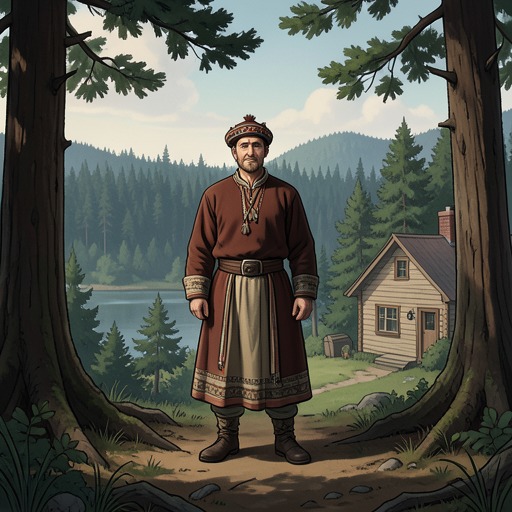
Sosep is introduced at Odanak as an old trapper and sagmaw, a figure with several kinds of standing whose reputations are not equally intact. He is still known as an important trapper-hunter; his reputation as a sagmaw is wavering, and that of a local chief has faded. His scarred face, failing sight, and grave manner mark him as an elder, while his advice shows the practical authority he retains. He knows the country through work and memory, including trapping routes and the places favored by Theotiste’s father.
His understanding is not limited to survival. Sosep recognizes the pressure of French settlement in the landscape and objects to the priest at Odanak, Father Lacet, for damaging waltes bowls so they cannot be used for divination. The detail connects religious intervention to a broader attempt to displace Mi’kmaw practices. Sosep’s knowledge thus encompasses both the material conditions of life and the cultural practices under pressure.
Guide to the Return
When Theotiste, Elphège, and Achille want to leave for Mi’kma’ki, Sosep advises them not to set out as winter advances. He explains that the country is a summer place and that winter there is difficult without provisions; his pointed measure of adequate preparation is ten cached moose and sixteen bears. The young people have heard their mother Mari describe abundant fish, shellfish, birds, and plants, but Sosep distinguishes those remembered summer riches from the scarcity they might face in winter.
The group waits more than four lunar cycles at Odanak. During that time the siblings hunt, fish, and discuss the best route, while the women help Noë and Zoë dry and smoke venison and eel for the journey. Sosep’s insistence on waiting makes preparation, rather than eagerness, the condition of a safe return. When they finally depart, he accompanies them, along with a woman friend of Theotiste’s deceased wife. He has a practical reason to go: his trapping run remains in Mi’kmaw country, if French settlers have not built on it. He also tells the travelers that he knows their father’s favored trapping places because the father’s brother told him.
That information leads to a family revelation. Sosep identifies the brother as Cache Emil, who is alive and can show the siblings those places. The news that they have a living uncle gives the journey a personal destination as well as a territorial one. Yet Sosep does not soften the danger: he warns that white settlers want those places and take them without discussion or courtesy.
Colonial Pressure and Cultural Continuity
Sosep explains that returning is dangerous not only because of the weather. The French king, he tells the travelers, has given their lands to the British. Theotiste rejects the premise: the land belongs to the Mi’kmaq, not to a French king with authority to transfer it. Their exchange sets two conflicting understandings of territory against each other—land as something a European ruler can grant, and homeland as a place to which its people already belong.
Later, Sosep describes encroachment through its effects on everyday subsistence. Settlers’ animals damage food sources, their boats and nets take fish, and introduced plants displace local plants. He recognizes that many newcomers may not intend harm, but stresses the imbalance between their numbers and those of the Mi’kmaq. His warning that they are like a great wave makes the threat cumulative: land, food, and customary access are being lost through many changes, not just a single confrontation.
Sosep’s answer is not to demand that his people reject every new object. Noë wonders whether his teaching means they must abandon metal pots and return to older cooking methods. What he asks them to preserve is a Mi’kmaw understanding of relationship: people, plants, animals, and birds are persons who help one another. They must keep that world alive in thought and practice even as they live in two worlds. Cultural continuity, in Sosep’s account, is an active discipline that can withstand external pressure; it is not simply a return to an untouched past.
Teacher, Hunter, and Grandfather
Achille’s close association with Sosep develops through shared hunting. Achille prefers to hunt with him and calls him Nikskamich, meaning grandfather. He learns from a man who treats hunting as intimate knowledge of animal habits and environment. Achille does not use dogs to find moose outside winter; he can smell them at a distance and understands their behavior. Sosep tells Cache Emil that Achille is a hunter of extraordinary ability, comparing him to a megumoowesoo, one of the Mi’kmaq whom Kluskap has honored with unusual gifts.
Sosep’s encouragement is also personal and teasing: he tells Achille that he should marry and learn the flute to attract a partner. The joke places the young hunter’s exceptional skill within the ordinary expectations of communal life. Achille’s growing competence does not set him apart from the community; Sosep imagines it as part of a life that includes relationships and responsibility.
Death and Narrative Significance
Sosep dies suddenly after a hard day hunting moose, seated by the fire with meat in his hand. Achille first thinks he has simply fallen asleep and cannot be roused. The quietness of the death is important because Sosep had planned a death song: a formal account of his hunting feats, journeys, children, and remarkable experiences. He dies without singing it, and the story he meant to tell is left unspoken.
Achille goes to the sea and addresses his grandfather with a wish for a good journey beneath it, recalling the words Sosep had spoken during an earlier encounter with an orca: “You are not.” In that episode the animal had carried away Achille’s spear after he struck it; Sosep’s familiar voice seemed to issue from the creature before it disappeared. The phrase returns at Sosep’s death as a reminder of the limits of Achille’s understanding and of the bond between teacher and pupil. Sosep’s life is not reduced to the absence of his death song: his warnings about territory, his knowledge of the seasons, and his teaching about a shared Mi’kmaw world continue through those who heard him.