Josime Sel
BarkskinsJosime Sel is Kuntaw Sel’s son, a Mi’kmaw woodsman whose path diverges from the lumber camps and the wage-dependent life increasingly imposed on his people. He moves between family and forest, joining Jinot Sel and Amboise Sel on a northward journey before choosing to live with his Odawa wife on Manitoulin Island. To Aaron Sel, who later seeks him out as a guide to the old forest life, Josime represents both a living relative and a way of life that Jinot believes no longer exists in its original form.
Identity and Family
Josime is one of Kuntaw’s sons, alongside Francis-Outger, and the uncle of Jinot and Amboise. When Tonny arrives with his three children, Kuntaw is away hunting with Josime and Francis-Outger; Beatrix Duquet tells Tonny that Kuntaw has often spoken of him and wondered whether he was alive. Josime belongs to a family whose members take different paths through the changing world: Francis-Outger marries and settles near home, while Josime works in distant lumber camps and later makes a home far away on Manitoulin Island.
That kinship is not merely a matter of names. After Francis-Outger turns twenty-one and marries a woman of half-French and half-Mi’kmaw ancestry, Josime leaves for the New Brunswick lumber camps. His departure is one in a sequence of young men moving outward from Kuntaw’s household. Amboise follows a month later; Jinot, left behind, watches the river drives and longs to join the camps. The family’s dispersal thus unfolds alongside the pull of paid forest work, while Josime’s eventual return to his wife marks another, contrasting kind of departure.
Joining Jinot and Amboise
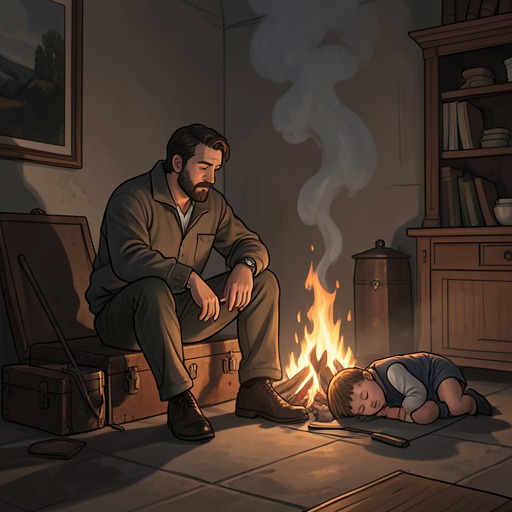
Josime re-enters the lives of Jinot and Amboise unexpectedly, arriving at their shack at night. Jinot wakes to a presence outside and reaches toward his axe; a voice begins a story about three children lost in the forest. Amboise recognizes his uncle-brother and calls him a fool, relieved that the intruder is Josime rather than a threat. The brothers gather by the fire, and the encounter becomes the start of a shared journey.
Jinot and Amboise intend to travel west as hunters, toward Pennsylvania and Ohio, following Kuntaw’s account of a forest that reaches the end of the world. Josime corrects them: the journey is his plan, and he has already given up the woodland he was to share with Francis-Outger. He tells his nephew-brothers that they should come with him, but insists that he is going that very day. His arrival turns their private longing into a joint undertaking. Together they travel north through woods already chopped and broken, past land converted into cornfields and pasture, looking for a place where trees still stand thick and wild. Josime has heard of a timber operation in the Gatineau country, giving their search a practical destination even as it answers a deeper desire to leave the altered landscape behind.
Leaving the Lumber Trade
The brothers’ shared work does not become Josime’s permanent life. More than two months after he has been away, he returns to Jinot and tells him that he no longer chops trees. He has stayed with the woman he met on Manitoulin Island, made her his wife, and come back only to say that he is returning to her. He describes his choice as a rejection of white work and of the men and practices that wound the land; living with his wife in the forest is what he wants.
Jinot sees the decision through a different lens. He compares Josime to Kuntaw, saying that both are enslaved to women, and notices that Josime’s speech has changed after spending so much time with the woman on Manitoulin. The exchange exposes a divergence between the brothers’ priorities: Jinot remains drawn to forestry work, while Josime chooses a life away from lumbermen and the damaged land. Josime’s decision is not presented as an abstract escape from society; it is tied specifically to his wife, the forest where they live, and his refusal to continue chopping trees.
Kinship, Memory, and Cultural Change
Years later, as Maine’s forests are cut into smaller pieces and logging becomes more mechanized, Jinot and Amboise leave the heavily cut Penobscot for New Brunswick’s older, quieter camps. Josime, by then, is still far away on Manitoulin. The brothers’ move reflects their discomfort with the scale and speed of commercial progress, but their work also shows the pressures on Mi’kmaw life: their people can no longer live without white goods and food, and increasingly work for pay instead of hunting and making what they need. Josime’s choice to leave logging stands in contrast to the brothers’ continued dependence on it.
Josime remains part of Jinot’s longing for family, even when they are apart. After Amboise is lost, Jinot decides to seek both Josime and Elise. In a letter, Francis-Outger says that the last news he has of Josime is Jinot’s account of parting from him in Montreal; he is pained that his full brother has never written. The lack of contact makes Josime’s absence palpable without erasing his place in the family: news of him travels through Jinot, and the possibility of finding him becomes part of a renewed search for relatives.
That search acquires a new purpose through Aaron. Jinot’s son does not want to cross the ocean to New Zealand; he wants to go to Nova Scotia and find Sel relatives, to know that life. Jinot suggests instead that he seek Josime on Manitoulin, because Josime has returned to the old ways. Yet Jinot immediately qualifies the promise: Josime’s life is not Mi’kmaw, but is bound to the Odawa woman he married. If Aaron wants to know the old forest life of their people, Jinot says, he must find Josime—but Aaron is too young to travel alone, so Jinot offers to accompany him after the New Zealand voyage. Josime is therefore a possible guide, not a simple repository of an intact past. Jinot’s words hold both the attraction and the loss: the old forest life may be approached through Josime, while the old Mi’kmaw ways themselves, he believes, no longer exist.