Pollo Jacko
BarkskinsPollo Jacko, the younger brother of Blony Jacko, enters the logging trade as a teenager and loses his left foot in a work accident. The injury ends his place on a cutting crew and river drive, but not his working life: with help from his brother, a camp cook, and other laborers, he recovers, learns to move with a prosthesis, and becomes a cook. His brief arc makes visible the human consequences of a logging system that treated dangerous labor as indispensable and injured workers as replaceable.
Identity and Background
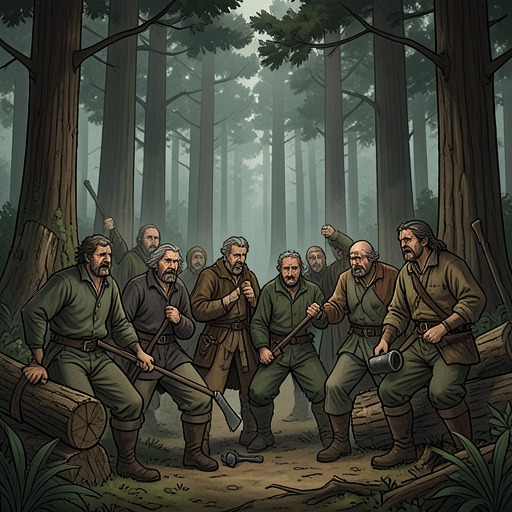
Pollo is one of the two sons of Mike Jacko. He and Blony resent their father’s efforts to keep watch over them, and the brothers leave for distant logging camps rather than remain under parental supervision. At fifteen winters, Blony is already working on a cutting crew in Queens County; Pollo is younger. Their departure places them within a wider history of Mi’kmaq men entering forestry work as traditional lifeways and access to land are constrained.
The brothers’ work belongs to a changing industry. Across generations, the Sel and Jacko families encounter successive tools and forms of transport: the poll ax gives way to the double-bitted ax and then the crosscut saw; oxen yield to horses, donkey engines, and geared locomotives. As roads reach timber farther from waterways, trucks replace river drives. The expansion of machinery changes the work but does not remove its danger; it relocates and intensifies it.
Logging Work and the Accident
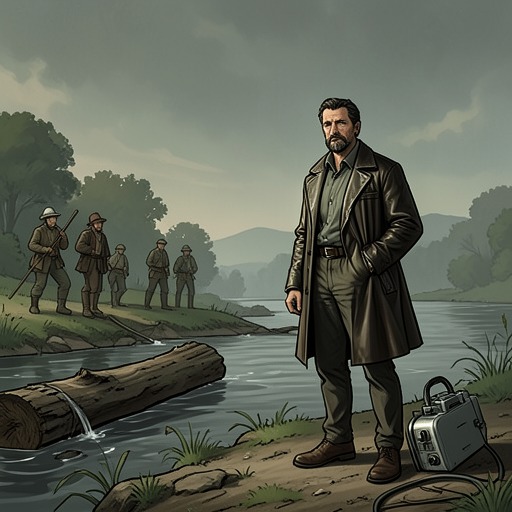
Pollo and Blony move west and spend a winter in Idaho, where logs are still transported along difficult rivers. In a later camp, the brothers encounter a donkey engine hauling timber with a steel cable. They watch a huge log being dragged toward the engine and run clear when it moves violently across the ground. The episode gives them an immediate view of the force that machinery brings into the woods, though Pollo cannot know that he will soon be caught by the same kind of cable.
Pollo is assigned to the steam-kettle crew. An hour into the work, he stands near a curve in a cable already attached to a distant log. When the engineer activates the mechanism, the tightened wire amputates Pollo’s left foot. The accident abruptly ends his logging work and leaves him dependent on the camp’s practical responses to injury.
Recovery and a New Role
Blony and the engineer carry Pollo to the bunkhouse. Andre Mallet, the second cook and the camp’s medic, elevates the injured leg, binds it with a clean towel soaked in melted lard, and gives Pollo whiskey for pain. Blony brings hot partridge broth and cake, while Mi’kmaw remedies their mother had supplied—crinkleroot and lady’s slipper root—are also used. Pollo sleeps through the immediate aftermath and gradually heals over the following weeks.
The camp boss initially allows him to remain until he can get around, but makes clear that Pollo’s bunk is needed for a workingman. Another chopper makes him a pair of crutches. When Mallet tells him that the boss has approved his helping in the kitchen, Pollo accepts the available work. After a year, he can move around using a prosthesis carved by loggers. He is becoming a cook, and a more permanent job may be possible.
Family and Narrative Significance
Pollo’s recovery is marked by mutual aid, but it takes place within a labor system with little security for injured workers. The boss’s condition—that Pollo can stay only until he is mobile enough to free the bunk—makes clear how quickly a worker’s place can be reassigned. The improvised crutches, the loggers’ carved prosthesis, and the transfer to kitchen work offer a path forward, but only within the camp’s limited options.
Blony’s later death deepens the consequences of the brothers’ departure. Pollo is the one who must write the letter home, turning him from the injured younger brother receiving help into the family member responsible for communicating a loss. His story links industrial danger not only to bodily change and altered employment, but also to the burdens carried back to family. It also stands within the novel’s broader account of Mi’kmaq labor: water and timber work expose Indigenous workers to severe risks, even as companies depend on their labor to move logs through the production chain.