Mi’kmaq
BarkskinsThe Mi’kmaq are not merely a people encountered by the novel’s settlers but a community with its own knowledge, political claims, and enduring relationship to place. Across the novel’s generations, that relationship is strained by colonial settlement, disease, resource depletion, and coercive assimilation. Their story records both material dispossession and the persistence of a Mi’kmaw identity that cannot be reduced to the changing boundaries or names imposed upon their homeland.
Homeland, Knowledge, and Everyday Life
The novel grounds Mi’kmaw knowledge in detailed familiarity with local waters, plants, animals, and seasons. When René Sel struggles to fish with the equipment Monsieur Trépagny has given him, Mari explains that her people use weirs to catch large quantities of fish. She later weaves three eel traps, supplies bait, and shows René where to use them; thereafter he brings her eels nearly every day. The exchange makes knowledge practical and relational: Mari teaches René a method adapted to the river rather than treating her own expertise as an abstraction.
Mari’s care for the household’s animals offers another instance of that expertise. While Monsieur Trépagny’s attempts to protect his oxen from insects are ineffective, Mari steeps tamarack bark in spring water and uses it to soothe their eyes. At the same time, she is made to labor in a garden she despises, and Monsieur Trépagny claims three days of René’s work each week, including a duty to supply fish for his table. These scenes place Mi’kmaw knowledge and labor inside a colonial household whose demands do not recognize the people’s equal standing or prior relationship to the land.
For Mari, homeland is inseparable from a network of rivers, foods, and medicinal plants. She recalls Sipekne’katik as a place of rivers, fish, eels, and good medicine plants, and contrasts it with the unfamiliar country where she has been displaced. Her account makes loss concrete: it is not simply a change of residence but separation from the ecological resources and lived knowledge that make a place home.
Displacement, Disease, and Colonial Pressure
Mari’s personal history introduces a pattern of coercion and epidemic harm. As a child at an eastern shore camp, she and six other Mi’kmaq were seized by French sailors and carried away on a ship, despite their unwillingness to leave. Taken to Paris, Mari became ill with smallpox but survived the return voyage to her homeland. The sickness she brought back contributed to the deaths of most of her people. Later, Monsieur Trépagny found her at a mission, hired her as a housekeeper, and forced himself on her. Her story connects colonial power not only to the seizure of territory but also to the control of movement, work, and personal life.
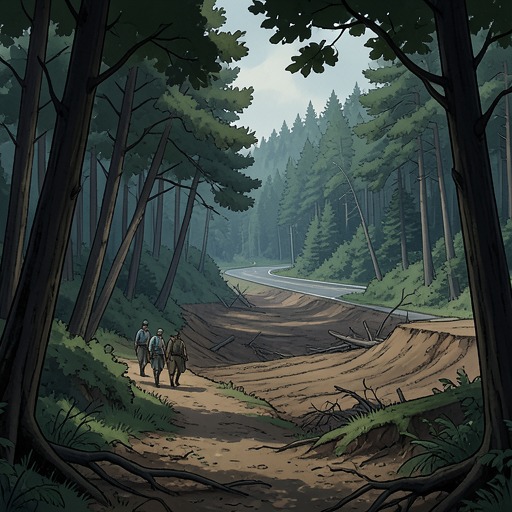
Settlement alters the landscape and the conditions of subsistence over time. On returning to Mi’kmaw country, Sosep points to French families along the shore, land turned over to maize and turnips, and salt marshes drained for hay. Moose, caribou, and bears have retreated; beavers have been reduced by trapping, and beaver skins have become a form of European money, displacing the practice of placing a skin on a grave. The changes accumulate across food, habitat, trade, and ceremony. They are not a single rupture but a continuing narrowing of the resources and practices through which people sustain themselves.
Sosep also describes a political landscape in which Mi’kmaq are repeatedly drawn into conflict even as their population has fallen. French authorities call on them to fight for France, while the English move onto their land and offer money for Mi’kmaw scalps. Sosep warns that the French king has given their lands to the British; war against the English follows, but the Mi’kmaq are few and frequently ill. The competing colonial powers treat Mi’kmaw lives and territory as instruments of their own contests, while the community bears the costs.
Identity, Adaptation, and Two Worlds
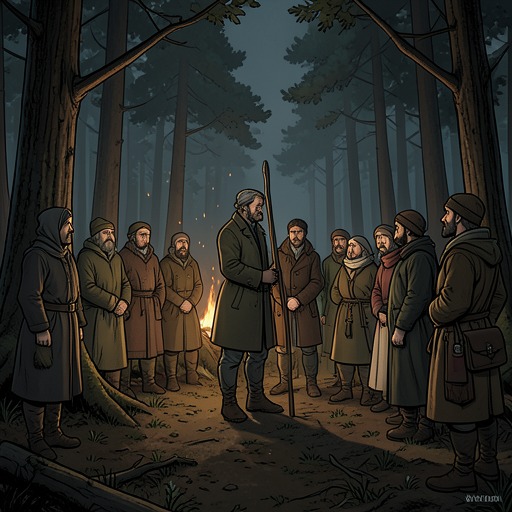
Sosep’s account of encroachment gives the novel a clear statement of Mi’kmaw identity and its conditions of survival. He observes that settlers’ animals damage food sources, settlers’ boats and nets take fish, and introduced plants displace local ones. Though many newcomers do not intend individual harm, their numbers and cumulative impact threaten a people who are few. Sosep remembers a time when Mi’kmaq could travel freely through woods that were theirs, but he does not present memory alone as sufficient. He urges the community to keep Mi’kmaw ways alive and to preserve a world in which plants, animals, birds, and people are persons who help one another.
This insistence exists alongside cultural change, not outside it. Some Mi’kmaq welcome Acadian clothing, boats, vegetables, tools, ornaments, and other goods; French words enter the language alongside traces of Portuguese and Basque. Mi’kmaq and Acadians intermarry, exchange language and beliefs, and absorb each other’s practices. Père Crème wonders whether a new people, part Mi’kmaq and part Acadian, is emerging. Yet Sosep recognizes that a growing relationship with the French can also become a means of survival under conditions that Mi’kmaq did not choose. His appeal is not for change to be denied, but for Mi’kmaw identity and memory to remain present within it.
The novel returns to that tension through the image of two substances that mix but do not disappear into one another. Kuntaw stirs water and mackerel oil in a wooden bowl, then points out that the oil rises to the surface. He uses the image to explain his own experience of trying to be white while his Mi’kmaw identity remained within him, and imagines a future in which the two peoples may be changed through contact without either being wholly absorbed. The image gives cultural mixture a particular form: not a simple resolution, but a contested relationship in which continuity persists through change.
Land, Law, and the Long Retreat
In later generations, dispossession becomes a question of documents and recognized ownership as well as residence and use. When Renardette Meillard claims René Sel’s property through a notarized title, she rejects the Mi’kmaw claimants’ assertion that they are René’s children and characterizes them as squatters. Her claim exposes the uneven force of colonial property rules: written title carries authority, while Indigenous kinship and occupation are dismissed. Sosep’s warning that the French king has transferred Mi’kmaw lands to the British belongs to the same history of political decisions made over the community’s homeland.
Aaron Sel’s return to Mi’kma’ki reveals how deeply dispossession has disrupted the transmission of knowledge. He arrives expecting welcome and a clearer understanding of who he is, but he does not know how to make eel weirs, identify blueberries, or hunt caribou and beaver. The animals are no longer there in abundance, and the skills that once linked people to local resources cannot simply be recovered by an individual returning to the place of his ancestors. His uncertainty shows the human consequence of a damaged relationship between land, livelihood, and inherited knowledge.
Kuntaw’s people later drift back to Sipekne’katik, now called Shubenacadie and designated a reserve in 1820. The land available to them is described as poor; crowding, racist jeering, past massacres, and government restrictions shape their return. Still, they carry memories of earlier places beneath the visible landscape of roads and square houses. Some who attempt to paddle back to Kuntaw’s former home after a St. Anne’s Day celebration perish in a storm. The community’s population falls to fewer than fifteen hundred, compared with more than one hundred thousand before the arrival of white settlers, while settlers predict that the Mi’kmaq will disappear. The narrative sets those predictions against continued attachment to home ground and repeated efforts to find food and refuge.
Continuity Under Assimilation
For Kuntaw, survival requires learning the settlers’ systems without mistaking them for the only measure of belonging. He explains that paper titles secure land for white settlers and that Mi’kmaq seeking to recover or protect old land must learn to read and write in English and understand English law. Children must learn those practices if they are to live in the country without being erased. The demand is strategic, but it also records the conditions colonial rule imposes: access to land and security is made dependent on a foreign language and legal system.
The community’s later return to Shubenacadie is accompanied by further changes. English names replace older Mi’kmaw names, and the people live in close-knit groups while taking in newcomers. Outsiders who present themselves as hunters sometimes prove to be scouts seeking timber or minerals, turning hospitality and knowledge of the land into possible routes for further extraction. In the novel, the threat to Mi’kmaw life therefore continues even when overt conflict is not taking place: attention to the land’s value can precede another attempt to claim it.
The residential-school system marks an especially severe assault on cultural transmission. The novel describes a forty-year collapse in the lives of Mi’kmaw children, culture, and language. Some parents sign forms believing their children will learn what they need to survive in English-speaking society; few know the abuses inflicted by the schools’ religious authorities. Children who pass through the schools are never again wholly Mi’kmaw. The account frames assimilation as a structural pressure, not a voluntary exchange between equals, and emphasizes the burden placed on women to preserve language when men leave for wage labor.
Across these episodes, the Mi’kmaq are shown facing a linked history of land loss, ecological change, illness, legal exclusion, and cultural coercion. The novel also preserves acts of teaching, memory, return, and collective care. Its account refuses both the colonial fiction that Indigenous people vanish and the simplification that cultural survival means remaining unchanged: Mi’kmaw continuity is shown as an active, pressured practice carried across altered landscapes and generations.