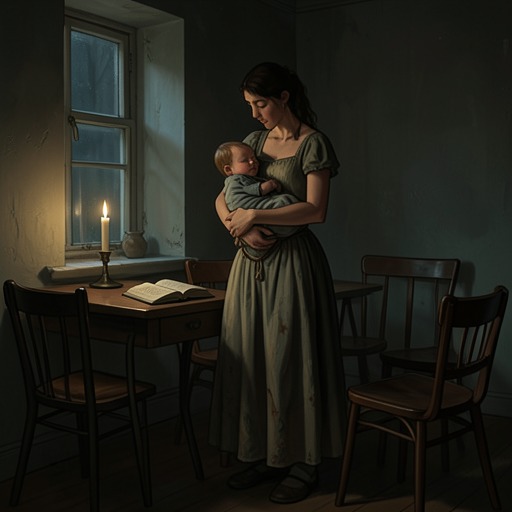
Père Perreault
BarkskinsPère Perreault is a Catholic missionary whose appearances connect the mission’s teaching and pastoral authority with the coercive colonial order shaping Mari’s life. Known to her as Père Pillow, he is both a teacher at the Wobik mission and, in her recollection, one of the Frenchmen involved in her forced removal from her community and journey to France.
Identity and role
Père Perreault belongs to the Catholic mission network in New France. In Wobik, Mari identifies him as the priest who taught her confession, mass, reading, writing, and French. His authority is not limited to instruction: he is present when Claude Trépagny announces that Mari will marry René Sel, and is ready to officiate. The narrative therefore places him at the intersection of religious education and the colonial institutions that arrange and regulate Indigenous lives.
Connection to Mari’s history
Mari’s account reaches back to her childhood, when French visitors arrived at her people’s coastal camp. She recalls that the newcomers identified themselves as French and were initially welcomed; her people shared food and showed them how to gather shellfish and berries. After some weeks, the visitors announced that they were returning to France and that some Mi’kmaq would accompany them. Mari says that sailors seized seven people, including her, and carried them aboard before those remaining on shore could stop the ship. She identifies one of the Frenchmen as Père Perreault, whom she calls Père Pillow.
The voyage brought Mari and the other captives to France. After surviving smallpox and returning across the ocean, Mari found that illness had devastated her people. She says Père Perreault then brought her to Kébec. There she married Lolan, a Mi’kmaq man, and had Elphège, Theotiste, and Jean-Baptiste. After Lolan and one baby died, she went with Père Perreault to Wobik, where she later encountered Trépagny. Mari’s recollection makes the priest a figure in a sequence of forced movement, loss, and religious institutional contact, rather than only the teacher she names at the mission.
Mission teaching and marriage
At the Wobik mission, Mari tells René Sel that she learned confession, mass, reading, writing, and French from Père Perreault. Her answer comes after she has described Sipekne’katik as the river country where her people had food and medicinal plants, contrasting that home with the place where she has been living. The mission’s education is thus part of Mari’s history of movement and adaptation, while her description also preserves the value she assigns to her homeland.
Père Perreault later appears in the immediate aftermath of negotiations involving Trépagny. When the men return to the settlement early the next morning, he urges that René be told at once; Trépagny then declares that René will marry Mari immediately, with the priest present to conduct the ceremony. The scene assigns Père Perreault a formal religious role in a marriage decided by Trépagny, not by a mutual proposal described in the passage. His presence gives the decision institutional form.
Religious authority and colonial attitudes
The novel places missionary activity within wider disputes over Indigenous knowledge, labor, and land. Père Perreault’s documented role includes teaching Mari French and Catholic practice, while other missionaries in the narrative express an explicit program of cultural and economic change. Père Crème, for example, argues that Mi’kmaq should abandon aspects of their existing livelihood, and describes land as belonging to those who clear and improve it. The distinction matters: the evidence does not attribute those particular statements to Père Perreault, but it situates his mission work in a colonial religious world where education and conversion coexist with pressure to reorganize Indigenous life.
That world is also marked by a sharp contradiction between Christian claims of care and the treatment of Indigenous people. In a later account, an official dismisses a missionary’s concern for Mi’kmaq people and insists that his duty is to their souls and to loyalty to the French king. Père Perreault’s own story is tied to this institutional setting, but the evidence does not establish that he shared every attitude expressed by other clergy or officials. His significance lies in the roles the narrative shows him occupying: teacher, priest, participant in Mari’s remembered displacement, and officiant in a marriage imposed by a colonial seigneur.