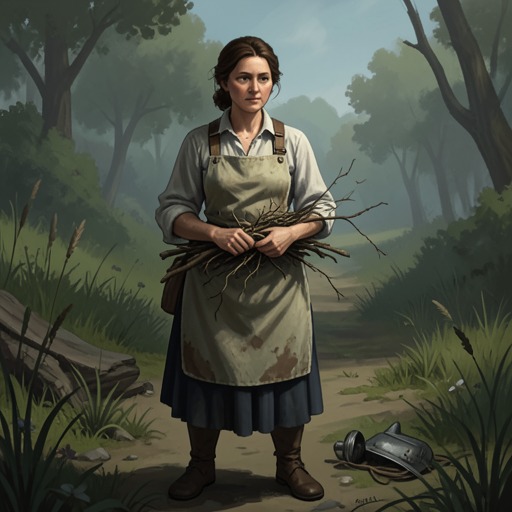
Marie Sel
BarkskinsMarie Sel is the younger daughter of Egga and Bren, and her defining traits are a restless mechanical curiosity and an insistence on retaining her own working life. From taking apart a motor as a child to operating a cut-to-length harvester and marrying a lobsterman who respects her employment, she embodies a practical, self-directed future shaped by both family expectations and forestry work.
Identity and Family Background
Marie grows up in a household where identity and education are matters of active discussion. Egga has tried to put away the pain associated with being Mi’kmaw, while Bren insists that heritage cannot simply be discarded and wants their daughters to inherit a broader sense of belonging. She imagines them as a new kind of woman, formed from whiteman, Wôpanâak, and Mi’kmaw influences rather than confined to one inherited role. The daughters’ spirited independence pleases Egga in part because it contrasts with the fearful children he remembers from residential school.
Bren makes education a concrete family priority. She hopes her daughters will attend university and takes night-shift work at a fish plant, putting nearly all of her pay into an education fund. Her determination that they should not be limited to fish-plant or tourist-motel work gives Marie’s later technical employment a particular family context: opportunity is something her mother labors to secure, while Marie’s own choice to keep working makes that opportunity part of her adult identity.
A Mechanical Mind
Egga sees Marie’s character early in her fascination with machines. As a toddler, she partly dismantles an electric motor and puts it back together, incorporating pink plastic stacking rings from her toy box into the reconstruction. The episode makes her curiosity both playful and purposeful: she does not merely handle objects but investigates how they work. Later, Egga finds it easy to please her with ship and plane models, gifts that suit her interest in mechanical forms.
Marie is outspoken and brash, qualities Egga reads as signs that she will not be easily subdued. That interpretation links her temperament to Bren’s hope for daughters with lives of value, but Marie’s independence is expressed in specific choices rather than as a general family ideal. During a college summer, she works with a cut-to-length harvester, a machine that fells and delimbs trees ahead of itself while laying the resulting material as a mat beneath its path. Marie regards the machine as a hero-machine, an enthusiasm that places her close to the technical processes of forestry and the practical problem of how logging is carried out.
Work, Marriage, and Independence
Marie falls in love with Davey Jones, a young lobsterman who writes poetry, dances reels and strathspeys, plays poker, and has kept a weather notebook since childhood. Their interests differ, but the account presents the relationship through mutual accommodation rather than a demand that one person give up a vocation. When Davey proposes, Marie agrees on the condition that she keep her job; he answers that he likes his own work too and sees no reason for an argument.
They marry in December 1978. The detail that follows their wedding night captures the difference in what each brings into the marriage: Marie tells Davey that the cut-to-length harvester compacts soil less than even a horse team, while he redirects the conversation toward lobster pots. The exchange does not diminish either subject. It shows that forestry technology remains central to Marie’s attention even in an intimate domestic moment, and that her husband meets her insistence on work without trying to displace it.
Narrative Significance
Marie’s story offers a distinct answer to the pressures surrounding the Sel family’s next generation. Bren’s ambition for her daughters begins in the sacrifices of night work and saved wages; Marie’s adult life carries that ambition forward not by leaving practical work behind but by pursuing it with evident interest. Her mechanical curiosity develops into experience with forestry equipment, while her condition that marriage leave her job intact gives her independence a clear, consequential form.
Her machine-centered outlook also sits within the family’s wider concern with what happens to forests after cutting. Elsewhere, the narrative contrasts the rush to take timber with the much longer work of regenerating it, and presents seedlings, site preparation, and planning across decades as necessary to a forest’s future. Marie’s college work with a harvester places her within the technical world of logging, though the evidence does not specify her later forestry plans or assign her a particular conservation role. What it does establish is a woman who is curious about machinery, confident in her work, and unwilling to treat marriage as a reason to give that work up.