Molti Sel
BarkskinsMolti Sel, the eldest son of Etienne Sel, enters the family’s story as one of the young men drawn into logging for wages and the promise of helping others. His brief working life ends in a preventable cable accident: a makeshift rig lashes his midriff, and he dies that night. The episode gives a particular, bodily cost to the dangerous work that carried the Sel family from riverside labor into the industrial forests of the West.
Family and the Choice of Woods Work
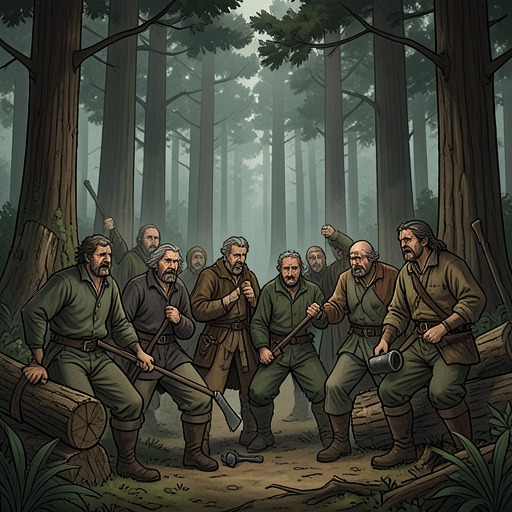
At a family gathering, Molti takes the talking stick and argues that the young men can bring money to everyone. The claim is practical and collective: logging offers income when other livelihoods are precarious. But as the stick is thrown into the fire at evening’s end, the old practice of deliberation gives way to the young men’s departure for woods work. Molti’s choice thus belongs not only to him; it marks a generational turn from inherited forms of community life toward wage labor.
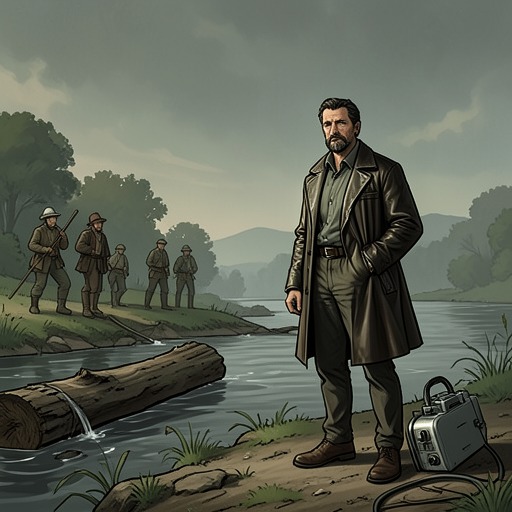
The Sels had worked across Nova Scotia, New Brunswick, and Maine in the many linked tasks of the timber trade: felling and spudding trees, making and cranking booms, driving logs, sawing, building log roads, and cutting cordwood, pulp, and pit props. River driving was especially dangerous, and Indigenous men were routinely assigned to it as if they were naturally suited to violent water. A camp boss explains the commercial logic bluntly: water moves the logs and powers the mills, so the company must pay the cost of the drive. The logs’ journey to market depended on perilous labor whose risks fell disproportionately on Mi’kmaq workers.
A Changing and Hazardous Industry
The work Molti enters belongs to a rapidly changing trade. Across generations, the poll ax gives way to the double-bitted ax, then the crosscut saw; mills replace older gang saws with circular and band saws; oxen give way to horses, then donkey engines and Shay-geared locomotives. As roads reach timber beyond navigable rivers, trucks and roads displace the river drives. Mechanization changes how forests are cut and moved, but it does not remove danger: workers must remain watchful amid machinery, and logging remains a profession in which survival depends on luck as well as skill.
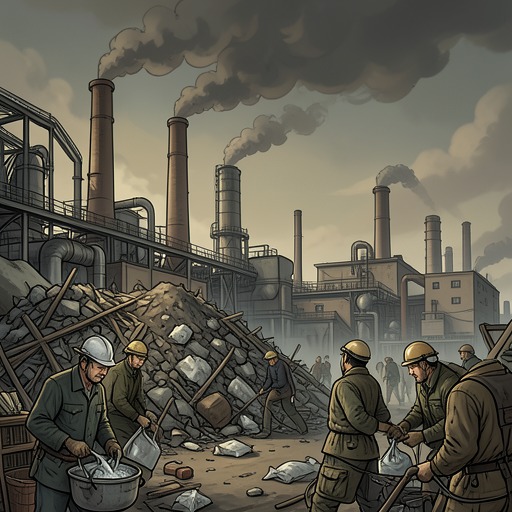
The larger industrial ambition is to turn forests into vast supplies of usable timber. Armenius Breitsprecher recognizes in Duke & Sons’ hunger for the newly found Michigan pine a drive to clear the continent, accompanied by waste, soil destruction, and erosion. The men making the cuts regard the supply as endless. Molti’s later death takes place within this widening extractive system, where speed and production press workers into hazardous conditions while the company’s appetite expands beyond the limits of any one forest.
The Accident and Death
After Blony Jacko’s death makes the crew reluctant to climb and rig tall trees, Molti works for Flannel Logging, a small outfit owned by Robbie and Glen Flannel. In his second week, the other choker setters steal the chains and leave. When Robbie returns, he has not replaced them with proper chains; the crew instead uses cheaper coils of cable and old haywire, with two men recruited from a bar to replace the missing workers. Glen tells Molti to show the inexperienced replacements how to do the work.
The improvised system turns a routine movement of cable into a fatal trap. Haywire is attached to the skyline cable and pulled uphill by the donkey engine. After one man fumbles with the excess, Molti fastens the haywire to another cable that must be moved and signals the tender to pull. He sees that one of the replacements is still in the cable’s bight and shouts a warning. The man starts to run, but the tangled haywire is already being drawn tight. It kinks and snaps, striking Molti in the midriff with terrible force.
The frightened replacements help him down to the bunkhouse. He lies there with blood filling his mouth and dies at ten o’clock that night. His death is not presented as the result of a dramatic rescue or a heroic last act: it follows a preventable failure of equipment and supervision, in a crew already made precarious by theft, replacement labor, and improvised materials.
Significance
Molti’s death makes visible the human cost hidden within the timber industry’s expanding production chain. Logs must be felled, hauled, and delivered to the sawmill; each stage depends on workers exposed to risks that company accounts can treat as expenses. The camp boss’s defense of river-drive costs and the accident’s improvised cable rig belong to the same world: production continues because laborers absorb the danger.
The episode also extends a family history in which logging brings wages but repeatedly threatens the people who earn them. Molti had joined the work in the hope of bringing money to everyone; instead, his death leaves that promise inseparable from the hazards of the trade. In this way, his short working life connects the Sel family’s changing livelihoods to the wider transformation of forests into industrial resources—and to the people whose bodies bear that transformation’s cost.